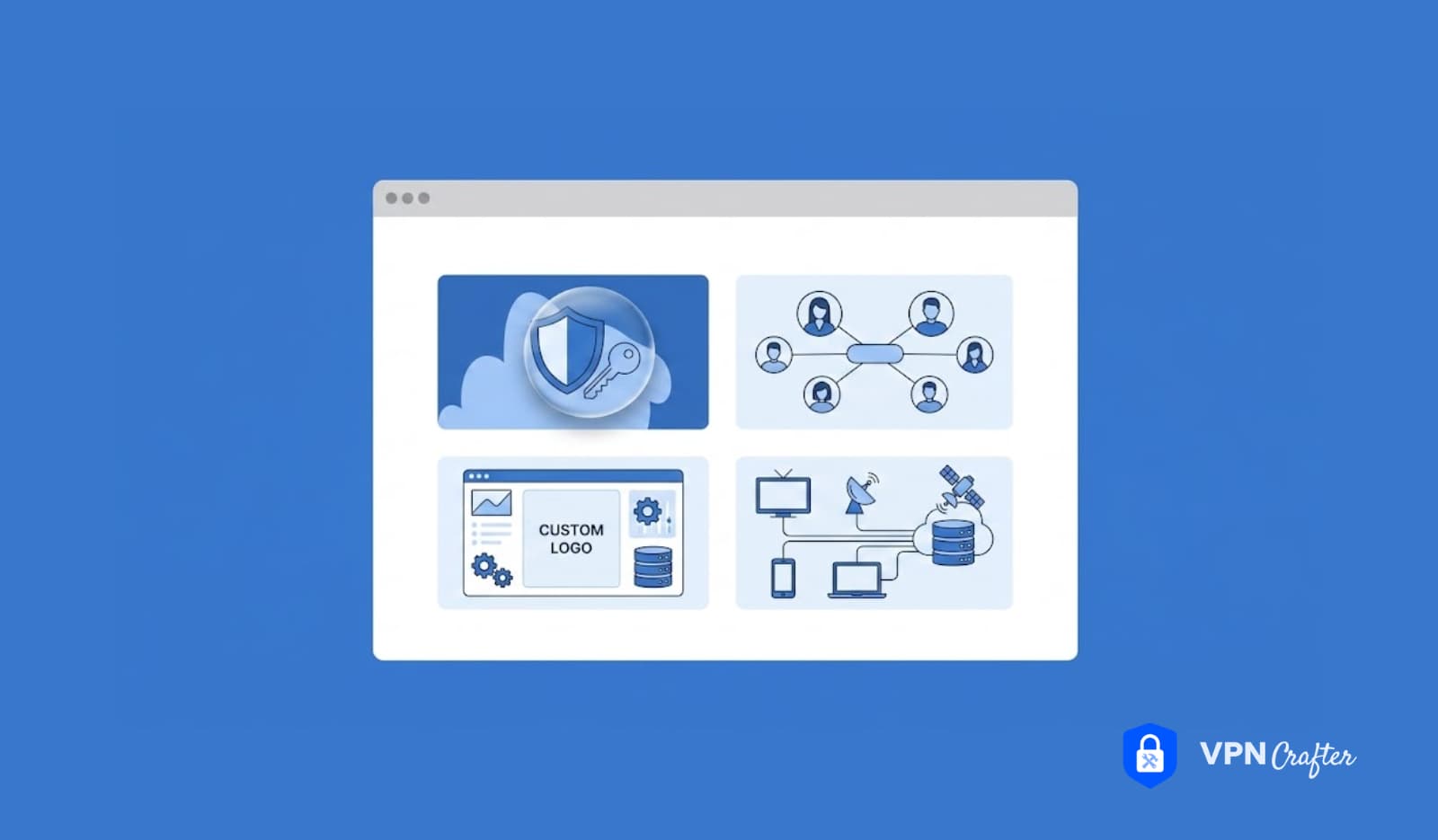

The white-label VPN for SaaS and cloud platforms market is no longer a niche opportunity — it’s a $534 billion industry in motion. According to Precedence Research, the global VPN market grows at a 22.04% CAGR through 2034. Meanwhile, the SaaS industry surpassed $250 billion in annual revenue in 2024, and cloud infrastructure spending crossed $680 billion globally (Synergy Research Group, 2025). The convergence of these two markets has created an extraordinary window for SaaS founders, cloud platform builders, VPN developers, and resellers who move decisively.
Here’s the uncomfortable truth most guides won’t tell you: building a VPN from scratch costs between $300,000 and $1.2 million in engineering alone, takes 18–36 months, and still doesn’t guarantee product-market fit. White-label VPN development flips that equation entirely. You launch in weeks, not years. You spend on growth, not infrastructure. And you compete in a market where consumer demand — driven by cyberattacks, censorship, remote work, and data privacy regulation — shows absolutely no sign of cooling.
This guide covers everything: how white-label VPN integrates with SaaS and cloud architectures, how to white label WireGuard, compliance requirements, go-to-market strategy, real revenue models, and the VPN reseller vs white-label decision that determines your margins. Whether you’re a developer, a platform owner, or a VPN reseller scaling toward enterprise — this is the blueprint.

What Is White-Label VPN for SaaS and Cloud Platforms?
A white-label VPN for SaaS and cloud platforms is a fully built, enterprise-ready VPN product — including apps, backend infrastructure, admin dashboard, and API — that a business licenses, rebrands, and distributes under its own name. The underlying technology provider remains invisible to end users. The business launching the product controls branding, pricing, user management, and go-to-market entirely.
The distinction from a standard reseller arrangement is significant. A VPN reseller sells someone else’s branded product at a markup. A white-label VPN business owns the branded product experience — the app looks, feels, and operates as your product, not theirs.
For SaaS companies, this means adding privacy and security as a first-class feature within their existing platform. For cloud providers, it means offering encrypted network access as a native infrastructure service. For independent VPN brands, it means launching a credible, fully-featured product without building a single line of backend code.
The Three White-Label VPN Models
Model 1 — Standalone Branded VPN App A completely independent VPN product launched under your brand. Your own app store listing, your own website, your own subscription. The white-label provider powers the backend. This is the most common starting point for new VPN brands.
Model 2 — VPN as an Embedded SaaS Feature VPN functionality integrated directly into an existing SaaS platform via SDK or API. Users activate VPN within your existing product — no separate app required. Common in security platforms, endpoint management tools, and productivity suites.
Model 3 — VPN for Cloud Infrastructure (B2B) Private encrypted tunnels provided to cloud platform customers as a managed network service. This model targets developers and DevOps teams who need secure connectivity between cloud environments, offices, or developer workstations.
Why SaaS and Cloud Companies Are Adding VPN in 2026
The business case for adding white-label VPN to a SaaS or cloud platform has never been stronger.
Data privacy regulations are multiplying. GDPR (EU), CCPA (California), PDPB (India), LGPD (Brazil), and dozens of emerging national frameworks all create direct demand for encrypted data transmission tools. SaaS companies serving regulated industries face pressure to offer built-in privacy features — or lose enterprise contracts to competitors who do.
Cybercrime costs reached $8 trillion globally in 2023 and are projected to hit $10.5 trillion annually by 2025 (Cybersecurity Ventures). Every dollar of that represents a potential customer for security-adjacent SaaS products.
Remote and hybrid work is permanent. Approximately 93% of organizations now use VPNs to support distributed teams (Statista, 2024). SaaS platforms targeting remote-first companies have a natural upsell path with branded VPN access.
Subscription fatigue favors bundled value. Users increasingly prefer a single platform that solves multiple problems over managing five separate subscriptions. Adding VPN to an existing SaaS product increases average revenue per user (ARPU) without requiring new customer acquisition.
White-label VPN development has matured dramatically. The quality gap between self-built and white-labeled VPN products has essentially closed. Modern white-label solutions offer WireGuard, IKEv2, AES-256, kill switch, split tunneling, no-logs architecture, and full multi-platform app coverage — the same feature set as leading standalone VPN products.
White-Label VPN Architecture — How It Works
Understanding the technical architecture helps SaaS and cloud companies make better integration decisions — and helps VPN developers communicate value more effectively.
The Core Stack
📊 [Insert diagram: White-label VPN architecture — Client App → API Gateway → VPN Backend → Server Infrastructure → Admin Dashboard]
| Layer | Component | What It Does |
|---|---|---|
| Client layer | Branded iOS/Android/Windows/macOS apps | User-facing interface and VPN tunnel client |
| API layer | RESTful API / SDK | Authentication, server selection, subscription management |
| Protocol layer | WireGuard, IKEv2, OpenVPN | Actual tunnel encryption and data transport |
| Infrastructure layer | VPN server network (global nodes) | Encrypted traffic routing and IP assignment |
| Management layer | White-label admin dashboard | User management, analytics, billing, server control |
| Billing layer | Payment gateway integration | Subscription management, trials, upgrades |
White-Label vs Self-Built: The Build Cost Reality
| Component | Build-It-Yourself Cost | White-Label Equivalent |
|---|---|---|
| iOS app | $40,000–$120,000 | Included |
| Android app | $35,000–$100,000 | Included |
| Windows/macOS app | $30,000–$80,000 | Included |
| Backend infrastructure | $60,000–$200,000 | Included |
| Server network (global) | $5,000–$20,000/month ongoing | Included |
| Admin dashboard | $20,000–$60,000 | Included |
| Security audit | $15,000–$50,000 | Provider responsibility |
| Total Year 1 | $300,000–$1,200,000+ | Fraction of cost |
These figures explain why white-label VPN development isn’t just convenient — it’s the economically rational choice for any business that isn’t a pure-play VPN infrastructure company.
How to White Label WireGuard
WireGuard has become the protocol of choice for modern VPN products — and for good reason. Its ~4,000-line codebase, kernel-level performance, and formally verified cryptography make it the fastest, most auditable protocol available. Here’s how white-labeling WireGuard actually works.
WireGuard White-Label Architecture
WireGuard itself is open source (GPLv2 kernel module, MIT for user-space tools). White-labeling doesn’t modify the core protocol — instead, it wraps WireGuard in:
- Branded client apps that manage WireGuard connections without exposing the underlying protocol to users
- A credential management layer that generates, distributes, and rotates WireGuard key pairs per user and per device
- A server management layer that provisions WireGuard endpoints across your server infrastructure
- An API layer that connects credential management to user authentication and subscription status
Step-by-Step: White Labeling WireGuard for a SaaS Platform
Step 1 — Choose your deployment model Decide between embedding WireGuard via SDK within your existing SaaS app, or deploying it as a standalone companion app. SDK integration is cleaner for user experience but requires more development work upfront.
Step 2 — Set up WireGuard server infrastructure Deploy WireGuard server nodes on cloud infrastructure (AWS, GCP, Azure, Hetzner, Vultr). Each node needs a public IP, UDP port 51820 open, and WireGuard installed. Use configuration management tools (Ansible, Terraform) for repeatable, scalable deployment.
Step 3 — Build the credential management system Each user device needs a unique WireGuard public/private key pair. Your backend generates the private key client-side (never stored on your server), submits the public key to the WireGuard server, and returns the full .conf file or inline config to the client.
Step 4 — Integrate with your user authentication system Connect WireGuard credential issuance to your existing auth (OAuth2, JWT, SAML). When a user authenticates to your SaaS platform, their VPN credentials activate automatically — no separate login required.
Step 5 — Apply your branding The client UI — connection toggle, server selection, status indicators, settings — carries your brand entirely. WireGuard operates silently underneath. Users experience your VPN, not WireGuard.
Step 6 — Add protocol fallback WireGuard is UDP-only. Networks that block UDP (some corporate firewalls, hotels, certain ISPs) will prevent connections. Add IKEv2 as an automatic fallback to ensure reliability across all network environments.
VPN Crafter’s white-label platform handles Steps 2 through 6 entirely, reducing the WireGuard integration path for SaaS developers from months of backend engineering to days of API configuration.
VPN Reseller Program vs White-Label VPN
This distinction determines your margins, your brand equity, and your long-term positioning. Many businesses start with a reseller program and graduate to white-label — understanding the difference helps you plan that transition.
📌 Direct Answer: A VPN reseller program lets you sell an existing branded VPN product at a margin. A white-label VPN gives you a completely rebranded product that appears to be your own. Resellers build the provider’s brand. White-label owners build their own.
| Dimension | VPN Reseller Program | White-Label VPN |
|---|---|---|
| Brand visibility | Provider’s brand | Your brand |
| Margin | 10–40% of retail | 60–85% gross margin |
| Customer relationship | You introduce, provider owns | You own entirely |
| Customization | Minimal | Full (UI, features, pricing) |
| Technical control | None | Full API/SDK access |
| Time to launch | Days | Days to weeks |
| Switching cost (for customers) | Low — they know it’s a resale | High — they’re loyal to your brand |
| Best for | Testing market appetite | Building a scalable VPN business |
| LTV impact | Low | High |
For a detailed breakdown of the positioning and revenue implications, explore the full VPN Reseller vs White Label VPN comparison.
White-Label VPN Compliance Checklist
SaaS companies and cloud platforms face regulatory scrutiny that standalone consumer VPN brands often don’t. Before launching, verify your white-label VPN solution meets these requirements:
Data Privacy Regulations
- ✅ GDPR (EU) — Confirm your provider processes no personal data logs. Verify data processing agreements (DPA) are in place. Ensure EU user data doesn’t transit non-compliant jurisdictions without appropriate safeguards.
- ✅ CCPA (California) — Verify the no-logs policy covers IP addresses, connection timestamps, and browsing activity. Ensure user data deletion requests can be fulfilled.
- ✅ LGPD (Brazil) — Brazil’s data protection law mirrors GDPR in key requirements. Confirm your provider’s DPA covers Brazilian users explicitly.
- ✅ PDPB (India) — India’s Personal Data Protection framework requires data localization for certain categories. Assess whether VPN traffic routing through Indian servers triggers localization obligations.
Security Standards
- ✅ No-logs policy — Independently verified (ideally audited) — not just a marketing claim
- ✅ AES-256-GCM encryption — Minimum standard for enterprise clients
- ✅ Perfect Forward Secrecy — Each session uses unique keys; historical traffic stays protected
- ✅ Kill switch — Prevents data exposure if the VPN tunnel drops
- ✅ DNS leak protection — Encrypted DNS traffic routes through the VPN tunnel
- ✅ IPv6 leak protection — IPv6 requests don’t bypass the tunnel
App Store Compliance
- ✅ Apple App Store guidelines — VPN apps must use the NEVPNManager or NetworkExtension API, declare VPN entitlements, and comply with App Store Review guidelines on privacy policy and data handling
- ✅ Google Play Store — VPN apps must declare the VPN_SERVICE permission, provide a prominent privacy policy, and may face additional review scrutiny in regulated markets
- ✅ App privacy labels — Both platforms require accurate privacy label declarations covering data types collected, linked to identity, and shared with third parties
Business Licensing
- ✅ Confirm legal VPN operation status in your target markets (VPNs face restrictions in China, Russia, UAE, Iran, and others)
- ✅ Verify your white-label provider holds the appropriate operating licenses in jurisdictions where this is required
- ✅ Review terms of service to confirm commercial redistribution rights
VPN App Development Cost — What You’re Actually Paying For
When evaluating VPN app development cost through a white-label provider, most pricing models include a combination of:
Typical White-Label VPN Cost Components
| Component | One-Time Cost | Recurring Cost |
|---|---|---|
| App customization (all platforms) | $500–$3,000 | — |
| Admin dashboard setup | $200–$1,000 | — |
| API integration support | $300–$1,500 | — |
| Server infrastructure | — | $200–$800/month |
| Technical support | — | $100–$400/month |
| Subscription commission | — | 15–30% of revenue |
| Payment gateway integration | $0–$500 | Transaction fees |
Contrast this with VPN App Development Cost for a fully custom build — typically $300,000–$1.2M in Year 1 — and the white-label value proposition becomes arithmetically obvious.
Minimum Viable Customer Base
Industry benchmarks suggest a white-label VPN business needs 300–500 active paying subscribers for sustainable unit economics. At an average $5–8/month ARPU, 500 subscribers generates $2,500–$4,000 MRR — enough to cover operational costs and begin reinvesting in growth.
How to Sell VPN Service — Go-to-Market Strategy
Understanding the product is the easy part. Building distribution is where most white-label VPN businesses stall. Here’s the framework that works.
Step 1 — Define Your Niche
The VPN market has a massive consumer segment and a growing enterprise segment. Trying to serve both simultaneously at launch is a trap. Choose:
- Consumer privacy — individuals, families, remote workers
- Gamers — low latency, DDoS protection, geo-unblocking
- Streamers — geo-restricted content access
- SMB security — small businesses needing encrypted remote access
- Developer tools — secure API testing, geo-testing, privacy-first infra
- Online communities — privacy-focused forums, Discords, or membership sites
Step 2 — Build Your Pricing Architecture
A three-tier model consistently outperforms flat pricing:
| Tier | Price | Features | Purpose |
|---|---|---|---|
| Free | $0 | Limited servers, 1 device, data cap | Acquisition funnel |
| Standard | $4.99–$7.99/month | All servers, 5 devices, no ads | Core revenue |
| Premium | $9.99–$14.99/month | Everything + priority support | Upsell / annual |
Step 3 — Launch Channels
Content marketing remains the highest-ROI channel for VPN businesses long-term. Educational content targeting keywords like “VPN for online community,” “VPN for developers,” and comparison content against established brands drives organic traffic that converts at significantly higher rates than paid traffic.
Affiliate marketing provides immediate distribution. VPN affiliate programs typically offer 30–50% commission per referred subscription — attractive to tech bloggers, YouTubers, and cybersecurity creators.
B2B partnerships — particularly with SaaS companies, cybersecurity consultancies, and IT managed service providers — accelerate enterprise acquisition.
Community-driven growth works exceptionally well for niche VPN products. Building an active presence in developer communities, privacy forums (Reddit r/privacytoolsIO, Hacker News), and Discord servers relevant to your niche generates organic word-of-mouth that paid channels can’t replicate.
VPN Marketing — Channels, Messaging, and Positioning
Effective VPN marketing in 2026 requires navigating an increasingly competitive landscape where the top three brands (ExpressVPN, NordVPN, Surfshark) dominate paid media. White-label VPN brands win through differentiation, not outspending.
Positioning Frameworks That Work
“Privacy for [specific audience]” — A VPN marketed specifically to journalists, activists, or remote developers in censored markets commands higher trust and higher pricing than a generic privacy VPN.
“Security feature within [existing platform]” — SaaS companies that embed VPN as a platform feature (rather than a separate product) achieve dramatically higher activation rates. Users don’t need to choose to adopt it — it’s just part of the tool they already use.
“No-logs, independently audited” — In a market saturated with no-logs claims, third-party audits from firms like Cure53, KPMG, or Deloitte convert skeptical enterprise buyers.
Content Clusters That Drive Organic VPN Traffic
Build topical authority around clusters including:
- Protocol comparisons (WireGuard vs IKEv2, OpenVPN vs WireGuard)
- Privacy regulation guides (GDPR, CCPA for VPN users)
- Platform-specific guides (VPN for iOS, VPN for Windows, VPN for developers)
- Use-case guides (VPN for remote work, VPN for streaming, VPN for gaming)
- Technical explainers (Shadowsocks VPN Protocol, Singbox vs Other Proxy Solutions)
White-Label VPN for Online Communities and Niche Audiences
One of the most underexplored white-label VPN opportunities exists in online communities — Discord servers, Telegram groups, membership platforms, and privacy-focused forums.
Community-owned VPN products generate exceptional retention. When a privacy-focused Discord community launches its own branded VPN, members don’t just use the product — they advocate for it. Community VPNs become identity products.
Practical Models for Community VPNs
Model A — Community subscription add-on Existing community membership platforms (Circle, Mighty Networks, Patreon) add a branded VPN as a premium tier. Members pay $3–7/month above base membership for VPN access. Low perceived cost, high perceived value.
Model B — Standalone community VPN product A privacy-focused community launches its VPN as a separate product with strong community branding. Existing community trust dramatically reduces customer acquisition costs.
Model C — Developer community VPN tool A VPN positioned specifically for developers — with features like custom DNS, API testing modes, and geo-switching for locale testing — marketed through developer communities, GitHub, and Hacker News.
VPN for Developers — SDK, API, and Integration Guide
The technical audience is one of the most valuable segments in the VPN market — and one of the most underserved by current products. VPN for developers means something specific: SDK access, clean APIs, documentation quality, and integration flexibility.
What Developers Need From a White-Label VPN Platform
- RESTful API — User provisioning, credential management, server list retrieval, subscription status
- iOS SDK — NetworkExtension-based WireGuard/IKEv2 integration with minimal boilerplate
- Android SDK — VpnService-based integration with automatic reconnection handling
- Windows SDK — WFP (Windows Filtering Platform) or TAP-based tunnel management
- Webhook support — Subscription events, connection events, server status changes
- Sandbox/staging environment — For integration testing without production traffic
Integration Complexity by Use Case
| Integration Type | Estimated Dev Time | Skill Level Required |
|---|---|---|
| Standalone branded app (using provider UI templates) | 3–7 days | Junior to mid-level |
| SDK embedded in existing iOS/Android app | 1–3 weeks | Mid-level mobile developer |
| Full API integration with custom UI | 2–6 weeks | Full-stack developer |
| White-label WireGuard server deployment | 1–2 weeks | DevOps / backend engineer |
VPN Crafter’s developer portal provides SDK documentation for iOS, Android, and Windows alongside a full RESTful API reference — reducing integration time to days rather than weeks for most use cases.
Expert Insights: Real Builder Patterns
Pattern 1 — The SaaS Security Upsell A B2B SaaS company serving remote teams embeds white-label VPN via SDK as a “Secure Connection” feature in their existing desktop client. Feature activates automatically when users connect to public Wi-Fi — zero additional friction. Result: 40% of active users adopt it within 30 days. ARPU increases by $4.50/month with a single feature addition.
Pattern 2 — The Niche Consumer Brand A cybersecurity blogger builds a white-label VPN specifically marketed to journalists and activists in censored markets. The product features obfuscated servers and a Tor-over-VPN option. Community trust and specific positioning drive organic growth without paid advertising — 2,000 subscribers at $8.99/month within 9 months of launch.
Pattern 3 — The MSP Bundle A managed service provider adds white-label VPN to its SMB security bundle (antivirus + backup + VPN). Existing clients adopt immediately — they trust the MSP and value the consolidated billing. The MSP earns an additional $5–8 per seat per month across their existing client base without new sales effort.
Pattern 4 — The Developer Tool A developer tools platform adds VPN-as-a-feature for API testing, allowing developers to switch their outbound IP to any of 60+ countries for geo-specific testing. Marketed through Product Hunt and Hacker News. Developer communities amplify it organically. Converts to 1,800 paying users in 6 months on a freemium model.
Statistics & Data
- Global VPN market projected to reach $534.22 billion by 2034 at 22.04% CAGR (Precedence Research, 2024)
- Global cloud infrastructure spending: $680 billion in 2025 (Synergy Research Group, 2025)
- SaaS market annual revenue exceeded $250 billion in 2024 (Gartner, 2024)
- Cybercrime costs projected to reach $10.5 trillion annually by 2025 (Cybersecurity Ventures)
- 93% of enterprises now use VPN infrastructure (Statista, 2024)
- 68% of American adults use VPN services — approximately 142 million users (GlobalWebIndex, 2024)
- 36% of VPN users globally use VPNs daily (Statista, 2024)
- White-label VPN break-even threshold: 300–500 active subscribers (industry benchmark)
- Affiliate marketing drives 15–30% of VPN brand new subscriptions on average (Performance Marketing Association)
- WireGuard merged into Linux kernel 5.6 in March 2020 — now the default protocol for new VPN product launches (kernel.org)
- 56% of organizations experienced cyberattacks via VPN vulnerabilities in 2024 (Zscaler ThreatLabz, 2024)
Common Mistakes to Avoid
1. Launching without a niche Generic VPNs compete on price against brands with $100M+ marketing budgets. Niche-specific products compete on relevance — a far more winnable battle.
2. Choosing a reseller program when you intend to build a brand Reseller margins are thin, and you’re building the provider’s brand equity, not your own. If long-term brand ownership is the goal, white-label from day one.
3. Underestimating compliance requirements App Store review rejections, GDPR violations, and data processing agreement gaps are the most common reasons white-label VPN launches stall. Run the compliance checklist before development begins, not after.
4. Skipping the free tier Free tiers feel like lost revenue. Actually, they’re your acquisition engine. Users who experience your product before paying convert at 3–5× the rate of users asked to pay immediately.
5. Using outdated protocols as default Launching in 2026 with OpenVPN as your primary protocol signals technical debt to technical users. WireGuard should be your default, with IKEv2 as fallback.
6. Neglecting the admin dashboard The admin dashboard is your operational control plane — server management, user analytics, subscription data, support tools. A weak dashboard creates operational bottlenecks that scale badly.
7. No independent no-logs audit In a market where every provider claims no-logs, unaudited claims carry zero credibility with privacy-conscious buyers. Budget for a third-party audit within your first year.
Best Practices for White-Label VPN in 2026
✅ Build on WireGuard by default — with IKEv2 as a reliable fallback for UDP-blocked networks
✅ Define your niche before your product — positioning drives every subsequent decision
✅ Run the compliance checklist before development — not after
✅ Offer a free tier or trial — acquisition funnel first, monetization second
✅ Invest in content SEO from month one — compound interest of organic traffic takes time to build
✅ Launch with affiliate infrastructure — let other people’s audiences do initial distribution
✅ Document everything — API documentation quality is the primary signal developers use to evaluate whether to integrate
✅ Audit your no-logs claim — third-party verification converts enterprise buyers
✅ Plan for SDK integration from day one — even if you start standalone, future SaaS embedding will require it
✅ Price annually aggressively — annual subscribers churn at 3–5× lower rates than monthly subscribers
FAQs — White-Label VPN for SaaS and Cloud Platforms
Q: What is a white-label VPN for SaaS platforms? A white-label VPN for SaaS platforms is a fully built VPN product — including apps, backend, and admin dashboard — licensed by a business, rebranded with their own name and identity, and distributed to their users as their own product. The underlying technology provider remains invisible.
Q: How do I white label WireGuard? White labeling WireGuard involves wrapping the open-source protocol in branded client apps, a credential management system, a server management layer, and a user-facing API. The WireGuard protocol itself remains unchanged — the branding applies to the product layer above it.
Q: What is the difference between a VPN reseller program and a white-label VPN? A VPN reseller sells an existing brand’s product at a margin. A white-label VPN owner launches their own branded product. Resellers build the provider’s equity; white-label owners build their own. For full detail, see the VPN Reseller vs White Label VPN guide.
Q: How much does white-label VPN development cost? White-label VPN development typically costs $1,000–$5,000 in setup and customization, plus $300–$1,200/month in ongoing operational costs. This compares to $300,000–$1.2M+ for a custom build. See our full VPN App Development Cost breakdown.
Q: What compliance requirements apply to white-label VPN products? Key requirements include GDPR (EU), CCPA (California), LGPD (Brazil), App Store privacy guidelines (Apple and Google), no-logs policy verification, AES-256 encryption, and business licensing in target markets. Run the full compliance checklist before launch.
Q: Can I embed a VPN into my existing SaaS app? Yes — through SDK integration. iOS, Android, Windows, and macOS SDKs allow VPN functionality to be embedded directly into your existing application. Users activate VPN within your platform without a separate app.
Q: How do I sell a white-label VPN service effectively? Define a specific niche audience, build a three-tier pricing model, launch with affiliate infrastructure, invest in content SEO targeting your niche’s search queries, and build community presence in relevant online spaces.
Q: What protocols should a white-label VPN support? WireGuard should be the default protocol for speed and simplicity. IKEv2/IPSec should be the fallback for networks that block UDP. OpenVPN (TCP) is valuable for firewalled environments. For censored markets, obfuscation via Shadowsocks VPN Protocol or Singbox vs Other Proxy Solutions may be required.
Q: Is a no-logs policy required for white-label VPN products? A no-logs policy is essential for consumer trust and enterprise sales — but claims alone are insufficient. Third-party audits from credible security firms convert skeptical buyers. Budget for an independent audit within the first year of operation.
Q: How many subscribers do I need for a sustainable white-label VPN business? Industry benchmarks suggest 300–500 active paying subscribers provide sustainable unit economics at typical white-label cost structures. At $5–8 ARPU, 500 subscribers generates $2,500–$4,000 MRR — enough to cover costs and reinvest in growth.
Q: Can white-label VPN work for online communities? Absolutely. Community-owned VPN products generate exceptional retention because members treat them as identity products, not just utilities. Community trust dramatically reduces customer acquisition costs and drives organic advocacy.
Q: What developer resources should a white-label VPN provider offer? Essential resources include RESTful API documentation, iOS/Android/Windows SDKs, webhook support for subscription events, a sandbox environment for integration testing, and responsive technical support. Documentation quality is the primary signal developers use to evaluate integration feasibility.
Key Takeaways
- White-label VPN for SaaS and cloud platforms reduces time-to-market from 18–36 months to weeks, and development cost from $300K–$1.2M to thousands
- WireGuard is the right default protocol in 2026 — open source, formally verified, kernel-native performance
- A VPN reseller program builds the provider’s brand; a white-label VPN builds yours — they’re fundamentally different business models
- Compliance requirements (GDPR, CCPA, App Store guidelines, no-logs audits) must be addressed before launch
- Niche positioning consistently outperforms generic VPN marketing against well-funded incumbents
- White-label VPN embedded in SaaS platforms via SDK increases ARPU without requiring new customer acquisition
- The minimum sustainable threshold is 300–500 active paying subscribers at typical operational cost structures
- Developer-facing SDK quality and API documentation quality directly determine integration adoption rates
You Have the Blueprint. VPN Crafter Has Everything Else.
Building a white-label VPN for your SaaS platform, cloud product, or independent brand in 2026 has never been more commercially compelling — or more technically accessible. The infrastructure exists. The market demand is accelerating. The window for well-positioned new VPN brands is genuinely open right now.
What most builders lack isn’t ambition. It’s the right technical partner.
VPN Crafter is the white-label VPN development platform built specifically for exactly this moment. WireGuard and IKEv2 out of the box. Full iOS, Android, Windows, and macOS app customization. RESTful API and SDK documentation that developers actually enjoy working with. Admin dashboard with real-time analytics, user management, and server control. AES-256-GCM encryption, no-logs architecture, kill switch, DNS leak protection — every feature your customers expect, every compliance requirement addressed.
You define the brand. You own the customer relationship. You keep the margins.
VPN Crafter handles everything underneath.
Whether you’re a SaaS founder adding security as a platform feature, a cloud developer building private network infrastructure, a VPN reseller ready to own your brand, or an entrepreneur entering the market from a standing start — VPN Crafter is the foundation your product deserves.
👉 Launch Your White-Label VPN with VPN Crafter — Get Started Today
Full platform access. WireGuard + IKEv2. Multi-platform apps. SDK & API. Real technical support. Built for builders.