
Online privacy and censorship resistance have become essential for both individuals and businesses navigating today’s digital world. The Shadowsocks VPN protocol offers a lightweight yet powerful solution, enabling users to bypass restrictions while maintaining speed and security. Unlike traditional VPNs that encrypt all traffic, Shadowsocks takes a selective approach – making it faster, more efficient, and especially well‑suited for mobile environments.
For developers and enterprises, this protocol is more than just a tool for secure browsing. It plays a pivotal role in white‑label VPN development, helps reduce VPN app development cost, and provides seamless integration for Android VPN development and iOS VPN development. By combining flexibility with robust encryption, Shadowsocks has become a cornerstone technology for modern VPN solutions.
This guide explores how Shadowsocks works, its advantages over conventional VPNs, and why it’s increasingly the protocol of choice for forward‑thinking VPN development projects.

What is the Shadowsocks VPN Protocol?
At its core, the Shadowsocks VPN protocol is an open-source, secure SOCKS5 proxy. It was originally designed to circumvent internet censorship in regions with restrictive firewalls. Its primary innovation lies in its design philosophy: it is not a full-tunnel VPN but a smart, lightweight proxy that encrypts and forwards specific network traffic.
Key Technical Specifications:
- Transport: Supports both TCP and UDP, making it suitable for a wide range of applications, from web browsing (TCP) to streaming and VoIP (UDP).
- Encryption: Utilizes modern, efficient ciphers like AES-256-GCM and ChaCha20-Poly1305, offering strong security with minimal CPU overhead.
- Obfuscation: By default, its traffic pattern is designed to resemble ordinary HTTPS traffic, making it difficult for deep packet inspection (DPI) systems to identify and block.
This lightweight nature makes it the go-to protocol for embedding within mobile apps where preserving battery life and device performance is critical.
Shadowsocks vs. Traditional VPNs: The Developer’s Perspective
For a user, a traditional VPN (like WireGuard or OpenVPN) is a simple on/off switch. For a developer, the difference is fundamental. Choosing between a traditional VPN and a proxy-based protocol like Shadowsocks dictates the architecture, cost, and user experience of your application.
| Feature | Shadowsocks (Proxy Protocol) | Traditional VPN (e.g., WireGuard/OpenVPN) |
|---|---|---|
| Traffic Handling | Selective proxying. Routes only traffic from specific apps or ports defined by the client. | Full-tunnel routing. Routes all system traffic through the VPN interface. |
| Integration Complexity | Moderate. Requires embedding a SOCKS5 client SDK and managing app-level routing logic. | High (for OpenVPN) to Low (for WireGuard) . WireGuard offers simpler kernel integration. |
| Performance | Excellent for targeted use. Minimal latency and CPU impact as only selected traffic is encrypted. | Variable. Can add overhead, especially on mobile devices with full-tunnel encryption. |
| Use Case | App-specific proxying, censorship circumvention, streaming. Ideal for white-label apps. | Complete network privacy, enterprise remote access. |
| Detection | Harder to block. Designed to obfuscate traffic patterns. | Easier to detect. Standard VPN handshakes and traffic patterns are well-known. |
For a business looking into white-label VPN development, Shadowsocks offers a unique advantage: you can build an app that provides security for specific activities (like streaming or secure messaging) without the overhead and complexity of a full-system VPN.
Technical Deep Dive: How Shadowsocks Works?
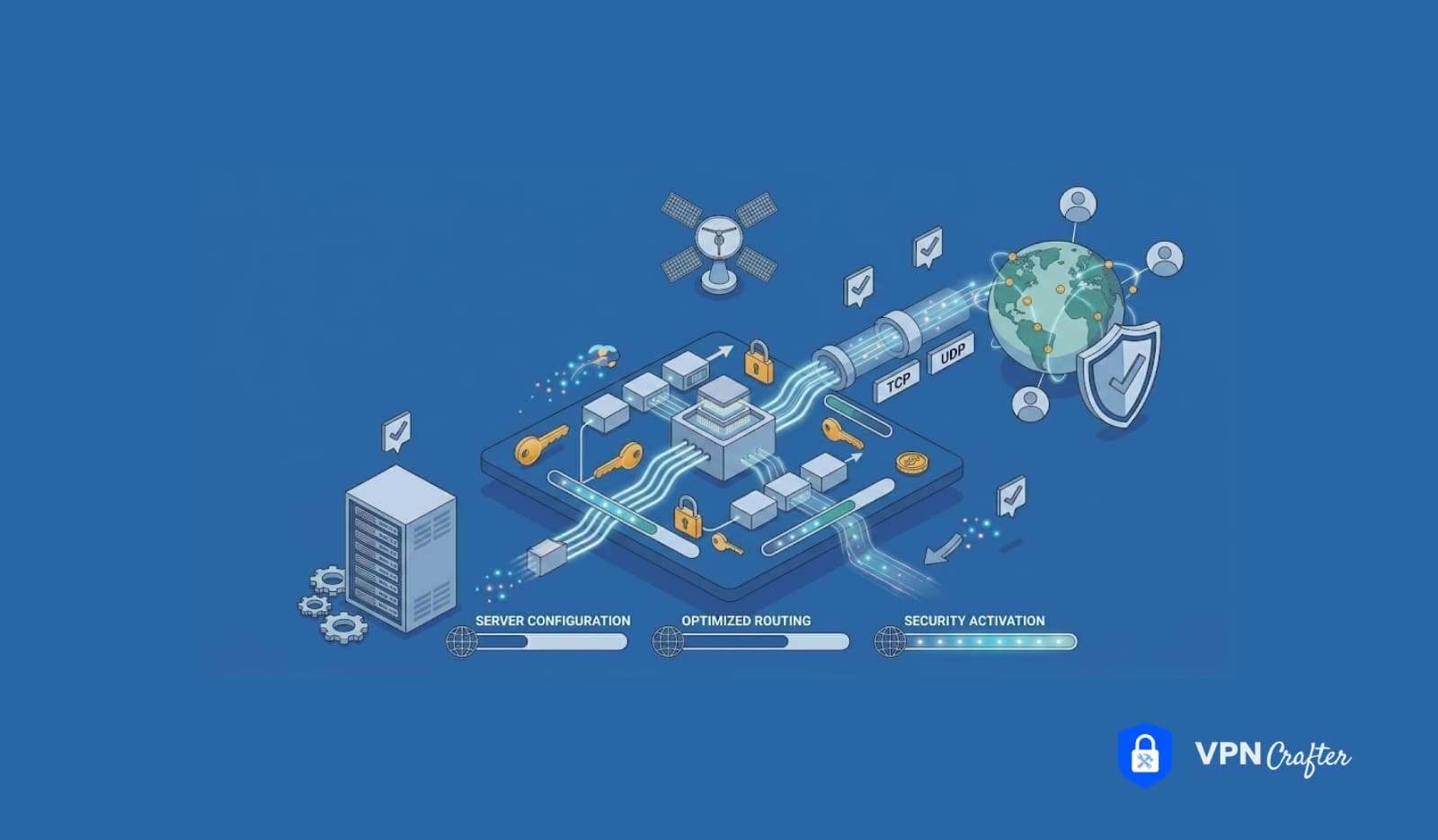
Understanding the request flow is key to successful integration. Shadowsocks operates in a client-server model, using a lightweight handshake to establish a secure session.
- Client Request: A configured application on the user’s device (e.g., your custom app) directs its traffic to a local Shadowsocks client (often a library or SDK integrated into your app).
- Encryption & Forwarding: The local client encrypts the data stream using the agreed-upon cipher (e.g., AES-256-GCM) and sends it to a remote Shadowsocks server over a standard port (e.g., 443) to mimic web traffic.
- Server Relay: The remote server decrypts the request, determines the original destination (e.g.,
api.example.com), and forwards the unencrypted request on its behalf. - Response Handling: The server receives the response from the destination, encrypts it using the same cipher, and sends it back to the local client.
- Local Decryption: The local client decrypts the response and delivers it to the original application.
This process creates a secure, encrypted tunnel for only the traffic you explicitly route through it, leaving all other device traffic untouched.
Server Setup: Building the Backbone of Your Proxy
For a production deployment, especially for a white-label VPN service, manual setup on a Virtual Private Server (VPS) is the most common approach. Here’s a concise, developer-focused guide using shadowsocks-libev.
Prerequisites: A VPS (Ubuntu 20.04/22.04 LTS recommended), root access.
- Installation:bashsudo apt update sudo apt install shadowsocks-libev
- Configuration: Create or edit the configuration file at
/etc/shadowsocks-libev/config.json. This defines the server’s behavior.json{ “server”:”0.0.0.0″, “server_port”:8388, “password”:”your-strong-password”, “timeout”:300, “method”:”chacha20-ietf-poly1305″, “fast_open”:true, “nameserver”:”8.8.8.8″, “mode”:”tcp_and_udp” }method: Use modern AEAD ciphers (aes-256-gcmorchacha20-ietf-poly1305) for security and performance.mode: Set totcp_and_udpto support all traffic types.
- Start and Enable Service:bashsudo systemctl enable shadowsocks-libev sudo systemctl start shadowsocks-libev
- Firewall: Ensure your firewall allows inbound traffic on the chosen port (e.g.,
8388).
For large-scale VPN development, you would not manage individual servers. Instead, you would use this configuration as a baseline for an orchestrated infrastructure using tools like Docker, Ansible, and a load balancer.
Integrating Shadowsocks into Your Application
This is where the protocol transitions from a tool to a product. The goal is to embed the client-side logic directly into your iOS or Android app.
For Android VPN Development
Android offers robust support for VPN and proxy services via the VpnService API. However, implementing a SOCKS5 proxy from scratch is complex. A more efficient approach is to use a pre-built library:
- Use a Native Library: The official
shadowsocks-androidclient is open-source. You can fork it and integrate its core library (libss-local) into your project using JNI (Java Native Interface) to handle the low-level SOCKS5 proxy and encryption. - Implement as a VpnService: Your app would create a
VpnService, configure it to route traffic through a local proxy (e.g.,127.0.0.1:1080), and then run the Shadowsocks client library in the background to establish the connection to your remote server. This allows you to offer a “VPN-like” one-click experience with the underlying Shadowsocks protocol.
For iOS VPN Development
On iOS, the approach is different due to stricter sandboxing. The standard method for implementing a custom VPN protocol is to use the NetworkExtension framework, specifically the NETunnelProvider and NEAppProxyProvider classes.
- App Proxy Provider: You would create a
NEAppProxyProviderextension. This extension acts as the local Shadowsocks client. It handles encryption/decryption and forwards packets to your remote Shadowsocks server using raw sockets. - Traffic Routing: You cannot easily proxy all app traffic. You must use the
NEAppRuleAPI to specify which specific apps or domains should have their traffic routed through yourAppProxyProvider. This selective routing aligns perfectly with Shadowsocks’s design philosophy, making iOS development a natural fit for this protocol.
The Business Case: White-Label VPN Development with Shadowsocks
For companies looking to offer VPN services under their own brand, white-label VPN development is the standard model. Traditionally, this involves licensing a complete solution from a vendor. However, building a custom solution with Shadowsocks offers several distinct advantages:
- Infrastructure Efficiency: Because Shadowsocks is lightweight, server costs can be significantly lower than those for a full OpenVPN-based service, reducing operational expenditure.
- Superior User Experience: By integrating the protocol at the app level, you can create a seamless “smart VPN” feature. For example, your app could automatically use Shadowsocks only for streaming services to bypass geo-blocks while leaving banking apps on a direct connection. This granular control is a powerful differentiator.
- Censorship Circumvention as a Feature: If your target market includes regions with restrictive internet policies, offering an app built on Shadowsocks provides a valuable and relevant service that full-tunnel VPNs often struggle to deliver reliably.
Understanding VPN App Development Cost with Shadowsocks
When budgeting for VPN app development cost, it’s critical to move beyond simple hourly estimates. The total cost is determined by three primary factors, which are influenced by your choice of protocol:
- Initial Development Cost:
- Lower than OpenVPN: Implementing Shadowsocks is generally faster than building a full OpenVPN client due to its simpler protocol and handshake. Expect development to be 15-30% faster, reducing initial costs.
- Comparable to WireGuard: Complexity is similar, but Shadowsocks offers easier integration into multi-platform apps via cross-platform libraries (like Flutter or React Native bindings).
- Infrastructure & Recurring Costs:
- Lower than OpenVPN: Shadowsocks servers have a smaller footprint, allowing you to run more connections per server, thus lowering your monthly server (VPS) costs.
- Tooling Costs: Budget for orchestration tools (Kubernetes, Terraform) to manage a fleet of Shadowsocks servers, which is essential for a reliable, global service.
- Maintenance & Compliance:
- Ongoing Maintenance: Regular updates to ciphers and client libraries to address security vulnerabilities.
- App Store Compliance: Your development team must be well-versed in Apple and Google’s VPN guidelines to ensure your app is accepted, a non-negotiable part of the development cost.
A simple single-platform app with basic Shadowsocks integration might start in the low-to-mid five figures. A full-featured, cross-platform, white-label solution with a global server network and subscription management will be a significant six-figure investment, but with a lower operational cost than traditional VPN solutions.
Conclusion: Is Shadowsocks Right for Your Project?
The Shadowsocks VPN protocol is not a one-size-fits-all solution, but in the right context, it is an exceptionally powerful tool. Its strengths lie in its efficiency, its design for censorship circumvention, and its suitability for embedded, app-level integration.
For developers and businesses undertaking iOS VPN development, Android VPN development, or a comprehensive white-label VPN development project, Shadowsocks offers a path to create a fast, secure, and cost-effective product. It enables you to build an application that provides targeted privacy and access features, delivering a superior user experience compared to heavy, resource-intensive full-tunnel VPNs.
If you are evaluating a new VPN product and want to leverage the unique benefits of the Shadowsocks protocol, a strategic discussion on architecture, VPN app development cost, and go-to-market strategy is the essential next step.
Frequently Asked Questions (FAQs)
Q1: Is Shadowsocks a full VPN protocol?
No, it is a secure SOCKS5 proxy protocol. It creates an encrypted tunnel for selected traffic, not all device traffic, which distinguishes it from full-tunnel VPNs like WireGuard or OpenVPN.
Q2: How secure is the Shadowsocks protocol?
When configured correctly with modern AEAD ciphers like aes-256-gcm or chacha20-ietf-poly1305, it is highly secure for its intended use. However, unlike a full VPN, it does not protect all of a device’s traffic by default.
Q3: What is the main advantage of using Shadowsocks for app development?
Its primary advantage is efficiency and control. Its lightweight nature minimizes battery drain and CPU usage on mobile devices, and its selective proxying allows developers to build “smart” apps that only secure specific, sensitive activities.
Q4: Can I use Shadowsocks for a commercial, white-label VPN service?
Yes. Its low server overhead and flexibility make it an excellent choice for building a custom, commercial VPN service. Many providers use it as a core protocol, especially for bypassing censorship and for mobile-first VPN applications.
Q5: How does the cost of developing a Shadowsocks-based VPN compare to OpenVPN?
The initial VPN app development cost for a Shadowsocks-based solution is often lower than for OpenVPN due to its simpler protocol and faster implementation time. Additionally, ongoing server infrastructure costs are typically lower due to its better performance and lower resource usage.