
The global VPN market is projected to exceed $75 billion by 2027, yet profitability remains elusive for many entrants. If you are building a VPN service, reselling white label infrastructure, or scaling an existing app, understanding VPN monetization models is not optional — it is survival. The difference between a thriving privacy business and a forgotten app store listing often comes down to revenue architecture, not encryption protocols.
At VPN Crafter, we have spent years helping VPN startups, developers, and resellers architect sustainable revenue engines. This guide breaks down every proven VPN business model, from premium subscriptions to enterprise licensing, so you can choose the strategy that aligns with your audience, your ethics, and your growth targets.
What Are VPN Monetization Models?
VPN monetization models are the revenue frameworks that transform encrypted tunneling services into sustainable businesses. Unlike generic SaaS products, VPNs operate in a unique market where trust, privacy ethics, and technical performance directly influence willingness to pay.
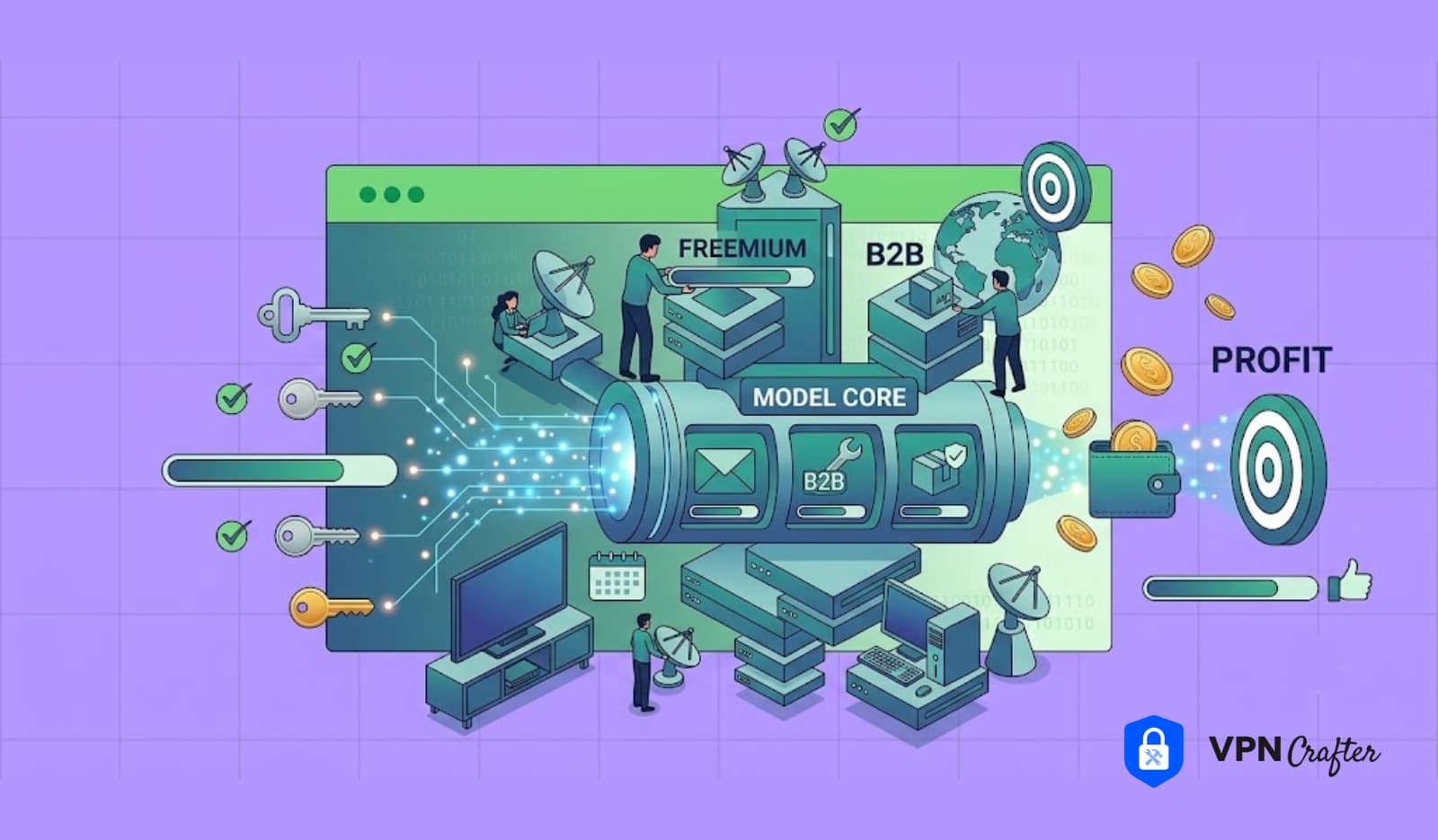
Broadly, these models fall into four categories:
| Category | Model | Revenue Driver |
|---|---|---|
| Direct Consumer | Subscription, Freemium, Lifetime | User payments |
| Indirect Consumer | Ad-supported, Data licensing | Third-party payments |
| B2B & Enterprise | Corporate licensing, Managed VPN | Contract revenue |
| Channel | White label, Affiliate, Reseller | Commission & licensing fees |
Choosing the right mix depends on your target market, regulatory environment, and brand positioning. Moreover, the most profitable VPN businesses rarely rely on a single stream. Instead, they diversify across subscriptions, B2B contracts, and partnership revenue.

The Subscription Model: The Core Revenue Engine
Premium subscriptions remain the gold standard for VPN business revenue streams. This model generates predictable recurring revenue through monthly or annual payments, creating a foundation for forecasting, scaling, and investor confidence.
Why Subscriptions Dominate
Subscription models align perfectly with the ongoing nature of privacy protection. A user does not need a VPN for one day; they need it continuously. Consequently, monthly recurring revenue (MRR) and annual recurring revenue (ARR) become the primary metrics that determine business health.
Subscription Pricing Strategies
Successful VPN pricing strategy follows a tiered approach:
- Basic Plan: Essential encryption, limited servers, single device. Entry-level price point for price-sensitive users.
- Standard Plan: Multi-device support, faster protocols, broader server network. This is your conversion sweet spot.
- Premium Plan: Dedicated IP, advanced security features, priority support. Targets power users and professionals.
Annual billing discounts drive subscription retention and reduce churn. Offering two months free with an annual plan typically increases lifetime customer value (LTV) by 40–60% compared to monthly-only billing.
Retention Mechanics
Customer retention in subscription VPNs depends on three pillars:
- Reliable connectivity: Downtime kills renewals faster than price hikes.
- Feature evolution: Regular protocol updates, new server locations, and split tunneling keep users engaged.
- Trust signals: Transparent privacy policies and regular audits prevent cancellation triggers.
Ultimately, the subscription model works because it transforms privacy from a one-time purchase into an ongoing relationship.
The Freemium Model: Converting Free Users Into Paying Customers
The freemium VPN business model offers a basic service at no cost while reserving advanced features for premium tiers. This approach maximizes user acquisition by lowering the entry barrier, then monetizes through subscription upgrades.
The Conversion Funnel
Freemium success hinges on the conversion funnel. Here is how it typically flows:
- Acquisition: Free users download the app through organic search, app stores, or content marketing.
- Activation: Users experience the core value — bypassing geo-blocks or securing public Wi-Fi.
- Engagement: Daily or weekly usage builds habit formation.
- Conversion: Speed caps, server limits, or device restrictions trigger upgrade prompts.
- Retention: Premium users receive full functionality, reducing churn.
Freemium Conversion Benchmarks
Industry data suggests that freemium VPNs convert between 1% and 5% of free users to paid plans. However, freemium conversion rate varies dramatically based on restriction strategy. VPNs that throttle speed to unusable levels see lower conversions but higher refunds. Conversely, services that offer genuinely functional free tiers with clear premium value — such as additional server locations or streaming access — achieve healthier long-term user conversion strategy outcomes.
The Privacy Paradox
Freemium VPNs face a unique challenge. Users attracted by “free” are often skeptical about logging. Therefore, freemium providers must invest heavily in no-logs audits and public transparency reports to build the trust necessary for conversion. If you are launching a freemium service, planning your first audit should happen before your first ad campaign. Learn more about how to prepare your VPN for its first no-logs audit to establish credibility early.
Ad-Supported VPNs: Free at What Cost?
Ad-supported VPN models generate revenue by displaying advertisements to free users instead of charging subscription fees. While this approach expands reach, it introduces complex ethical and technical trade-offs.
How Ad Monetization Works in VPNs
VPN apps typically implement three ad formats:
| Ad Type | Placement | CPM Range | User Impact |
|---|---|---|---|
| Banner Ads | App dashboard | $0.50–$2.00 | Low intrusion |
| Interstitial Ads | Connection screens | $3.00–$8.00 | Moderate disruption |
| Rewarded Video Ads | Premium feature unlock | $10.00–$30.00 | High engagement |
VPN CPM rates depend heavily on user geography. US and European users command significantly higher rates than emerging market users. Consequently, ad-supported VPNs often optimize for user acquisition in high-CPM regions.
The Trust Problem
Here is the critical issue: users download VPNs for privacy. Advertising requires data. Even anonymized behavioral data collection contradicts the core value proposition of a privacy tool. Furthermore, some ad-supported VPNs have been caught injecting tracking pixels or selling aggregated usage patterns.
For this reason, VPN Crafter generally advises against pure ad-supported models for brands positioning themselves as privacy-first. However, rewarded ads for non-essential features — such as temporary speed boosts — can work if implemented with strict data minimization.
White Label & Reseller Programs
White label VPN business models allow entrepreneurs to launch branded VPN services without building backend infrastructure from scratch. Instead, they license technology from established providers, rebrand the apps, and focus on marketing and customer acquisition.
White Label VPN Revenue Structure
White label operators typically pay a licensing fee per user or a revenue share percentage. Their profit comes from the margin between licensing costs and end-user subscription pricing.
White label VPN profitability depends on:
- Volume: Low per-user licensing costs require thousands of active subscribers.
- Branding: Strong niche positioning (e.g., VPN for gamers, VPN for remote workers) reduces customer acquisition costs.
- Retention: Because licensing fees continue regardless of churn, retention directly impacts margins.
Reseller Programs
VPN reseller business models are lighter than white label. Resellers promote an existing VPN brand and earn commissions on referred subscriptions. This requires minimal upfront investment but offers lower margins and less control.
If you are considering launching your own privacy brand, white label VPN development offers the fastest path to market. You inherit proven protocols, server networks, and client applications while building your own audience.
Affiliate & Partnership Revenue
VPN affiliate marketing remains one of the most lucrative verticals in the digital privacy space. VPN companies pay commissions — often between 30% and 100% of the first subscription payment — for referred customers.
How VPN Affiliate Programs Work
Affiliates create content comparing VPN services, reviewing features, or explaining privacy concepts. When readers click affiliate links and subscribe, the affiliate earns a commission. Top-performing VPN affiliates generate six and seven figures annually.
Partnership Models Beyond Affiliates
Beyond traditional affiliates, VPNs monetize through:
- Influencer marketing: YouTube creators and Twitch streamers promote VPNs to gaming and tech audiences.
- Bundle partnerships: VPNs bundle with antivirus software, password managers, or cloud storage.
- ISP and telecom deals: White-label VPN services sold as add-ons by internet providers.
Affiliate commissions work best when paired with a strong direct-to-consumer subscription model. The affiliate channel drives new user acquisition while subscriptions provide the underlying revenue stability.
Enterprise & B2B Monetization
While consumer VPNs grab headlines, enterprise VPN solutions often generate higher margins and lower churn. Businesses pay premium prices for centralized management, dedicated support, and compliance guarantees.
Corporate VPN Revenue Streams
B2B VPN SaaS business models typically include:
- Per-seat licensing: Monthly fees per employee using the VPN.
- Site-to-site tunnels: Fixed pricing for connecting office locations.
- Managed VPN services: Fully outsourced network security with SLAs.
Compliance as a Selling Point
Enterprise buyers prioritize regulatory compliance. A business VPN service that demonstrates GDPR, HIPAA, or SOC 2 compliance commands premium pricing. Moreover, multinational corporations operating in Brazil or Europe specifically seek providers familiar with GDPR & LGPD for VPN companies, as these frameworks impose strict data handling requirements.
Enterprise VPN Pricing
Corporate contracts rarely use standard consumer pricing. Instead, they negotiate based on user count, contract length, and support tiers. Annual contracts with quarterly billing are standard, providing predictable recurring revenue at scale.
Alternative & Emerging Revenue Streams
Beyond the core models, innovative VPN businesses explore additional revenue channels.
Browser Extensions and Add-Ons
Lightweight VPN browser extensions attract users who want quick geo-unblocking without full-device tunneling. These extensions often serve as lead generators for premium desktop subscriptions.
Lifetime Deals (LTD)
Some VPNs offer lifetime subscriptions at a steep upfront discount. This generates immediate cash flow but creates long-term service obligations. Consequently, lifetime deals work best for established providers with sustainable infrastructure economics.
Merchandise and Education
A small number of privacy-focused brands monetize through merchandise, online courses, or consulting. While these streams rarely replace subscription revenue, they build community loyalty and brand differentiation.
Expert Insights: Real-World Case Studies
At VPN Crafter, we have observed distinct monetization patterns across different market segments.
Case Study 1: The Freemium Convert
A mobile-first VPN launched with a generous free tier — 10GB monthly, five server locations. Conversion hovered at 0.8%. After restricting free users to three locations and adding a streaming-unlock premium feature, conversion jumped to 3.2%. The key insight: free users must feel the restriction, not the service itself.
Case Study 2: The White Label Pivot
A cybersecurity blogger launched a white label VPN targeting remote workers. By bundling the VPN with a productivity course and charging an annual fee, they achieved 70% margins after licensing costs. Niche positioning beat generic “privacy for everyone” messaging.
Case Study 3: The Enterprise Landing
A consumer VPN with strong no-logs credentials pivoted into B2B after receiving inbound inquiries from fintech startups. By adding team management dashboards and priority support, they increased average revenue per user by 400%.
Statistics & Market Data
The VPN industry continues expanding, but monetization efficiency varies significantly by model.
- The global VPN market is projected to reach $75.59 billion by 2027, growing at a CAGR of 17.4% (Grand View Research).
- Subscription-based VPNs account for approximately 78% of total consumer VPN revenue.
- Freemium VPNs report average conversion rates between 1% and 5%, with top performers reaching 8%.
- Enterprise VPN spending represents roughly 35% of total market revenue but serves only 12% of total users.
- VPN affiliate commissions typically range from 30% to 100% of first payment, with lifetime cookie durations common.
- Customer acquisition cost (CAC) for consumer VPNs averages $15–$45 depending on region and channel.
These figures underscore a clear reality: revenue diversification separates sustainable VPN businesses from those dependent on a single channel.
Common Mistakes in VPN Monetization
Mistake 1: Competing Solely on Price
The VPN market is saturated with $2/month lifetime deals. Competing on price triggers a race to the bottom. Instead, compete on trust, speed, or niche features.
Mistake 2: Ignoring Churn
Acquiring users is expensive. Losing them after one month destroys unit economics. Successful VPNs invest heavily in onboarding sequences, usage notifications, and win-back campaigns.
Mistake 3: Misaligned Freemium Restrictions
Throttling free users to 500kbps creates frustration, not desire. Effective freemium models limit location or device count while maintaining usable speeds.
Mistake 4: Neglecting Trust Signals
Privacy tools require proof. Skipping no-logs audits, transparency reports, or independent security reviews kills conversion among informed buyers.
Mistake 5: Overlooking B2B Opportunities
Consumer marketing is noisy and expensive. Meanwhile, businesses with remote workforces desperately need managed VPN solutions and often pay annually upfront.
Best Practices for Maximizing VPN Revenue
1. Build Trust Before You Build Funnels
Privacy is a trust-first market. Publish a clear no-logs policy. Complete an independent audit. Display trust badges prominently. Without trust, no pricing strategy works.
2. Optimize for Annual Subscriptions
Annual plans improve cash flow and reduce churn. Use pricing psychology — “Save 40% with annual billing” — to nudge users toward longer commitments.
3. Implement Smart Upsells
Offer dedicated IPs, password managers, or cloud storage as add-ons. These increase average order value without requiring new user acquisition.
4. Localize Payment Methods
Brazilian users prefer Pix and Boleto. Germans often use SEPA. Indians favor UPI. Supporting local payment methods can increase conversion by 20–30% in target markets.
5. Monitor CAC and LTV Relentlessly
If your customer acquisition cost exceeds your lifetime customer value within six months, your model is broken. Track these metrics weekly, not quarterly.
6. Diversify Revenue Early
Do not wait until subscription growth stalls. Explore affiliate partnerships, white label licensing, or enterprise pilots while your consumer base is healthy.
7. Invest in Technical Infrastructure
Revenue means nothing if servers crash during peak hours. Reliable infrastructure is a monetization prerequisite, not an afterthought. If you are building from scratch, solid VPN development practices ensure your backend can scale with demand.
Frequently Asked Questions
What are the most profitable VPN monetization models?
Premium subscriptions and enterprise B2B contracts generate the highest profit margins. Subscriptions provide predictable recurring revenue, while enterprise deals command premium pricing with lower churn.
How do free VPN apps make money?
Free VPNs typically monetize through advertising, data aggregation, or freemium upsells. Ad-supported models display banners and interstitials, while freemium models restrict features until users upgrade. Some free VPNs have faced criticism for selling user data to third parties.
What is the average freemium conversion rate for VPNs?
Freemium VPNs convert between 1% and 5% of free users to paid plans. Top-performing apps with clear premium value propositions can reach 8% or higher.
How much revenue can a VPN app generate?
Revenue varies dramatically based on user base and pricing. A consumer VPN with 100,000 paying subscribers at $5/month generates $6 million in annual recurring revenue. Enterprise contracts can add millions more depending on seat count.
Is the white label VPN business model profitable?
Yes, but it requires scale. White label operators must cover licensing fees while maintaining competitive pricing. Success depends on niche branding, strong marketing, and retention rates above 85%.
What is better: subscription or ad-supported VPN revenue?
Subscriptions are superior for privacy-focused brands because they align incentives with users. Ad-supported models often compromise privacy and generate lower per-user revenue in the long term.
How do VPN companies reduce customer churn?
Effective strategies include annual billing discounts, feature expansion, proactive customer support, and regular communication about security improvements. Onboarding sequences that teach users how to maximize the VPN also improve retention.
What pricing strategy works best for new VPN startups?
Start with a mid-tier price point and a generous annual discount. Avoid competing on price alone. Instead, offer a clear value proposition — such as streaming access, gaming optimization, or business compliance.
Can VPNs monetize without advertising?
Absolutely. Subscription fees, enterprise licensing, affiliate partnerships, and white label deals all generate revenue without displaying a single ad. Many premium VPNs operate entirely ad-free.
How important are no-logs audits for monetization?
Critical. Audits convert skeptical visitors into paying customers. They also reduce refund requests and chargebacks by setting clear expectations about privacy practices.
What is the typical customer acquisition cost for a VPN?
Consumer VPN CAC ranges from $15 to $45 depending on region and channel. Organic content marketing lowers CAC over time, while paid advertising requires careful funnel optimization.
How do VPN affiliate programs work?
Affiliates promote VPN services through content, reviews, and comparisons. When referred users subscribe, affiliates earn commissions — often 30% to 100% of the first payment. Some programs offer recurring commissions.
What enterprise features justify higher pricing?
Team management dashboards, dedicated IPs, centralized billing, priority support, SLA guarantees, and compliance certifications (GDPR, HIPAA, SOC 2) all support premium B2B pricing.
Should new VPNs offer lifetime deals?
Generally no. Lifetime deals provide short-term cash but create unsustainable long-term service obligations. They are best reserved for established providers with proven unit economics.
How can VPN startups compete with industry giants?
Focus on a specific niche — gamers, remote workers, or privacy activists — rather than competing as a generic alternative to NordVPN or ExpressVPN. Niche positioning reduces CAC and increases brand loyalty.
Final Verdict
VPN monetization models are not one-size-fits-all. The subscription model provides stability. Freemium unlocks scale. White label accelerates market entry. Enterprise B2B delivers margin. And affiliate partnerships amplify reach without fixed costs.
The most successful VPN businesses in 2026 and beyond will combine multiple streams. They will pair consumer subscriptions with enterprise pilots. They will use freemium acquisition funnels while monetizing power users through premium add-ons. And above all, they will treat trust as a revenue driver, not a marketing slogan.
If you are building a VPN service, scaling an existing app, or exploring white label VPN development, the architecture of your revenue model matters as much as the strength of your encryption. Choose wisely, measure relentlessly, and never stop optimizing for both privacy and profitability.
Ready to build a VPN business that actually makes money?
At VPN Crafter, we provide the infrastructure, strategy, and technical guidance to turn privacy concepts into profitable products. Whether you need help with VPN development, launching a white label service, or preparing for your first security audit, our team has done it before. Visit VPN Crafter today and start crafting a VPN business built to last.