
Two VPN providers can run the exact same protocol, the exact same encryption standard, and the exact same client app, and still deliver wildly different results for their users. The difference often comes down to a decision made long before launch, buried in a server contract nobody outside the infrastructure team ever reads: dedicated VPN server vs shared VPN server.
That single choice shapes IP reputation, connection speed, uptime during peak hours, and how exposed the business is if one customer misuses the network. Get it wrong, and a VPN service can look identical to its competitors on paper while performing worse in practice for reasons that have nothing to do with the app or the marketing.
We build and manage VPN infrastructure at VPN Crafter, and this question comes up in nearly every client conversation we have, whether the client is launching a white-label brand, running a reseller operation, or building a VPN app from the ground up. This guide breaks down exactly what changes between the two models, where each one makes sense, and what the decision actually costs in dollars and in risk.
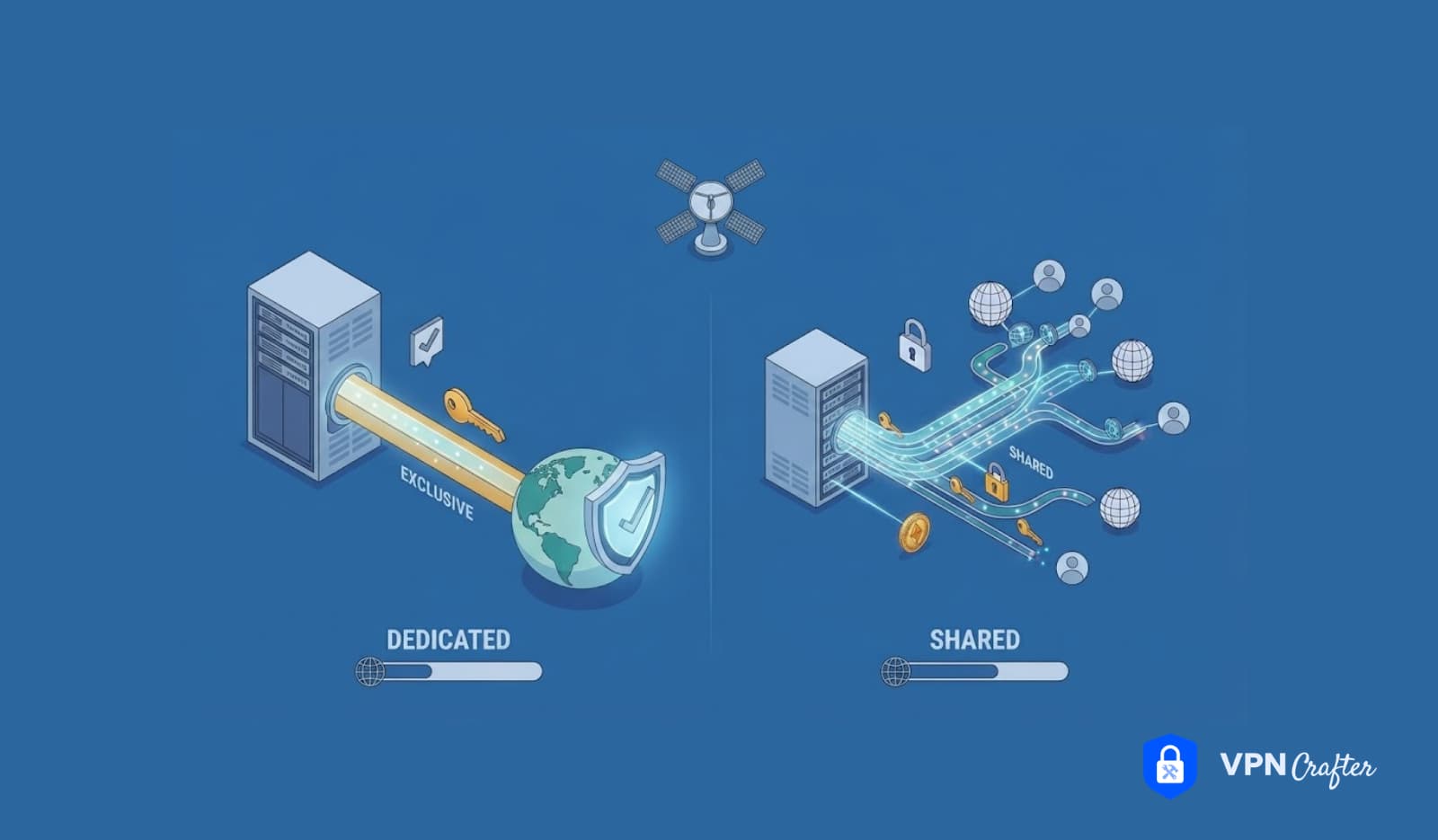
A dedicated VPN server is a physical or virtual machine, along with its IP address, used exclusively by one customer or one VPN brand, with no other tenants sharing its resources. A shared VPN server hosts many users or many brands on the same machine and IP pool simultaneously. Dedicated servers offer better performance predictability, cleaner IP reputation, and stronger isolation, at a meaningfully higher cost per user. Shared servers are cheaper to scale and work well for casual browsing and streaming, but they carry a higher risk of IP blacklisting, server congestion, and one tenant’s abuse affecting everyone else on the same machine.

Table of Contents
- What Is a Dedicated VPN Server?
- What Is a Shared VPN Server?
- Dedicated VPN vs Shared VPN: The Full Comparison Table
- Performance: Speed, Latency, and Server Congestion
- Security and Privacy Differences
- Dedicated IP vs Shared IP: The Confusion Everyone Has
- Cost Comparison: What Each Model Actually Costs
- Who Should Use a Dedicated VPN Server?
- Who Should Use a Shared VPN Server?
- Use-Case Breakdown: Business, Gaming, Streaming, Banking, Remote Access
- Expert Insights From the VPN Crafter Team
- Statistics and Data
- Common Mistakes When Choosing Between Dedicated and Shared VPN Servers
- Best Practices for Choosing the Right Model
- Frequently Asked Questions
- Conclusion
What Is a Dedicated VPN Server?
A dedicated VPN server is infrastructure, whether physical hardware or an isolated virtual machine, allocated entirely to one customer, one brand, or one specific purpose. Nobody else’s traffic touches that server’s resources, and in most configurations, the IP address tied to it belongs to that single tenant as well.
Three defining traits separate a dedicated server from every shared alternative.
Exclusive resource allocation. CPU, RAM, and bandwidth on a dedicated server serve one workload. There is no neighbor consuming capacity during a traffic spike.
IP isolation. The public IP address (or a small dedicated pool) is not shared with any other customer, which directly affects how streaming platforms, banks, and fraud-detection systems perceive traffic coming from that address.
Full configuration control. Dedicated deployments typically allow the tenant to choose the VPN protocol, firewall rules, and hardening approach, rather than inheriting a one-size-fits-all setup built for hundreds of unrelated users.
For a VPN business specifically, “dedicated” usually means a dedicated server per brand or per region within the provider’s own network, rather than one server per individual end user. A well-run VPN service still serves many customers through that dedicated infrastructure; the dedication applies at the business or brand level, not necessarily one machine per person.
What Is a Shared VPN Server?
A shared VPN server hosts multiple, unrelated users, and sometimes multiple unrelated VPN brands, on the same machine and often the same IP address pool at the same time. This is the default model behind most consumer VPN pricing, since it spreads infrastructure cost across a large user base.
Shared infrastructure works through a few core mechanics.
Pooled resources. CPU, RAM, and bandwidth get divided dynamically among however many users are connected at a given moment. During low-traffic hours, this feels no different from a dedicated setup. During peak hours, it can mean real congestion.
Shared IP addresses. Hundreds or thousands of users might exit through the same handful of IPs. This is precisely why a shared VPN IP can end up flagged by a streaming service or blacklisted by an email provider due to another user’s behavior entirely unrelated to you.
Standardized configuration. Because the same server serves many tenants, protocol choices, firewall policy, and hardening decisions are usually uniform across the whole pool rather than customized per customer.
Shared servers are not inherently insecure. Reputable providers still encrypt every session independently and isolate user sessions from one another at the software level. What shared infrastructure sacrifices is predictability, not necessarily safety.
Dedicated VPN vs Shared VPN: The Full Comparison Table
| Factor | Dedicated VPN Server | Shared VPN Server |
|---|---|---|
| Resource allocation | Exclusive CPU, RAM, bandwidth | Pooled among many users |
| IP address | Dedicated or small private pool | Large shared pool, often rotating |
| IP reputation risk | Low; you control who uses it | Higher; affected by other tenants’ behavior |
| Performance predictability | Consistent regardless of others’ usage | Can degrade during peak load |
| Server congestion | Rare, if capacity is sized correctly | Common on popular servers at peak hours |
| Configuration control | High; custom firewall, protocol, hardening | Standardized across the whole pool |
| Setup and management cost | Higher | Lower |
| Scalability | Requires provisioning new servers manually or via automation | Scales easily by adding users to existing capacity |
| Isolation from abuse | Strong; one tenant cannot affect another | Weaker; one abusive user can get the shared IP blacklisted |
| Typical monthly cost per server | $20–$150+ depending on specs and provider | Fractions of a cent per user, bundled into subscription pricing |
| Best suited for | Businesses, streaming-heavy brands, remote access, compliance-sensitive use | Casual browsing, general privacy, cost-sensitive consumer plans |
Performance: Speed, Latency, and Server Congestion
Performance is where the dedicated vs shared VPN server debate becomes concrete rather than theoretical, because users feel this difference immediately.
Bandwidth allocation on a dedicated server is fixed and known. If a server has a 10 Gbps uplink and only your traffic uses it, throughput stays consistent whether it’s 3 AM or peak evening hours. On a shared server, that same 10 Gbps gets divided among everyone connected simultaneously, and popular shared servers routinely hit capacity during evening peaks in major time zones.
Latency behaves similarly. A dedicated server experiencing no contention for CPU cycles processes encryption and routes packets with fewer delays. Shared servers under heavy load can introduce queuing delay as the CPU juggles encryption workloads across many simultaneous sessions, which shows up to end users as increased ping.
Server congestion is the most visible symptom of shared infrastructure done poorly. When too many users connect to the same shared server relative to its capacity, everyone’s throughput drops, even for users doing nothing more demanding than browsing. This is precisely the problem that fuels complaints about VPN speed on major consumer platforms during peak hours.
Connection stability also differs. Dedicated servers see fewer unpredictable capacity swings, which translates into fewer dropped connections and more consistent VoIP or video call quality. For a technical breakdown of the protocols underlying this behavior, our comparison of VPN Protocols explains how WireGuard’s lightweight handshake reduces the CPU cost of each connection, which matters more on shared infrastructure than on dedicated hardware with capacity to spare.
Summary Box: Performance in One Sentence
Dedicated VPN servers deliver predictable speed and latency because resources belong to one tenant; shared VPN servers deliver good average performance most of the time but are vulnerable to congestion whenever demand spikes.
Security and Privacy Differences
Security and privacy diverge between the two models in ways that matter differently depending on who is asking the question.
Isolation from other users’ behavior. On a dedicated server, nothing another customer does can affect your session, your IP reputation, or your exposure to abuse complaints. On a shared server, one user running abusive traffic, torrenting copyrighted material, or launching automated scraping can trigger IP-level consequences that land on everyone sharing that address.
Attack surface. A shared server is a more attractive target for attackers precisely because compromising it yields access to many users’ traffic at once, rather than just one. This does not mean shared servers are poorly defended, but the incentive to attack them is objectively higher. Our detailed breakdown of Common VPN Server Vulnerabilities covers the specific misconfigurations, from exposed management ports to weak authentication, that turn any server, dedicated or shared, into an easy target if hardening is neglected.
Data protection and encryption apply equally to both models when configured correctly. Encryption happens per session regardless of whether the underlying hardware is shared, so a properly run shared server still protects each user’s traffic from every other user on the same machine. The difference is in the blast radius if something does go wrong, not in the baseline cryptographic protection.
Privacy from the provider’s perspective. Shared infrastructure, ironically, can offer a subtle privacy advantage for individual anonymity, since a given IP address represents thousands of overlapping user sessions, making it harder to correlate a specific action to a specific person purely from the IP. Dedicated IPs trade this crowd-based anonymity for cleaner reputation and consistent access, which is the opposite goal for some use cases and exactly the right goal for others.
Dedicated IP vs Shared IP: The Confusion Everyone Has
This is the single most common point of confusion in the entire topic, and it deserves its own section: a dedicated VPN server and a dedicated IP address are related but not identical concepts.
A dedicated IP VPN means the customer connects and always exits through the same, unique IP address that no other customer uses. This can technically run on shared server hardware, where the provider allocates one static IP exclusively to a customer while the underlying machine still serves other tenants through different IPs.
A shared IP VPN means many customers exit through the same IP address, whether or not the underlying server is dedicated or shared hardware.
A dedicated VPN server, as covered earlier, refers to the machine and its resources, which usually, but not always, comes bundled with a dedicated IP as part of the package.
| Setup | Server Hardware | IP Address | Common Use Case |
|---|---|---|---|
| Dedicated server + dedicated IP | Exclusive | Exclusive | Business VPN, remote access, compliance |
| Dedicated server + shared IP | Exclusive | Shared pool | Rare; high-performance consumer tiers |
| Shared server + dedicated IP | Shared | Exclusive | Add-on IP purchased on consumer VPN plans |
| Shared server + shared IP | Shared | Shared pool | Standard consumer VPN default |
A static IP VPN, incidentally, is simply a dedicated IP that does not change between sessions, as opposed to a dynamic dedicated IP that stays assigned to one customer but could theoretically change on reconnection. For businesses needing consistent allowlisting on a firewall or banking portal, the static, dedicated combination is the one that actually solves the problem; a rotating shared IP will not.
Cost Comparison: What Each Model Actually Costs
Cost is where the decision becomes a business conversation rather than a purely technical one.
Shared VPN server costs are effectively fractional. A provider spreads the cost of a single server, often $20 to $150 per month depending on specs and data center, across hundreds or thousands of simultaneous users, which is exactly why consumer VPN subscriptions can sell for $3 to $10 per month and still profit. Our overview of VPN Monetization Models breaks down how that per-user margin actually works across different pricing tiers.
Dedicated VPN server costs scale with the number of servers deployed, not the number of users on any single one, up to that server’s real capacity. A single dedicated server might run $50 to $300+ per month depending on bandwidth, location, and specs, and a VPN business needs enough of them, spread across regions, to serve its user base without congestion.
Dedicated IP add-ons, distinct from a fully dedicated server, are commonly priced as a flat monthly or annual add-on, typically $2 to $10 per month per IP, on top of a base subscription, since a single dedicated IP consumes far fewer resources than an entire dedicated machine.
The real cost comparison for a VPN business is not per-server pricing at all. It is cost per active user at target performance levels. A shared model might cost $0.05 per user per month in server overhead but degrade badly past a certain user density. A dedicated model might cost $2 per user per month but hold performance steady regardless of growth. Businesses evaluating How to Build a Profitable VPN Business need to model this cost curve explicitly rather than comparing sticker prices for a single server.
Who Should Use a Dedicated VPN Server?
Dedicated infrastructure earns its higher cost in specific, identifiable situations.
Businesses with compliance requirements. Financial services, healthcare, and legal firms often need auditable, isolated infrastructure where no external tenant could plausibly access shared resources, a requirement most compliance frameworks treat as non-negotiable.
Remote teams needing consistent access. A Business VPN supporting remote workers who need to reach internal systems benefits enormously from a dedicated IP that IT can allowlist on firewalls, VPNs, and internal tools without constantly updating access rules as a shared pool rotates.
High-volume streaming or scraping operations. Anyone running data collection at scale, or a brand built around reliable access to geo-restricted content, needs an IP that has not already been flagged by the destination service due to another tenant’s activity.
VPN brands prioritizing IP reputation. A new VPN service trying to establish itself with clean access to major streaming platforms and low CAPTCHA friction benefits from dedicated IPs precisely because reputation starts clean and stays that way under the brand’s own control.
Enterprises with strict security postures. Organizations that require full visibility into every configuration decision, every firewall rule, and every access log on their VPN infrastructure need the control a dedicated model provides, which a shared, standardized configuration cannot offer.
Who Should Use a Shared VPN Server?
Shared infrastructure remains the right call for a large share of use cases, and dismissing it as inferior misses the point of why it exists.
Individual privacy-focused users. Someone browsing, checking email, and occasionally streaming does not need dedicated hardware; a well-run shared server delivers more than adequate performance at a fraction of the cost.
Cost-sensitive consumer VPN plans. Any VPN business targeting a broad consumer audience at a competitive price point has to build on shared infrastructure at scale, since dedicated servers per user would make the pricing model impossible.
Small businesses without heavy compliance needs. A small team that just wants encrypted browsing for staff, without regulatory requirements dictating infrastructure isolation, gets full value from shared infrastructure without paying for capacity it does not need.
Casual streaming and general anonymity. For a user whose main goal is basic privacy and occasional geo-unblocking, the crowd-based anonymity of a large shared IP pool is a genuine, if underappreciated, benefit rather than a downside.
Use-Case Breakdown: Business, Gaming, Streaming, Banking, Remote Access
| Use Case | Recommended Model | Why |
|---|---|---|
| Corporate remote access | Dedicated | Allowlisting, compliance, consistent uptime for critical work |
| Online banking | Dedicated IP (server can be shared) | Reduces fraud-flagging and login friction from shared, high-risk IP pools |
| Gaming | Dedicated, low-latency regional servers | Congestion directly translates into higher ping and packet loss |
| Streaming | Dedicated or well-managed shared with rotating clean IPs | Streaming platforms actively blacklist known shared VPN ranges |
| Web scraping | Dedicated | Avoids shared IPs already flagged by target sites |
| Casual personal browsing | Shared | Cost-effective, sufficient performance, added anonymity from a large pool |
| Small business file access | Shared, unless compliance dictates otherwise | Lower cost, adequate for light, non-critical workloads |
| SaaS platform access control | Dedicated IP | Enables precise IP-based access rules for customers or internal tools |
| Multiple devices, single household | Shared | Typical home usage rarely saturates shared server capacity |
Expert Insights From the VPN Crafter Team
A handful of patterns from building infrastructure for VPN businesses across both models.
Most VPN businesses need a hybrid, not a single choice. We rarely recommend an all-dedicated or all-shared architecture. A typical build uses dedicated servers in high-demand regions and for premium tiers, while relying on well-provisioned shared infrastructure for lower-cost plans and less latency-sensitive regions. Treating this as an either/or decision usually leads to overspending on capacity nobody needs or underspending on the servers that actually determine customer satisfaction.
IP reputation decays faster on shared infrastructure than most operators expect. We have watched shared IP ranges go from clean to blacklisted on major streaming platforms within weeks purely because of one or two abusive tenants sharing the pool. Dedicated IP tiers exist largely to solve this exact problem, and providers who skip offering one lose customers to streaming-focused competitors quickly.
Server congestion is a capacity planning failure, not an inherent flaw of shared servers. A shared server sized correctly for its expected user count performs just as reliably as a dedicated one most of the time. The problem is that many providers oversell capacity to cut costs, and users experience that decision as “shared servers are slow” when the real cause is under-provisioning.
White-label and reseller partners inherit whichever model the infrastructure provider chose, whether they realize it or not. Anyone pursuing White Label VPN Development should ask directly whether the underlying servers are dedicated, shared, or a mix, and at what user density, before committing to a brand launch. This single question predicts a large share of the support tickets a white-label brand will receive in its first six months.
Dedicated servers change the security conversation, not just the performance one. With a dedicated server, a business can apply custom firewall rules, run its preferred intrusion detection setup, and control exactly which protocols are exposed. On shared infrastructure, that configuration is standardized across every tenant, which is efficient but leaves less room for a business with specific compliance or threat-model requirements.
Resellers evaluating a partner should ask about oversubscription ratios, not just server counts. A provider claiming “500 servers” says little if some of those servers each carry ten times the recommended user load. Anyone building through a VPN reseller program should request real utilization data, not marketing server counts, before choosing an infrastructure partner.
Statistics and Data
- Global VPN usage exceeded 1.6 billion downloads in a single year, according to Top10VPN’s annual VPN usage research, underscoring the scale at which infrastructure decisions like shared vs dedicated servers now operate.
- Streaming platforms actively and continuously update VPN IP blocklists, and independent testing by outlets such as Comparitech has repeatedly shown that shared VPN IP ranges get blacklisted far more frequently than dedicated IPs precisely because of the shared exposure to policy-violating traffic from unrelated users.
- 56% of organizations reported experiencing a VPN-related cyberattack in the past year, per Zscaler’s ThreatLabz VPN Risk Report (2024), a figure that applies to VPN infrastructure broadly and reinforces why isolation and hardening matter regardless of server model.
- The global VPN market was valued at approximately USD 51 billion in 2023 and is projected to grow substantially through the decade, according to Grand View Research, reflecting rising demand for both consumer shared-tier services and dedicated enterprise VPN infrastructure.
- Businesses citing “predictable performance” and “compliance” as top VPN infrastructure priorities have consistently appeared in enterprise IT surveys from firms like Gartner, aligning directly with the core reasons organizations choose dedicated over shared infrastructure.
- WireGuard’s efficient handshake reduces per-connection CPU overhead compared to older protocols, based on the original WireGuard whitepaper and subsequent independent benchmarks, which matters disproportionately on shared servers where CPU is the resource most often contended.
Common Mistakes When Choosing Between Dedicated and Shared VPN Servers
Assuming dedicated is always better. Dedicated servers solve specific problems. Paying for dedicated infrastructure to serve a low-traffic, non-sensitive use case wastes money without improving the actual user experience.
Confusing a dedicated IP with a dedicated server. As covered above, these are separate purchases with separate benefits. Buying one does not automatically include the other.
Ignoring oversubscription ratios on shared plans. Two shared servers with identical specs can behave completely differently depending on how many users each one actually serves.
Underestimating IP reputation decay. Businesses building a streaming-focused VPN brand on purely shared infrastructure often discover blacklisting problems only after customer complaints pile up, rather than planning around it from the start.
Overlooking regional distribution. A dedicated server in the wrong region does nothing for latency. Capacity needs to match where the actual user base is located, not just how much total bandwidth exists.
Treating security as automatically stronger on dedicated servers. Isolation reduces certain risks, but a poorly hardened dedicated server is still vulnerable to the same misconfigurations, weak authentication, and unpatched software that affect any VPN infrastructure.
Not planning for scale. A business that starts on shared infrastructure and grows rapidly needs a clear migration path to dedicated capacity before congestion starts driving away customers, not after.
Best Practices for Choosing the Right Model
- Map your actual use case to the use-case table above before comparing pricing. The right model depends on what the traffic needs, not on which sounds more premium.
- Ask any infrastructure provider for real oversubscription ratios, not just server counts. Marketing numbers rarely reflect real-world congestion risk.
- Separate the IP address decision from the server decision. Decide independently whether you need a dedicated IP, a dedicated server, or both.
- Build a hybrid architecture for growing VPN businesses. Use dedicated capacity where reputation and latency matter most, and shared capacity where cost efficiency matters most.
- Monitor server load continuously, not just at launch. A server sized correctly at 1,000 users may be undersized at 10,000; plan for regular capacity reviews.
- Harden every server regardless of model. Dedicated infrastructure is not automatically secure; apply the same patching, authentication, and monitoring discipline either way.
- Match regional server distribution to your actual user base. Dedicated capacity in the wrong geography solves nothing for latency-sensitive use cases.
- Reassess the decision annually as usage patterns shift. A model that made sense at launch may need revisiting after a year of growth or a shift in target market.
Frequently Asked Questions
What is the difference between a dedicated VPN server and a shared VPN server?
A dedicated VPN server allocates its resources and IP address to a single customer or brand exclusively, while a shared VPN server hosts multiple users or brands on the same machine and IP pool simultaneously. Dedicated servers offer more predictable performance and cleaner IP reputation; shared servers offer lower cost per user.
Is a dedicated VPN server better than a shared VPN server?
It depends on the use case. Dedicated servers are better for businesses needing compliance, consistent access, or clean IP reputation, such as remote work, banking, or streaming-focused brands. Shared servers are better for cost-sensitive, general-purpose use like casual browsing, where predictable dedicated performance isn’t necessary.
Is a dedicated VPN worth it?
For businesses with compliance needs, latency-sensitive use cases like gaming, or reputation-sensitive use cases like streaming and scraping, a dedicated VPN is generally worth the added cost. For casual individual use, a well-run shared VPN server typically delivers sufficient performance at a much lower price.
What is a dedicated IP VPN, and is it different from a dedicated server?
A dedicated IP VPN gives a single customer a unique, unshared IP address, which can run on either dedicated or shared server hardware underneath. A dedicated server refers to the exclusive allocation of the machine’s resources itself. The two are often bundled together but are technically separate purchases.
Do shared VPN servers get blacklisted more often?
Yes, generally. Because many unrelated users share the same IP address on a shared server, one user’s policy-violating behavior, such as spamming or automated scraping, can get that entire IP range flagged or blacklisted by streaming platforms, email providers, or fraud-detection systems, affecting every other user on that IP.
Are dedicated VPN servers more secure than shared VPN servers?
Dedicated servers offer stronger isolation, meaning another tenant’s compromise or misuse cannot affect your traffic. However, security also depends heavily on configuration, patching, and hardening, which matter equally on both models. A poorly secured dedicated server can still be more vulnerable than a well-managed shared one.
How much does a dedicated VPN server cost compared to a shared VPN server?
A dedicated VPN server typically costs $50 to $300 or more per month depending on specs and region, serving one customer or brand. Shared server costs are spread across many users, often amounting to just fractions of a cent per user per month, which is why shared-tier consumer VPN subscriptions can be priced so much lower.
Which is better for gaming, dedicated or shared VPN servers?
Dedicated VPN servers are generally better for gaming because consistent low latency and freedom from server congestion directly affect gameplay quality. Shared servers can introduce variable ping and packet loss during peak hours when many unrelated users compete for the same bandwidth.
Which is better for streaming, dedicated or shared VPN servers?
Dedicated IPs tend to work better for streaming because shared IP ranges are more frequently blacklisted by streaming platforms due to the behavior of other users sharing the same address. A dedicated or well-managed rotating IP reduces the chance of hitting a proxy detection block.
Can a shared VPN server still be secure?
Yes. Encryption and session isolation happen independently for each user regardless of whether the underlying server is shared or dedicated. A well-configured, properly hardened, and monitored shared server can be just as secure in practice, though it carries a higher risk profile from a reputation and abuse-exposure standpoint.
What is server congestion, and how does it relate to shared VPN servers?
Server congestion occurs when too many users connect to the same server relative to its available bandwidth and processing capacity, causing slower speeds and higher latency for everyone connected. It is more common on shared servers, especially popular ones, during peak usage hours, and is largely a result of provisioning decisions rather than an unavoidable trait of sharing.
Should a VPN business use dedicated or shared servers?
Most successful VPN businesses use a hybrid approach: dedicated servers for premium tiers, latency-sensitive regions, and reputation-critical use cases like streaming, combined with shared servers for cost-effective, general-purpose plans. The right mix depends on the target audience and the price points the business wants to offer.
Does a dedicated IP make a VPN slower or faster?
A dedicated IP itself does not directly change speed; speed depends on the underlying server’s resources and load. However, dedicated IPs often run on better-provisioned infrastructure and avoid the congestion that shared IP pools can experience, which indirectly leads to more consistent performance.
Conclusion
The dedicated VPN server vs shared VPN server decision is not really a question of which model is objectively better. It is a question of matching infrastructure to purpose. A business running remote access for a compliance-sensitive team needs the isolation and control that dedicated servers provide. A budget-conscious consumer checking email on public Wi-Fi gets everything they need from a well-run shared server at a fraction of the cost.
What matters most, regardless of which model a VPN business builds on, is honest capacity planning and real security discipline. Oversold shared servers create the congestion complaints that damage a brand’s reputation, and under-hardened dedicated servers offer a false sense of security that isolation alone cannot deliver. The right answer is rarely all-dedicated or all-shared; it is a deliberate, well-monitored mix built around how real users actually behave.
At VPN Crafter, we help VPN businesses design exactly that mix, from choosing the right server model per region and tier to hardening whichever infrastructure ends up carrying customer traffic. If you are building, scaling, or auditing a VPN service and are not sure which model fits your next phase of growth, that is a conversation worth having before the servers get provisioned, not after.
Talk to VPN Crafter about the right infrastructure for your VPN business →