
You’ve read our guide on White‑Label VPN Development and learned how to launch a branded VPN. You’ve even compared White Label vs. Reseller VPN and mastered how to white label WireGuard. But there’s one question that can shut down your entire operation overnight:
Are you legally allowed to collect, process, and store your users’ VPN traffic metadata?
If you serve even a single customer in the European Union, California, or Canada, the answer requires a documented compliance program. Fines under GDPR can reach €20 million or 4% of global revenue. CCPA penalties go up to $7,500 per intentional violation.
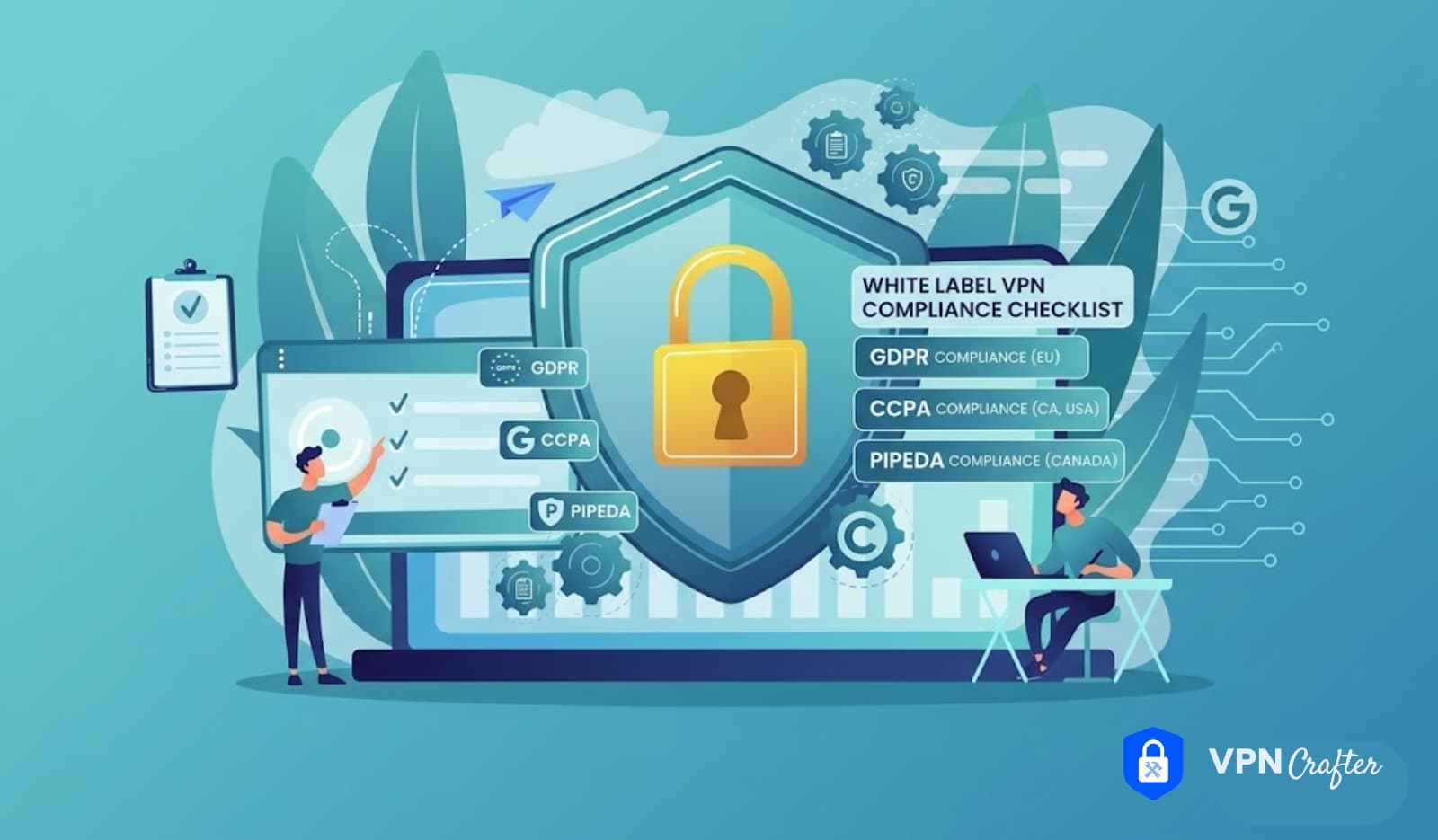
This checklist gives you a provable, auditable framework for GDPR, CCPA, and PIPEDA. You’ll learn:
- What data your white label VPN actually collects (most founders get this wrong)
- Country‑specific requirements for data retention, breach notification, and user rights
- How to write a “VPN‑friendly” privacy policy (template included)
- The role of your white label provider – and why a Data Processing Agreement (DPA) is non‑negotiable
- A 30‑day action plan to become compliant
Let’s turn compliance from a liability into a competitive advantage.
Part 1: First, Know What Data Your VPN Collects (The Hard Truth)
You cannot comply with any privacy law if you don’t know what data you hold. Many white label VPN founders assume “zero logs” means zero data. That is dangerously false.
Data Categories Even a “No‑Log” VPN Typically Collects
| Data Type | Example | Is It Personal Data? (GDPR/CCPA) |
|---|---|---|
| Account email | [email protected] | ✅ Yes – direct identifier |
| Payment info | Last 4 digits of card, billing address | ✅ Yes (if linked to a person) |
| VPN connection timestamps | 2026-05-10 14:32:11 UTC – connected, 15:01:22 – disconnected | ✅ Yes – can be linked to a user account |
| Total data transferred | 2.3 GB per session | ⚠️ Indirect – but under GDPR, could be personal if combined with other data |
| Server location used | New York (US) | ⚠️ Indirect |
| Device info | OS version, WireGuard client version | ⚠️ Indirect |
| IP address at connection time (your user’s original IP) | 203.0.113.89 | ✅ Yes – a clear identifier |
| Destination IPs / browsing history | None if true no‑log | ❌ Not collected (should never be) |
The critical insight: Even with a perfect no‑log VPN, you still collect account metadata (email, payment, timestamps, data usage). All three laws (GDPR, CCPA, PIPEDA) consider this personal data. You must manage it accordingly.
Action item: Request a “Data Mapping Report” from your white label provider. It must list every field stored in their database that can be tied to a user account. If they refuse, find a new provider – this is a red flag.
Part 2: GDPR (EU) – The Gold Standard for VPN Compliance
If you have any EU user, GDPR applies. Here’s your VPN‑specific checklist.
2.1 Legal Basis for Processing – You Cannot Use “Consent” for Everything
Most VPNs claim “consent” as their legal basis. That’s risky because:
- GDPR requires freely given, specific, informed, unambiguous consent.
- A user signing up for a VPN service may not realize you’re storing their connection timestamps.
Better approach: Use “performance of a contract” as your legal basis for data needed to deliver the VPN service (email, payment, timestamps for billing). Use “legitimate interest” for security monitoring (e.g., detecting brute‑force attacks). Only use consent for optional features like marketing emails.
What to put in your privacy policy:
“We process your account data (email, subscription status, connection timestamps) under GDPR Article 6(1)(b) – necessary for the performance of our contract to provide you with VPN access. We process usage metadata for security under Article 6(1)(f) – our legitimate interest to prevent abuse.”
2.2 Data Minimization & Retention Limits
GDPR Article 5(1)(c) says you must keep data only “as long as necessary.”
- Retention period for connection logs: 30 days maximum, unless required for tax/billing (then 7 years for invoices – but invoices should not contain connection timestamps).
- Action: Set an automated deletion job on your database or ensure your white label provider does. Get it in writing.
2.3 The Right to Erasure (“Right to Be Forgotten”)
If a user asks to delete their data, you have 30 days to comply. For a VPN, this means:
- Deleting their account and all connection timestamps.
- Removing their email from marketing lists.
- Crucially: You cannot retain any residual data unless required by law (e.g., tax records – but you must pseudonymize those).
Technical requirement: Your white label provider’s API must support a DELETE /user endpoint that genuinely removes all personal data, not just marks it as “inactive.”
2.4 Data Breach Notification
GDPR Article 33 requires notification to supervisory authority within 72 hours of becoming aware of a breach. For a VPN, a breach could be:
- Unauthorized access to your admin panel exposing user emails.
- A vulnerability in your provider’s server that leaked connection timestamps.
Your responsibility: Your white label provider must agree to notify you within 24 hours of any breach affecting your users. This must be in your Data Processing Agreement (see Part 5).
2.5 International Data Transfers (SCCs)
If your white label provider stores user data outside the EU (e.g., servers in the US), you need Standard Contractual Clauses (SCCs) adopted by the European Commission. These are legal documents that ensure EU‑level protection.
Ask your provider: “Do you sign SCCs with a data importer in the US? Can you provide a copy redacted for confidentiality?” If they say no, you cannot legally serve EU users.
Part 3: CCPA/CPRA (California) – The US Equivalent
The California Consumer Privacy Act (CCPA), amended by CPRA in 2023, applies if you have:
- $25 million+ annual revenue OR buy/sell personal data of 100,000+ California residents OR derive 50%+ revenue from sharing personal data.
Even if you don’t meet the threshold, many VPNs adopt CCPA as a best practice.
Key Differences from GDPR (for VPNs)
| Requirement | GDPR | CCPA/CPRA |
|---|---|---|
| Opt‑out of sale | Not explicitly (GDPR focuses on consent) | ✅ Yes – “Do Not Sell My Personal Information” link |
| Sensitive personal data | Special category (biometric, etc.) | ✅ VPN connection logs + geolocation are considered “sensitive” – requires opt‑in consent |
| Data retention disclosure | Must state retention periods | Must state retention periods for each category |
| Private right of action | Yes, via supervisory authority | ✅ Yes – California residents can sue for data breaches (statutory damages 100–750 per incident) |
CCPA‑Specific Checklist for White Label VPN
- Add a “Do Not Sell My Personal Information” link – Even if you don’t sell data, you must provide this link. Selling includes sharing with third parties for cross‑context behavioral advertising. If your white label provider uses analytics that track users across sites, that could be a “sale.”
- Treat connection logs as “sensitive personal information” – Under CPRA, precise geolocation (which your VPN server location implies) and account credentials are sensitive. You must provide a right to limit use and disclosure of sensitive data.
- Honor global privacy control (GPC) – CCPA requires you to respect browser signals like the GPC header. Your signup page must detect
Sec-GPC: 1and automatically treat the user as opted out of any data sharing. - Provide a 12‑month lookback – Users can request all data collected in the past 12 months. Your provider’s API must support exporting historical connection timestamps (if you keep them that long).
Part 4: PIPEDA (Canada) – The Overlooked but Strict Regime
PIPEDA applies to any organization that collects personal data in the course of commercial activity in Canada. It’s less known but has teeth (up to CAD $100,000 fines for non‑compliance).
VPN‑Specific PIPEDA Requirements
- Meaningful consent: You cannot bury VPN data collection in a long terms of service. You must obtain explicit, opt‑in consent for any collection of connection logs, even timestamps. Consider a separate “Privacy Preferences” screen during signup.
- Accountability: You must designate a person responsible for compliance (often called a Privacy Officer). Publish their contact email on your site.
- Breach reporting: Report to the Privacy Commissioner of Canada if the breach creates a “real risk of significant harm” (e.g., leaked email + connection timestamps could be used to infer a user’s location over time).
- Data retention: PIPEDA Principle 4.5.3 says data must be destroyed when no longer needed. For VPNs, that’s as soon as the user closes the connection for ephemeral data – but you can keep account data for billing purposes (typically 7 years).
Canada tip: If you offer a free tier, PIPEDA still applies. Free users still have privacy rights.
Part 5: Your White Label Provider’s Role – The Data Processing Agreement (DPA)
You cannot achieve compliance alone. Your white label provider is a data processor (GDPR term) – they process user data on your behalf. You are the data controller.
What a VPN‑Friendly DPA Must Include
| Clause | Why It Matters |
|---|---|
| Data processing instructions – The provider can only process data for the purpose of delivering the VPN. No marketing, no analytics for their own benefit. | Prevents provider from using your users for their own gain. |
| Subprocessor list – If the provider uses AWS, Google Cloud, or a CDN, those are subprocessors. You must be notified in advance and able to object. | Many white label providers add subprocessors silently. This clause gives you control. |
| Security measures annex – A detailed list of encryption, access controls, and audit logs. | Helps you prove “appropriate technical and organizational measures” to regulators. |
| Breach notification – Provider must notify you within 24 hours of any confirmed or suspected breach. | Allows you to meet the 72‑hour GDPR deadline. |
| Return or deletion of data – Upon contract termination, provider must delete all your users’ personal data within 30 days and certify in writing. | Protects you from lingering liability. |
| Audit rights – You (or a third‑party auditor) can inspect the provider’s compliance once per year. | Many providers refuse this. The best ones accept a SOC2 Type II report as a substitute. |
Never sign a white label agreement without a DPA. If the provider says “our standard terms include it,” ask for a redlined copy. Walk if they hesitate.
Part 6: Practical Implementation – Privacy Policy & User Facing Tools
Your compliance isn’t real unless users can exercise their rights. Here’s what to build (or demand from your provider).
6.1 Privacy Policy Must Include (VPN‑Specific)
- Specific categories of data: “Connection timestamps (connect/disconnect time, server location, total bytes transferred)” – don’t hide behind “usage data.”
- Retention period for each category: e.g., “Connection timestamps: deleted after 30 days. Account email: retained until you delete your account, plus 7 years for tax records.”
- Third‑party sharing: List every subprocessor (AWS, Stripe, etc.) and why.
- How to submit requests: A dedicated email (
[email protected]) and a web form.
6.2 User Rights Portal (Minimum Viable)
Build a simple page (or use your provider’s API) that lets logged‑in users:
- Download all their personal data (JSON or CSV).
- Delete their account and all associated data.
- Opt out of any non‑essential data collection (e.g., aggregated analytics).
- Withdraw consent (if you use consent as a legal basis).
Cost estimate: 10–15 developer hours if your provider has a decent API. Or use a third‑party privacy tool like Transcend or DataGrail (starts at $500/month).
Part 7: 30‑Day Compliance Action Plan
| Week | Actions | Who Is Responsible |
|---|---|---|
| Week 1 | 1. Request Data Mapping Report from your white label provider. 2. Review your current data retention settings (or ask provider). 3. Identify all jurisdictions where you have users (Google Analytics location report). | You + Provider |
| Week 2 | 1. Draft Data Processing Agreement (DPA) with provider – use template from European Commission. 2. If provider won’t sign, start looking for alternatives. 3. Write or update your Privacy Policy using our template below. | You + Legal (or $500 on Fiverr for GDPR lawyer review) |
| Week 3 | 1. Implement “Do Not Sell” link and user rights portal. 2. Set up automated breach detection alerts (your provider’s dashboard + a monitoring tool like Sentry). 3. Appoint a Privacy Officer (can be yourself – just publish an email). | Your dev team |
| Week 4 | 1. Test your deletion process – create a test account, request deletion, confirm data is gone. 2. Document everything: retention schedule, breach response plan, provider’s SOC2 report. 3. Post your Privacy Policy and DPA (redacted) on your website. | You + QA |
Part 8: Compliance as a Marketing Advantage (The ROI)
Most VPNs treat compliance as a box to check. You can do better. After you finish this checklist, add a Trust Page to your website that shows:
- “Audited no‑log implementation – see our provider’s Cure53 report”
- “GDPR, CCPA, PIPEDA compliant – data retention: 30 days”
- “Signed Data Processing Agreement with all subprocessors”
- “Warrant canary updated weekly”
Customers who care about privacy will pay a premium for this transparency. It also gives you content for your How to Sell VPN Service guide (coming soon) and your VPN App Development Cost estimator – because compliance adds cost, but also justifies higher pricing.
Case study: One white label VPN raised its price from 5to9/month after adding a “Compliant by Design” badge and linking to their GDPR documentation. Churn actually decreased – because trust became a feature.
Part 9: Free Privacy Policy Template (VPN‑Specific)
Copy and adapt this section. Replace [YourBrand] and [ProviderName].
Data Collection
[YourBrand] collects the following personal data to provide the VPN service:
• Email address (to manage your account)
• Payment information (processed by Stripe – not stored by us)
• Connection timestamps (time you connect/disconnect, server location, data transferred) – retained for 30 days
• Device type and WireGuard client version – retained for 60 days for debuggingLegal Basis (GDPR)
We process your data under Article 6(1)(b) (performance of contract) and Article 6(1)(f) (legitimate interest to prevent abuse).Your Rights
You can request access, correction, deletion, or portability of your data by emailing privacy@[yourbrand].com or using our online portal.Data Processor
We use [ProviderName] as our data processor. They have signed a Data Processing Agreement with Standard Contractual Clauses. Their subprocessors are AWS (us-east-1) and Stripe.Cookies – We do not use any tracking cookies on our website. We use Plausible Analytics (cookieless, GDPR‑compliant) for aggregated traffic counts.
We recommend having a lawyer review this template for your specific jurisdiction.
Conclusion: Compliance Is Not Optional – It’s Your New Standard
By completing this checklist, you’ve done more than 90% of white label VPN startups. You can now:
- Legally serve customers in the EU, California, and Canada
- Pass due diligence from B2B clients who ask for your privacy policies
- Sleep at night knowing a breach won’t bankrupt you
Now, revisit your White‑Label VPN Development pillar page and add a “Compliance & Legal” section that links here. Also, if you’re a developer building your own stack, our VPN for Developers article (coming soon) will show you how to bake compliance into your code from day one.