
Most people buying or building VPN services fixate on server count, price, or marketing copy. The protocol underneath — the actual engine running the connection — gets treated as a footnote. That’s a mistake, and if you’re building or reselling a VPN product, it’s a costly one.
VPN protocols are the technical rulebooks that govern how data moves between a user’s device and a VPN server. They determine encryption strength, connection speed, battery drain on mobile devices, firewall resistance, and how easily your app gets blocked in restrictive networks. Pick the wrong one, and your product will underperform regardless of how good everything else is.
This guide covers every major protocol in practical detail — not just what they are, but how they behave in real deployments, what compliance requirements they affect, and which ones actually make sense for modern VPN development and white label VPN businesses in 2026.
How VPN Protocols Actually Work?
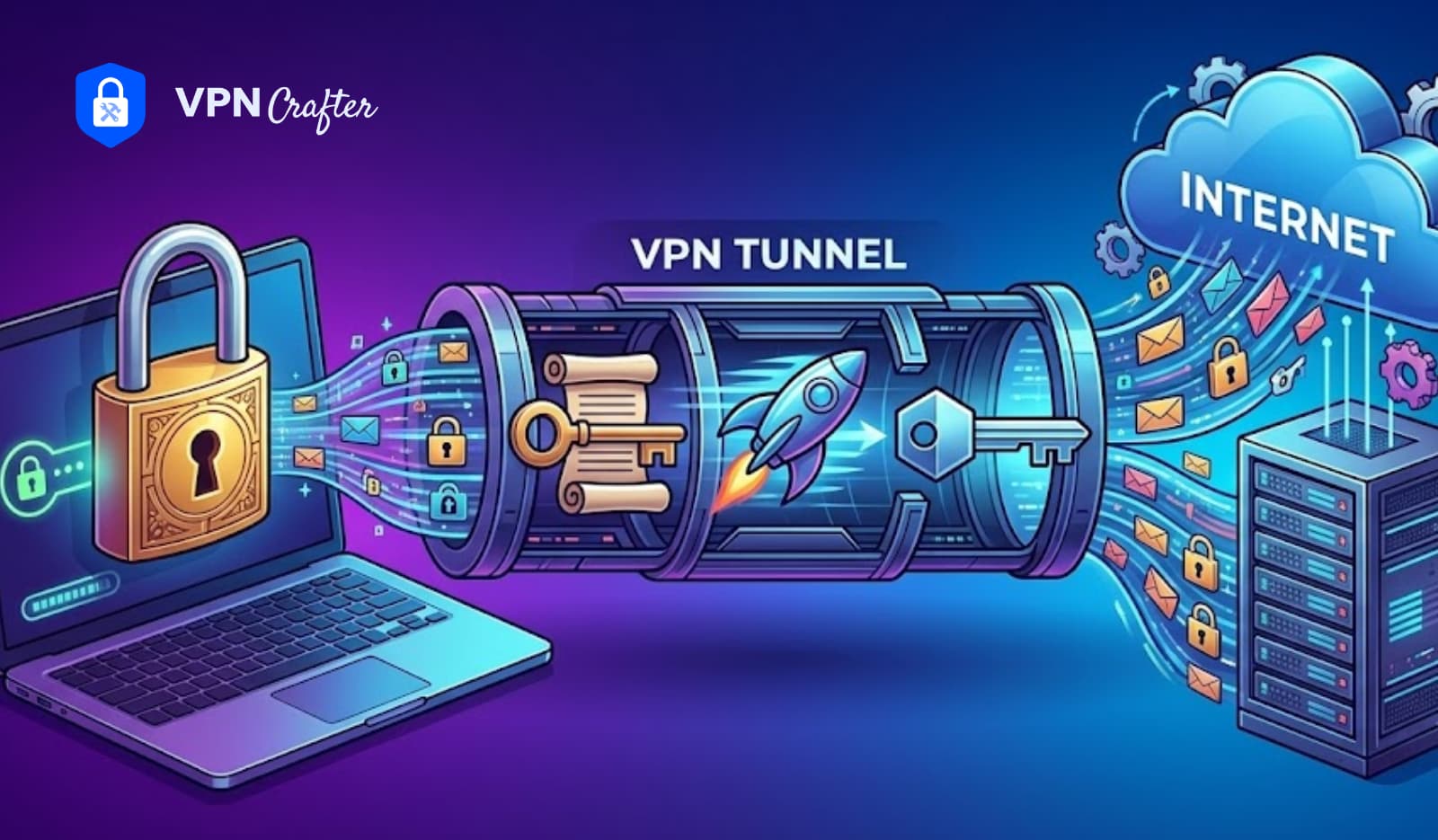
A VPN creates an encrypted tunnel between a client device and a server. The protocol defines the rules for building that tunnel: which encryption ciphers to use, how authentication happens, how packets get wrapped (encapsulated), and how the connection handles drops and reconnections.
Three layers interact in every VPN connection:
- The tunneling layer — wraps your traffic inside another packet for transmission
- The encryption layer — scrambles the data so it’s unreadable in transit
- The authentication layer — verifies that both the client and server are who they say they are
Different protocols solve these three challenges in different ways. Some prioritize speed over overhead. Others prioritize stealth over raw throughput. Understanding these trade-offs is the entire game when selecting a protocol for your product.
The Major VPN Protocols: A Detailed Breakdown
WireGuard
WireGuard is the most significant development in VPN protocol design in roughly two decades. Released as stable in 2020 after years of academic review, it uses around 4,000 lines of code — compared to OpenVPN’s roughly 600,000. That smaller codebase is easier to audit, harder to exploit, and faster to maintain.
How it performs: WireGuard consistently delivers the fastest throughput of any modern VPN protocol. In independent benchmarks, it routinely outpaces OpenVPN by 3x or more on raw speed, with significantly lower CPU overhead and battery drain on mobile. On a modern Linux server, WireGuard connection establishment takes milliseconds rather than seconds.
Encryption: WireGuard uses a fixed, modern cryptographic stack — ChaCha20 for symmetric encryption, Poly1305 for authentication, Curve25519 for key exchange, BLAKE2s for hashing. It doesn’t negotiate cipher suites, which eliminates a whole category of downgrade attacks. The trade-off is less flexibility, but for most use cases that’s a reasonable exchange.
Weaknesses: WireGuard assigns static IP addresses by default, which creates some user-tracking concerns in privacy-focused deployments. This is solvable — VPN services like Mullvad and ProtonVPN built their own wrappers around it — but it’s extra work. WireGuard also uses UDP only, which means it can be blocked by firewalls that restrict UDP traffic.
Best for: New VPN development, mobile apps, speed-sensitive use cases, white label VPN products targeting consumer markets.
OpenVPN
OpenVPN has been the default choice in serious VPN development for nearly 20 years. It’s open source, battle-tested, and supported on almost every platform. If something goes wrong with an OpenVPN deployment, someone else has probably already documented the fix.
How it performs: Slower than WireGuard, but stable and predictable. OpenVPN runs over both TCP and UDP. The TCP mode is slower but more reliable through restrictive firewalls. The UDP mode performs better under normal conditions. Latency is typically 10–20% higher than WireGuard on equivalent hardware.
Encryption: OpenVPN uses TLS/SSL for the control channel and supports a wide range of cipher suites including AES-256-GCM. This flexibility is both a strength and a complexity risk — misconfiguration can leave weaker ciphers enabled if you’re not deliberate about it.
Firewall resistance: Running OpenVPN on port 443 (the standard HTTPS port) makes it very difficult to block without disrupting regular web traffic. This is one reason it remains the go-to protocol for users in high-censorship environments.
Best for: Established deployments, corporate VPN infrastructure, users behind aggressive firewalls, any scenario where broad compatibility matters more than raw speed.
IKEv2/IPSec
IKEv2 (Internet Key Exchange version 2) paired with IPSec is the protocol built into most operating systems natively — iOS, macOS, Windows, and Android all support it out of the box. That’s a meaningful advantage for enterprise and mobile deployments where you want to avoid custom app installation.
How it performs: Fast, particularly on reconnection. IKEv2 handles network switching (say, moving from WiFi to LTE) better than almost any other protocol. This “MOBIKE” feature makes it genuinely excellent for mobile use cases where users frequently change networks.
Encryption: IPSec supports AES-256 and IKEv2 uses modern key exchange methods. It’s not as cryptographically clean as WireGuard’s fixed stack, but it’s well-vetted and used by governments and enterprises worldwide.
Weaknesses: IKEv2 uses UDP port 500 and port 4500 for NAT traversal. Both are well-known and easy for firewalls to block. In China, Iran, and other restrictive environments, IKEv2 connections often fail.
Best for: Enterprise mobility solutions, B2B VPN products, iOS-first deployments, corporate environments with managed device programs.
L2TP/IPSec
L2TP (Layer 2 Tunneling Protocol) combined with IPSec was widely used throughout the 2010s. It’s still around, but there’s little reason to build new products on it. The double-encapsulation design creates overhead, it’s slower than IKEv2 and WireGuard, and there have been credible concerns about NSA compromise of the IPSec standards it relies on.
If you’re maintaining a legacy deployment that uses L2TP/IPSec, the priority should be migration rather than optimization. For new VPN development, skip it.
PPTP
Point-to-Point Tunneling Protocol was Microsoft’s original VPN protocol from 1999. Its encryption has been broken. MS-CHAPv2, the authentication mechanism PPTP typically uses, can be cracked with commodity hardware. There is no valid security case for using PPTP in 2025. Some older routers and corporate systems still support it out of legacy necessity, but if you’re building a VPN product and PPTP is on your list, take it off.
Shadowsocks
Shadowsocks is technically a proxy protocol rather than a full VPN protocol, but it belongs in any serious discussion of Shadowsocks VPN protocol implementations because of what it does uniquely well: traffic obfuscation.
Originally developed by a Chinese programmer in 2012, Shadowsocks was built specifically to evade the Great Firewall. It disguises VPN traffic as ordinary HTTPS traffic using AEAD encryption, making it extremely difficult for deep packet inspection (DPI) systems to identify and block it.
Best for: Markets where VPN traffic is actively blocked or throttled — China, Iran, Russia, UAE. If your white label VPN product targets users in these regions, Shadowsocks or an obfuscation layer built on top of another protocol is not optional, it’s essential.
Limitations: It’s not a full VPN — it doesn’t encrypt all device traffic by default the way OpenVPN or WireGuard does. For complete network protection, Shadowsocks needs to be paired with routing rules or integrated into a larger VPN architecture.
SSTP
Secure Socket Tunneling Protocol is Microsoft’s proprietary protocol, designed to tunnel PPP traffic through SSL/TLS. It works well on Windows and integrates natively with the Windows VPN stack, but it’s essentially a Windows-only solution. Cross-platform support is limited. For white label VPN development targeting multiple platforms, SSTP rarely makes sense as a primary protocol.
VPN Protocol Comparison Table
| Protocol | Speed | Security | Firewall Resistance | Mobile Stability | Audit Status | Best Use Case |
|---|---|---|---|---|---|---|
| WireGuard | Excellent | Excellent | Moderate (UDP only) | Good | Fully audited | Consumer apps, new development |
| OpenVPN | Good | Excellent | Excellent (port 443) | Moderate | Extensively audited | High-censorship markets, enterprise |
| IKEv2/IPSec | Very Good | Very Good | Poor | Excellent (MOBIKE) | Well-vetted | Enterprise mobile, iOS-first |
| L2TP/IPSec | Moderate | Moderate | Poor | Moderate | Legacy | Legacy support only |
| PPTP | Fast | Broken | Poor | Poor | Compromised | Avoid entirely |
| Shadowsocks | Good | Good | Excellent | Good | Community-reviewed | Censorship bypass |
| SSTP | Good | Good | Good | Poor | Proprietary | Windows-only deployments |
Which Protocol Should You Build On?
The honest answer: there’s no single right choice, but there is a right framework for making the decision.
If you’re building a new consumer VPN app — start with WireGuard. The speed advantage is real, the codebase is auditable, and user experience on mobile is noticeably better. Add OpenVPN as a fallback for users behind restrictive firewalls.
If your target markets include China, Iran, or Russia — OpenVPN on port 443 with obfuscation, or Shadowsocks, or a proprietary protocol built on top of WireGuard (like NordLynx or Lightway-style designs). Without obfuscation in these markets, your product simply won’t work for a meaningful portion of users.
If you’re building a B2B or enterprise VPN product — IKEv2/IPSec handles corporate mobility requirements well. Enterprises care deeply about native OS integration and compatibility with existing network infrastructure.
If you’re building a white label VPN product — the answer is almost always a dual-protocol approach: WireGuard as the default fast protocol and OpenVPN (or a WireGuard-based proprietary protocol) as the resilient fallback.
How to White Label WireGuard: A Practical Overview {#white-label-wireguard}
White labeling WireGuard means building your brand’s VPN product on top of WireGuard’s open-source codebase. Because WireGuard is licensed under GPLv2, there are specific compliance steps involved.
Here’s a high-level breakdown of what the process involves:
1. Server infrastructure setup Deploy WireGuard servers across your target regions. Each server needs WireGuard installed, a keypair generated, and firewall rules configured to allow WireGuard traffic (typically UDP port 51820, though this can be changed).
2. Key management WireGuard uses public-key cryptography. Every client gets a keypair, and the server’s allowed-peers list needs to include each client’s public key. At scale, this requires an automated key provisioning system — generating keys, distributing them to clients during account creation, and revoking them cleanly when accounts are cancelled.
3. IP address management WireGuard’s static IP assignment behavior means you need to either assign static IPs to users (which creates privacy implications) or build a dynamic IP rotation layer on top of WireGuard. Several open-source projects address this, but it requires implementation effort.
4. Client application You’ll need either a custom client app or the ability to configure WireGuard through your app’s settings. The WireGuard client libraries are available for iOS, Android, Windows, macOS, and Linux. Most white label VPN platforms abstract this layer for you.
5. GPLv2 compliance Because WireGuard is GPLv2-licensed, any product distributing WireGuard-linked code must make the source code available to users. This is not optional and has legal consequences if ignored. Work with your legal team or your white label VPN provider on this requirement.
6. Obfuscation layer (optional but often necessary) Raw WireGuard traffic is identifiable by its packet structure. For markets where VPN detection is active, you’ll need a WireGuard obfuscation wrapper. Solutions like AmneziaWG (a fork of WireGuard with built-in obfuscation) exist specifically for this purpose.
White Label VPN Compliance Checklist
Running a white label VPN business involves more than technical implementation. Regulatory compliance varies significantly by region, and getting it wrong has serious consequences.
Data retention laws
- EU GDPR: No logs that could identify users without a lawful basis. Your privacy policy must accurately reflect what data you do and don’t store.
- US: No federal data retention law for VPN providers, but state laws (California’s CPRA, for example) apply based on user location.
- Brazil: LGPD (Lei Geral de Proteção de Dados) applies to users in Brazil and mirrors GDPR in many respects.
- Australia: Australian Privacy Act applies; ISPs and VPN providers with Australian users need to comply.
- India: CERT-In mandated that VPN providers store user data for 5 years starting in 2022. Many international VPN providers responded by pulling Indian servers.
- UK: The Investigatory Powers Act creates obligations around data retention for companies with UK users.
No-log policy verification If you market your product as a no-log VPN, you need independent audit verification. Several reputable firms conduct VPN audits — Cure53, KPMG, and Deloitte have all published VPN audit reports. An unaudited no-log claim is a marketing liability and, in some markets, a legal risk.
Export controls Strong encryption (256-bit and above) is subject to export control regulations in some jurisdictions. The US Commerce Department’s Bureau of Industry and Security (BIS) governs encryption export; most commercial VPN encryption qualifies for mass market exemptions, but verify this with legal counsel.
App store compliance Apple App Store and Google Play both have specific rules around VPN applications. Apple requires VPN apps to use the Network Extension framework and explicitly prohibits using VPN capabilities for tracking users. Both platforms require privacy policy disclosure. App review can be lengthy and unpredictable — factor this into your launch timeline.
Trademark and branding Ensure your white label brand name doesn’t conflict with existing VPN trademarks. This is basic but frequently overlooked in the rush to launch.
Common Mistakes VPN Businesses Make When Choosing Protocols
1. Defaulting to OpenVPN without evaluating WireGuard OpenVPN was the right answer for a long time. In 2025, it’s often not the best starting point for new development. Many teams stick with OpenVPN because their developers already know it, not because it’s the right fit.
2. Ignoring obfuscation until users complain Building for a market like India, Brazil, or any country with active VPN interference without an obfuscation strategy is building for failure. Retrofitting obfuscation after launch is significantly harder than building it in from the start.
3. Under-investing in protocol fallback logic A single protocol with no fallback means any network condition that disrupts that protocol disrupts your service entirely. Production VPN apps should attempt WireGuard first, fall back to OpenVPN UDP, and then fall back to OpenVPN TCP on port 443 if needed.
4. Publishing no-log claims without audit Legal exposure aside, users in 2025 are increasingly skeptical of unaudited claims. A no-log claim without third-party verification is genuinely weaker marketing than an audited no-log claim.
5. Treating all markets identically A protocol configuration that works perfectly in Germany or Canada may be unusable in India or Russia. Market-specific protocol configurations and server routing are table stakes for global VPN products.
6. Ignoring GPLv2 requirements for WireGuard derivatives Distributing WireGuard-linked code without making source available isn’t a gray area — it’s a license violation. Budget compliance work into your WireGuard white label plan.
Best Practices for Protocol Selection in Modern VPN Apps
Design for the worst case, not the average case. Your protocol stack should work in a coffee shop in Bangkok, on a corporate network in Frankfurt that proxies all traffic, and on a mobile connection in São Paulo switching between 4G and WiFi every five minutes. Build and test for all three.
Use WireGuard as default, OpenVPN as fallback. This configuration gives most users the best performance while giving all users reliable access. The automation logic to switch between protocols should be invisible to the user.
Encrypt your configuration files. Client-side WireGuard and OpenVPN configuration files contain private keys. Storing them unencrypted on a user’s device is a security flaw that auditors will flag and that sophisticated users will notice.
Pin your server certificates. Certificate pinning in your client app prevents man-in-the-middle attacks that target the VPN connection setup itself, not just the encrypted tunnel.
Implement kill switch functionality. A kill switch blocks traffic if the VPN connection drops unexpectedly. Without it, users on unstable connections may have unencrypted traffic exposed without knowing. This is now an expected feature, not a premium differentiator.
Log only what you need for operational purposes. Connection timestamps and aggregate bandwidth data help you operate the service. Individual user activity logs create legal liability and undermine your privacy positioning. Keep the distinction clear.
Audit regularly. The threat landscape changes. Cipher suites that were acceptable in 2020 may be deprecated by 2025. Schedule annual security reviews of your protocol configurations, especially for OpenVPN deployments with manual cipher suite configuration.
Expert Insights: What Protocol Choices Look Like in Production
At VPN Crafter, working with VPN businesses across more than a dozen markets, a few patterns consistently show up in the difference between products that scale well and products that don’t.
The most common differentiator isn’t server count or pricing — it’s protocol intelligence. Specifically, whether the app makes smart, automatic protocol decisions or forces users to configure their own settings.
Consumer VPN users have no idea what a protocol is. They just know when the connection drops, or when Netflix doesn’t load, or when the app drains their battery. The protocol decisions that cause those outcomes happen invisibly. So the VPN products that win in consumer markets are the ones that got protocol selection right in the architecture phase, not the ones that gave users a dropdown menu.
For white label VPN businesses, this insight has direct commercial implications. If you’re launching a brand and your technical foundation has poor protocol fallback logic, your user reviews will reflect that — and they’ll attribute it to your brand, not to the protocol underneath. Conversely, a product built on WireGuard with intelligent fallback to OpenVPN and proper obfuscation for affected markets will simply work reliably, and that reliability compounds into user retention.
The second pattern: compliance work always takes longer than expected. Every market in your target list has its own data handling requirements. Brazil’s LGPD, India’s CERT-In requirements, Germany’s particularly strict interpretation of GDPR, Australia’s Privacy Act — these aren’t interchangeable. Budget time and legal resources accordingly.
Statistics & Data
These figures are drawn from publicly available research and industry reports:
- WireGuard performance advantage: Multiple independent tests (including benchmarks from Mullvad VPN and academic papers) show WireGuard achieving 3–4x higher throughput than OpenVPN on equivalent hardware under similar conditions.
- Global VPN market: According to Grand View Research, the global VPN market was valued at approximately USD 44.6 billion in 2022 and is projected to grow at a CAGR of 14.5% through 2030, driven by remote work adoption and rising cybersecurity concerns.
- Mobile VPN usage: Statista data indicates that mobile devices account for over 60% of VPN connections globally, which directly favors protocols with strong mobile performance (WireGuard, IKEv2) over those with higher overhead.
- India’s CERT-In directive (2022): VPN providers are required to store user data including names, email addresses, contact numbers, and IP addresses assigned to users for a minimum of five years. This fundamentally changed the compliance calculus for any VPN business serving Indian users.
- WireGuard codebase: WireGuard’s kernel implementation is approximately 4,000 lines of code vs. OpenVPN’s roughly 70,000 lines in its core implementation and significantly more across the full codebase — a key factor in audit confidence and vulnerability surface.
- VPN blocking in restricted markets: According to OONI (Open Observatory of Network Interference) data, VPN traffic blocking is actively enforced in at least 20 countries as of 2024, with China, Russia, Iran, and UAE among the most restrictive.
Frequently Asked Questions
What is the fastest VPN protocol available in 2025?
WireGuard is the fastest VPN protocol for most use cases. It uses modern cryptography with minimal overhead and consistently outperforms OpenVPN and IKEv2 in throughput tests. For users on high-speed connections, the difference is measurable.
Which VPN protocol is most secure?
WireGuard and OpenVPN are both excellent choices when properly configured. WireGuard uses a fixed, modern cryptographic suite with no negotiation, which eliminates downgrade attack risk. OpenVPN with AES-256-GCM and TLS 1.3 is also strong. Avoid PPTP entirely — its encryption is broken.
What VPN protocol should I use for streaming?
WireGuard works well for streaming because its low latency and high throughput handle video buffering better. If your target streaming service is geo-restricted and the VPN gets detected, OpenVPN on port 443 is harder to fingerprint.
Can VPN protocols be detected and blocked?
Yes. WireGuard traffic has a distinctive pattern that DPI systems can identify. OpenVPN is similarly detectable without obfuscation. Shadowsocks and obfuscated variants of WireGuard (like AmneziaWG) are significantly harder to detect. For markets with active VPN blocking, obfuscation is not optional.
What is the best VPN protocol for mobile devices?
WireGuard is excellent on mobile due to its low battery drain and fast connection times. IKEv2 handles network switching better when moving between WiFi and cellular. Most modern VPN apps for mobile use WireGuard as the default with IKEv2 as an alternative.
How do I white label WireGuard legally?
WireGuard is licensed under GPLv2. Distributing a product that includes WireGuard-linked code requires making the source code available to users. You also need to handle key management, IP addressing, and obfuscation at the application layer. Working with a white label VPN platform that already manages GPLv2 compliance significantly reduces this complexity.
What is the difference between a VPN protocol and a VPN provider?
A VPN protocol is the technical standard for how data is encrypted and tunneled — WireGuard, OpenVPN, IKEv2, etc. A VPN provider is the company that operates the servers and software using those protocols. A VPN provider can use multiple protocols and may build proprietary protocols on top of open standards.
Does OpenVPN still make sense in 2025?
Yes, but primarily as a fallback protocol rather than a default. Its firewall penetration on port 443 is genuinely useful in restrictive networks. For new development where firewall resistance isn’t the primary concern, WireGuard is the better starting point.
What VPN protocol should I avoid?
PPTP. Its encryption has been cryptographically broken. L2TP/IPSec is also worth avoiding for new development — it’s slower than modern alternatives and has credible documented concerns around NSA influence on its standards.
What is a secure VPN protocol for a business VPN?
For business use, IKEv2/IPSec integrates well with enterprise network infrastructure and handles the mobility patterns common in corporate environments. For higher-security requirements, OpenVPN with certificate-based authentication and AES-256-GCM encryption is a solid choice.
Is WireGuard safer than OpenVPN?
Both are secure when properly implemented. WireGuard’s smaller, audited codebase means fewer potential attack surfaces. OpenVPN’s flexibility means more room for misconfiguration. In practice, a well-configured OpenVPN deployment and a WireGuard deployment are both safe choices — WireGuard just requires fewer decisions to get right.
What VPN protocols work in China?
OpenVPN on port 443 with obfuscation, Shadowsocks, and proprietary obfuscated protocols can work in China. Plain WireGuard and plain IKEv2 are typically blocked. The landscape changes frequently as the Great Firewall updates its detection methods, so this requires ongoing attention.
How do Virtual Private Network protocols affect user privacy?
The protocol itself is one layer of privacy. Your overall privacy depends on the protocol’s encryption strength, your provider’s logging practices, the jurisdiction your servers are in, and whether you use a no-log architecture. A strong protocol paired with excessive logging provides little real privacy protection.
What is NordLynx? NordLynx is NordVPN’s proprietary protocol built on top of WireGuard. It adds a double NAT system to address WireGuard’s static IP assignment privacy concern. Several other providers have built similar WireGuard wrappers. This is the approach many white label VPN products use — WireGuard as the performance foundation, with a custom layer solving the privacy edge cases.
How many VPN protocols should my app support? At minimum, two: a fast default (WireGuard) and a resilient fallback (OpenVPN). If you’re targeting markets with active VPN blocking, add an obfuscated option. More than three or four is usually unnecessary complexity.
Conclusion
VPN protocols aren’t a commodity decision. The protocol stack you build on — and how you implement it — directly determines whether your product is fast or slow, reliable or fragile, compliant or legally exposed, and effective in restrictive markets or blocked entirely.
The practical reality for VPN businesses in 2025 is this: WireGuard is the right foundation for most new development. OpenVPN remains essential as a fallback and for high-censorship markets. IKEv2 has a genuine place in enterprise mobility. Shadowsocks or obfuscated WireGuard variants are not optional if your product targets users in China, Russia, or similarly restrictive environments.
Compliance is equally non-negotiable. The LGPD in Brazil, GDPR in Europe, CERT-In requirements in India, and the Australian Privacy Act all have real teeth. “We’ll figure it out later” is not a compliance strategy.
Protocol selection is also just the beginning. Key management, kill switch implementation, certificate pinning, audit scheduling, and fallback logic all matter. The difference between VPN products that earn user trust and those that churn through reviews isn’t usually the feature list — it’s whether the technical foundation was solid enough to make the product reliable day-to-day.
Build Your VPN on the Right Foundation
At VPN Crafter, we work with VPN businesses at every stage — from early-stage white label launches to scaling established products into new markets. Our platform handles the protocol infrastructure, key management, compliance architecture, and obfuscation layer so your team can focus on the product experience and growth.
If you’re evaluating whether to build from scratch or launch on a white label foundation, we’re worth talking to. The protocol questions covered in this guide are ones we’ve solved across dozens of deployments in markets ranging from Germany and Brazil to India and Southeast Asia.