
Launching a VPN business looks deceptively simple from the outside. Buy servers, build apps, market privacy. In reality, most VPN startups fail long before they acquire their first thousand users. The reason is rarely branding or pricing. It is almost always a flawed infrastructure decision made at the beginning.
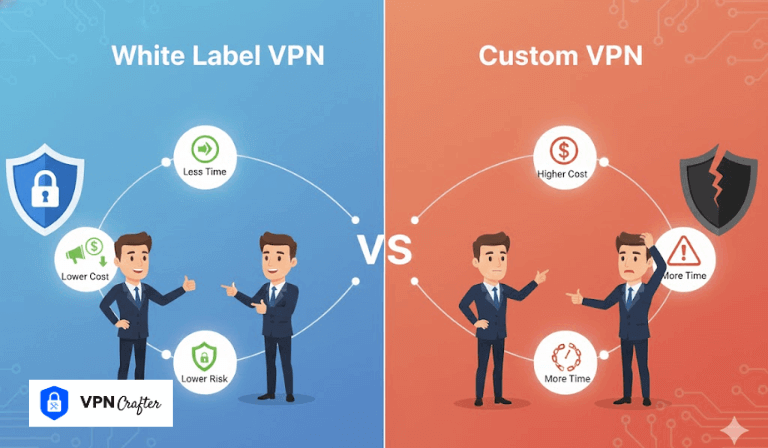
This is where the debate between White Label VPN vs Custom VPN becomes critical. The choice determines how fast you launch, how safely you scale, and how much risk you absorb before revenue arrives.
If you are serious about building a VPN brand that lasts, this decision deserves more than surface-level comparisons. Let’s break it down from the inside.
The Real Problem Founders Underestimate
The VPN market is crowded, but demand keeps growing. Privacy regulations tighten. ISP throttling increases. Remote work expands attack surfaces. The opportunity is real.
The problem is execution.
Many founders assume VPN development is a one-time engineering task. In practice, it is a living system that demands constant updates, security audits, traffic optimization, and compliance work. Miss one layer, and the entire stack becomes fragile.
This is why choosing between a white label VPN for business and a fully custom VPN build is not a technical preference. It is a business survival decision.
What Is a White Label VPN and How It Actually Works
A white label VPN solution allows you to launch your own VPN brand using an existing, battle-tested backend infrastructure. You control the brand, pricing, user relationships, and growth strategy. The provider handles the heavy lifting.
At a technical level, modern white-label VPN development includes:
- Multi-tenant server architecture
- Pre-integrated tunneling protocols like WireGuard and OpenVPN
- AES-256 encryption and secure key management
- Centralized authentication and billing systems
- Scalable load balancing across regions
You are not reselling a generic app. You are deploying your own branded VPN on top of proven infrastructure.
This model exists because infrastructure reliability matters more than novelty in the VPN space.
What It Really Takes to Build a Custom VPN
Building a custom VPN from scratch gives full control, but it comes at a steep cost. Development is only the first milestone.
A real custom VPN requires:
- Backend engineers with networking expertise
- Client apps for iOS, Android, Windows, macOS, and possibly TV
- Server orchestration across multiple regions
- DDoS mitigation and traffic obfuscation
- Ongoing penetration testing and compliance audits
Even experienced teams underestimate the operational overhead. A VPN is not a SaaS dashboard. It is a high-risk security product that attackers actively probe.
This is why many founders abandon custom builds midway or quietly migrate to white label models later.
Cost Comparison: Reality vs Expectations
White Label VPN for Business Costs
A white label VPN for business typically includes:
- One-time setup or onboarding fee
- Monthly infrastructure cost based on usage
- Optional per-platform app customization fees
What matters is predictability. Costs scale with users, not with unknown engineering surprises.
For most businesses, this means reaching the market with a five-figure investment instead of six.
Custom VPN Build Costs
Custom VPN development involves layered expenses:
- Engineering salaries or agency fees
- Cloud infrastructure across multiple regions
- Security audits and compliance work
- Maintenance and incident response
Even a lean build can cross six figures before launch. Ongoing costs increase as traffic grows. There is no cost ceiling.
Time to Market: Speed Wins in VPN
Speed matters more than perfection in privacy products. Trust builds through uptime, not promises.
With a white label VPN solution, brands typically launch within weeks. Apps ship faster because core systems already exist. Marketing starts early. Feedback arrives quickly.
A custom VPN often takes six to twelve months before meaningful traction. During that time, competitors capture mindshare.
In the VPN space, a late entry costs more than an imperfect entry.
Risk Analysis: Where VPN Projects Fail
Risks with White Label VPNs
White label models are not risk-free. The most common concerns include:
- Dependency on provider infrastructure
- Limited control over deep protocol changes
- Shared backend risks if the provider lacks transparency
These risks are manageable when you work with a credible VPN development company that offers isolation, SLAs, and clear data ownership terms.
Risks with Custom VPN Builds
Custom VPNs carry heavier risks:
- Security vulnerabilities from rushed development
- Scaling failures under traffic spikes
- Legal exposure due to logging mistakes or compliance gaps
One misconfigured logging policy can destroy brand trust permanently.
Control, Ownership, and Brand Equity
A frequent misconception is that white label VPNs limit ownership. That is outdated thinking.
Modern white label VPNs allow:
- Full brand ownership
- Independent pricing and monetization
- Control over user communication and support
What you do not control is the low-level packet routing logic. For most businesses, that is a feature, not a limitation.
Custom VPNs offer total control, but only if you can afford to manage it responsibly.
Revenue Models for Your White Label VPN Business
Monetization does not stop at subscriptions.
Strong revenue models for your white label VPN business include:
- Tiered plans based on speed or regions
- B2B VPN for security packages
- Bundled privacy tools
- Affiliate and reseller programs
- Enterprise access licensing
White label models allow faster experimentation with pricing without infrastructure changes.
How to Start a VPN Business Without Burning Capital
If your goal is to start your own VPN brand, focus on distribution first, infrastructure second.
A white label VPN works best when:
- You have an audience or niche
- Speed matters more than deep protocol customization
- You want predictable costs
- You plan to validate demand before a heavy investment
Custom VPNs make sense for large ISPs, governments, or security vendors with dedicated teams.
Everyone else benefits from starting lean.
Decision Framework: Which Path Fits You
Choose a white label VPN for business if:
- You want to launch within weeks
- You value reliability over novelty
- You plan to scale through marketing and partnerships
Choose a custom VPN if:
- You require proprietary protocols
- You operate under unique regulatory constraints
- You have long-term capital and security expertise
There is no universal winner. There is only alignment.
Final Perspective from the Field
Most successful VPN brands did not start with custom infrastructure. They started by proving demand, building trust, and optimizing experience. Infrastructure followed later.
The White Label VPN vs Custom VPN decision is not about shortcuts. It is about sequencing.
Launch smart. Validate fast. Scale responsibly.
If you want to launch your own VPN brand and compete in a trust-driven market, start with systems that let you focus on growth, not firefighting.
That is how durable VPN businesses are built.