
The VPN industry is no longer a niche. Over 1.75 billion people worldwide now use VPN services, and that number keeps climbing every quarter. Businesses, governments, and everyday users are all chasing the same thing: privacy, security, and freedom online.
Here is the part most people miss. The real money is not always in being the biggest VPN brand. It is in owning the product your customers trust every day.
That is exactly where a white label VPN platform changes everything. You get a fully branded, enterprise-grade VPN product without spending 18 months building one from scratch. No protocol engineering. No server infrastructure headaches. No guesswork.
Whether you are exploring how to start a VPN business, comparing the best white label VPN service providers, or trying to understand realistic white label VPN cost before you commit, this guide covers it all with real numbers and zero fluff.
The VPN market is projected to surpass $193 billion by 2030. The businesses building branded VPN products today are positioning themselves for a decade of compounding growth.
What Is a White Label VPN Platform?
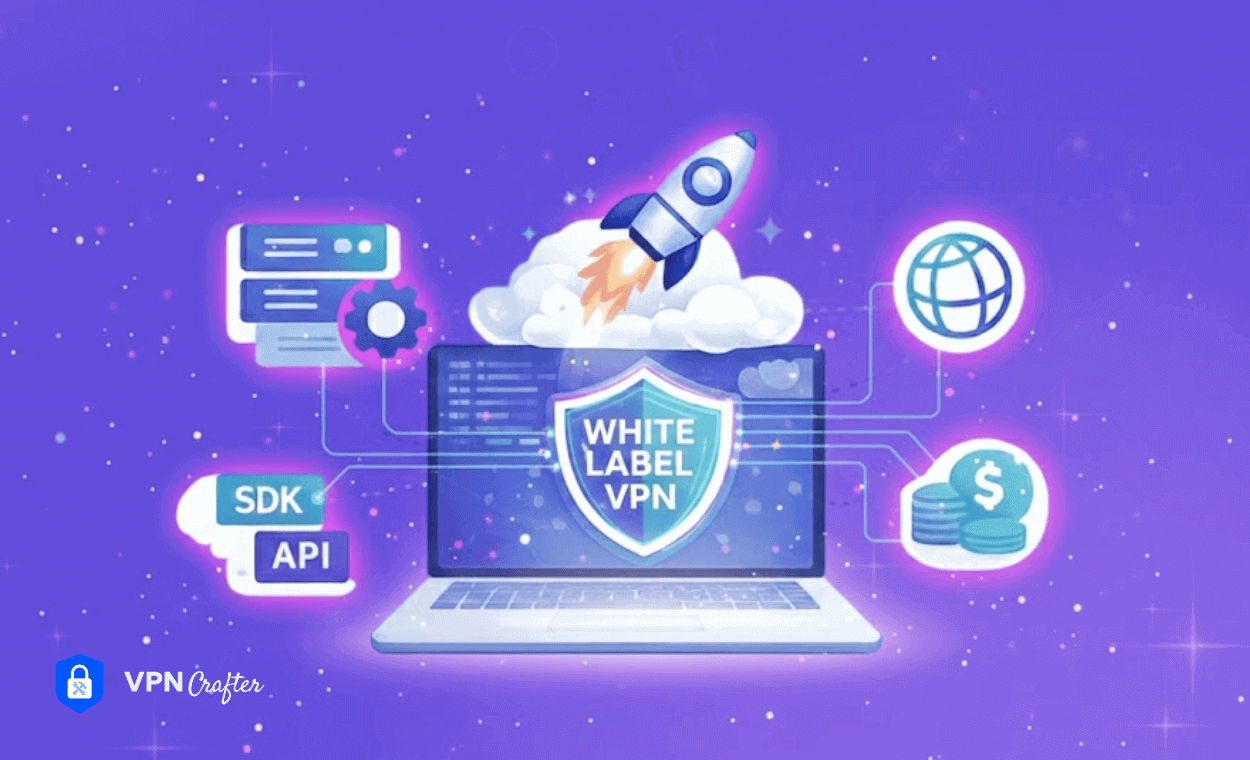
A white label VPN platform is a fully developed, infrastructure-ready VPN solution that you brand, customize, and sell as your own product. The core technology, servers, encryption protocols, and apps are already built. You configure the experience around your brand and take it to market.
Think of it as the difference between building a restaurant from the ground up versus buying a fully equipped kitchen and adding your own menu. The infrastructure already works. You focus on the business side: pricing, positioning, and growing your customer base.
This model works across virtually every type of tech business:
- Cybersecurity firms that want to expand their product portfolio
- ISPs and telecoms adding VPN as a premium service tier
- SaaS founders building privacy-first tools for niche audiences
- Digital agencies creating recurring revenue through reseller arrangements
- Entrepreneurs who want to know how to start a VPN company without a dev team
The white label approach is also the foundation of most VPN reseller solutions in the market. The difference is that a white label platform gives you full brand ownership rather than just a referral or wholesale deal.
1. You Launch a Real Product, Not Just a Reseller Account
Most people who explore VPN reseller solutions eventually hit the same wall. You are selling someone else’s product under a thin affiliate layer. Your customers see the original brand. You have no control over the user experience, pricing, or roadmap.
A white label VPN platform flips that completely. Your customers open an app with your name on it. They read your privacy policy. They contact your support team. The entire experience belongs to your brand.
That distinction matters enormously for customer retention. Research consistently shows that branded products command higher loyalty and lower churn than generic reseller services. When users feel they are using your product rather than borrowing someone else’s, the relationship is fundamentally different.
VPN Crafter is built around this principle. Every client receives a completely custom-branded VPN product with their own app icons, color schemes, onboarding flows, and in-app messaging. Nothing about the experience hints at a third-party platform underneath.
Brand ownership is not cosmetic. It is the single biggest driver of customer lifetime value in the subscription software market.
2. The Economics Are Dramatically Better Than Building From Scratch
Understanding realistic white label VPN cost is the first step toward making a smart business decision. Full custom VPN development is expensive, slow, and risky. Here is what building from scratch actually costs:
| Development Component | Build From Scratch | White Label Platform |
| Android VPN App | $5,000 – $15,000 | Included |
| iOS VPN App | $5,000 – $15,000 | Included |
| Windows + macOS Apps | $4,000 – $10,000 | Included |
| Admin Dashboard | $3,000 – $8,000 | Included |
| Protocol Integration | $2,000 – $6,000 | Included |
| Server Infrastructure Setup | $2,000 – $5,000 | Included |
| Time to Launch | 12 – 18 months | 2 – 8 weeks |
| Total Initial Cost | $21,000 – $59,000+ | Fixed package price |
The numbers tell the story clearly. Full VPN app development cost for a multi-platform product runs well past $40,000 before you even count server infrastructure and ongoing maintenance. A white label platform delivers the same output at a fraction of the cost and a timeline measured in weeks, not months.
VPN Crafter structures its white label VPN cost transparently. No discovery calls designed to inflate scope. No hidden fees that surface after you’ve signed. Just a clear package that includes everything required to launch a market-ready product.
3. Android VPN Development Is the Hardest Part, Already Solved
Ask any developer what the most technically demanding element of a VPN product is, and most will tell you the same thing: Android VPN development. The Android operating system’s VPNService API is powerful but notoriously complex to implement correctly across the fragmented Android device ecosystem.
Getting a kill switch to work reliably across 300-plus Android device variants is genuinely difficult engineering. DNS leak protection across different manufacturer firmware layers adds another level of complexity. IPv6 concealment, split tunneling, and auto-reconnect behavior all behave differently depending on the Android version and device manufacturer.
This is one of the most overlooked costs when entrepreneurs first research how to start a VPN company. The core app is not the hard part. The edge cases, device compatibility, and security hardening are where the real time and money disappear.
VPN Crafter’s Android VPN development uses the native VPNService API with custom protocol layers on top. Every client app ships with:
- Kill switch that works reliably across Samsung, Xiaomi, OnePlus, and stock Android devices
- DNS leak protection tested across IPv4 and IPv6 environments
- WireGuard and OpenVPN support with automatic protocol fallback
- Split tunneling that respects per-app routing rules correctly
- Battery-optimized background service that does not get killed by Android’s Doze mode
All of that is built, tested, and production-ready before your project even begins. That is the practical value of a mature white label VPN platform.
4. A White Label VPN Platform Supports Every Path to Revenue
One of the most compelling aspects of choosing a white label VPN platform is the flexibility it creates around your business model. You are not locked into a single monetization path.
Here are the revenue structures that work well on top of a white-label foundation:
Direct Consumer Subscriptions
The most straightforward model. You set monthly and annual pricing tiers, acquire users through content marketing and paid channels, and collect recurring revenue. A base of 1,000 active subscribers at $9.99 per month generates $119,880 annually. Scale that to 10,000 subscribers and you have a serious business by any standard.
B2B and Enterprise Licensing
Companies pay significantly more for VPN access when it is packaged for their workforce. A single enterprise deal covering 200 employees at $8 per seat per month is worth $19,200 annually from a single client. White label platforms with multi-tenant admin panels make this model operationally simple.
Reseller and Partner Networks
If you want to build a VPN reseller solution network on top of your own branded product, white label platforms support this too. VPN Crafter’s admin panel includes reseller management tools that let you create sub-accounts for partner businesses, turning your VPN product into a wholesale offering as well.
Niche Vertical Packaging
Healthcare organizations, financial services firms, and remote-first companies all have specific VPN requirements around compliance, logging, and access controls. A white label platform lets you configure and brand these specifics rather than selling a generic one-size-fits-all product.
The best VPN businesses in 2026 are not the ones with the most users. They are the ones with the most loyal users in a clearly defined niche. White label gives you the foundation to serve that niche precisely.
5. You Get to Market Before Your Competition
Speed matters more in the VPN market right now than it has at any point in the past decade. The market is growing fast, but the window for establishing brand authority in specific niches is closing.
Businesses that understand how to start a VPN business using a white label platform are launching in weeks. Their competitors who chose to build from scratch are still in development 12 months later, burning through cash reserves with no revenue to show for it.
VPN Crafter’s typical timeline from kickoff to live product runs two to eight weeks depending on the complexity of customization required. That includes:
- Brand configuration, UI customization, and app store asset creation
- Admin panel setup with your subscription tiers and payment gateway integration
- Server deployment across your chosen geographic locations
- QA testing across Android, iOS, Windows, and macOS
- App store submission support for both Google Play and Apple App Store
- Go-live support and post-launch monitoring for the first 30 days
Compare that to the 12 to 18 months required to build the same product from scratch, and the white label VPN platform decision becomes straightforward for any business that takes time-to-market seriously.
What to Look for When Choosing a White Label VPN Platform
Not all providers in the best white label VPN service providers category offer the same depth. Choosing the wrong one creates problems that are expensive to fix later. Here is what genuinely matters:
- WireGuard is the 2026 standard for speed. OpenVPN remains the gold standard for security. Any serious platform supports both.Protocol support:
- Your platform’s logging policy becomes your brand’s privacy promise. Verify it independently.Zero-logs architecture:
- A basic dashboard is not enough. You need user management, subscription billing, real-time analytics, and reseller tools in one place.Admin panel depth:
- Android, iOS, Windows, and macOS as a minimum. Browser extensions add reach.Cross-platform coverage:
- White label VPN cost should be clear upfront. Avoid providers whose pricing only appears after a sales call.Transparent pricing:
- Launching is the beginning. Ongoing maintenance, security patches, and feature updates determine long-term product quality.Post-launch support:
Reviewing a White Label VPN Guide from your shortlisted providers is one of the best ways to assess their transparency and technical depth before committing. Providers who publish detailed documentation are generally more reliable than those who keep everything behind a sales process.
How VPN Crafter Approaches White Label VPN Development
VPN Crafter was built around a simple observation: most businesses that want to launch a VPN product do not need a dev team. They need a trusted technical partner who has already solved the hard problems.
The platform covers the full stack. Android VPN development, iOS builds, desktop apps, admin infrastructure, and server deployment are all handled under a single engagement. Clients do not coordinate between a design agency, a development shop, and a server hosting provider. Everything comes from one team with one accountability structure.
VPN Crafter’s protocol layer supports WireGuard for performance-first use cases and OpenVPN for deployments where security certification matters. IKEv2/IPSec is available for mobile-focused products where connection stability across network changes is a priority.
Every product that ships through VPN Crafter includes AES-256 encryption, a verified zero-logs policy, and a kill switch that actually works across device variants. These are not checkboxes. They are the baseline security architecture your brand’s reputation depends on.
For businesses trying to understand how to start a VPN company without a technical background, VPN Crafter also provides strategic guidance on pricing, positioning, and go-to-market execution. The goal is not just to hand over a finished app. The goal is to help you build something worth keeping.
VPN Crafter’s clients do not just get a white label product. They get the ongoing technical partnership that keeps the product competitive as the market evolves.
The 2026 VPN Market: Why This Is the Right Moment
The global VPN market is expected to reach $88.96 billion in 2026, growing at a 22.04% CAGR through 2034. By 2035, projections point toward $481 billion. These figures reflect a structural shift, not a temporary trend.
Three forces are sustaining this growth well beyond the remote work boom of earlier years:
- Data breaches reached record levels in 2024, affecting more than 1 billion people in the first six months alone, creating lasting demand for privacy tools
- Government surveillance programs are expanding in every region, driving VPN adoption even among users who were previously indifferent to privacy concerns
- The mobile VPN segment now accounts for 38% of total VPN revenue, creating strong demand for quality Android and iOS VPN products
The SMB VPN segment is growing at 18.7% CAGR through 2030. Cloud VPN solutions are expanding even faster, with the segment projected to reach $15.63 billion in 2026 alone. These numbers confirm that businesses entering the market now with a strong branded product are entering at the right time.
Frequently Asked Questions
What is a white label VPN platform exactly?
A white label VPN platform is a fully built VPN product that you brand and sell as your own. The technology, servers, and apps are pre-developed. You apply your brand identity and take the product to market without building the underlying infrastructure yourself.
How long does it take to launch a white label VPN?
Most white label VPN platforms, including VPN Crafter, can take you from project kickoff to a live, branded product in two to eight weeks. This includes app customization, server deployment, admin panel configuration, and app store submission support.
What does a white label VPN cost in 2026?
White label VPN cost varies by provider and scope. Basic single-platform packages start around $3,500. Full multi-platform enterprise solutions with custom admin panels and dedicated infrastructure range from $15,000 to $40,000 or more. VPN Crafter provides transparent project pricing without hidden fees. Read our dedicated White Label VPN Cost guide for a full breakdown.
Is Android VPN development included in white label packages?
With VPN Crafter, yes. Android VPN development using the native VPNService API is included in all white label packages. This covers kill switch implementation, DNS leak protection, WireGuard and OpenVPN protocol support, and compatibility testing across major Android device variants.
Can I build a reseller network on top of a white label VPN platform?
Yes. VPN Crafter’s admin panel includes reseller management tools that let you create sub-accounts for partner businesses. This turns your branded VPN product into a wholesale offering, giving you a second revenue tier on top of your direct consumer subscriptions. See our VPN reseller solution guide for details on how this model works in practice.
What protocols should a white label VPN platform support?
WireGuard is the leading protocol in 2026 for performance and efficiency. OpenVPN remains the trusted standard for security-critical deployments. IKEv2/IPSec is preferred for mobile use cases where network switching stability matters. Any serious white label platform supports at least two of these three.
Do I need technical knowledge to launch a white label VPN?
No. That is the core value proposition of a white label platform. VPN Crafter handles the full technical setup, configuration, and deployment. You need clarity on your target market, your brand identity, and your pricing strategy. The engineering is already done.
The Fastest Path to Owning a VPN Product Starts Here
Launching a privacy business in 2026 does not require a 15-person engineering team or an 18-month development cycle. The infrastructure already exists. The protocols are proven. The hard technical work is solved.
What separates the businesses that succeed is the decision to move early, move with quality, and own their brand from day one. A white label VPN platform gives you exactly that foundation.
VPN Crafter has helped businesses across cybersecurity, telecom, SaaS, and digital media launch their own branded VPN products. Every engagement starts with a clear scope, transparent pricing, and a realistic timeline. No inflated proposals. No months of back-and-forth before a single line of code is written.
The market is growing. The technology is ready. The only variable left is whether you move before your competitors do.
Ready to launch your own white label VPN platform?
VPN Crafter offers a free consultation to walk through your requirements, share a realistic timeline, and give you honest pricing with no obligations.
Talk to the VPN Crafter team today at vpncrafter.com