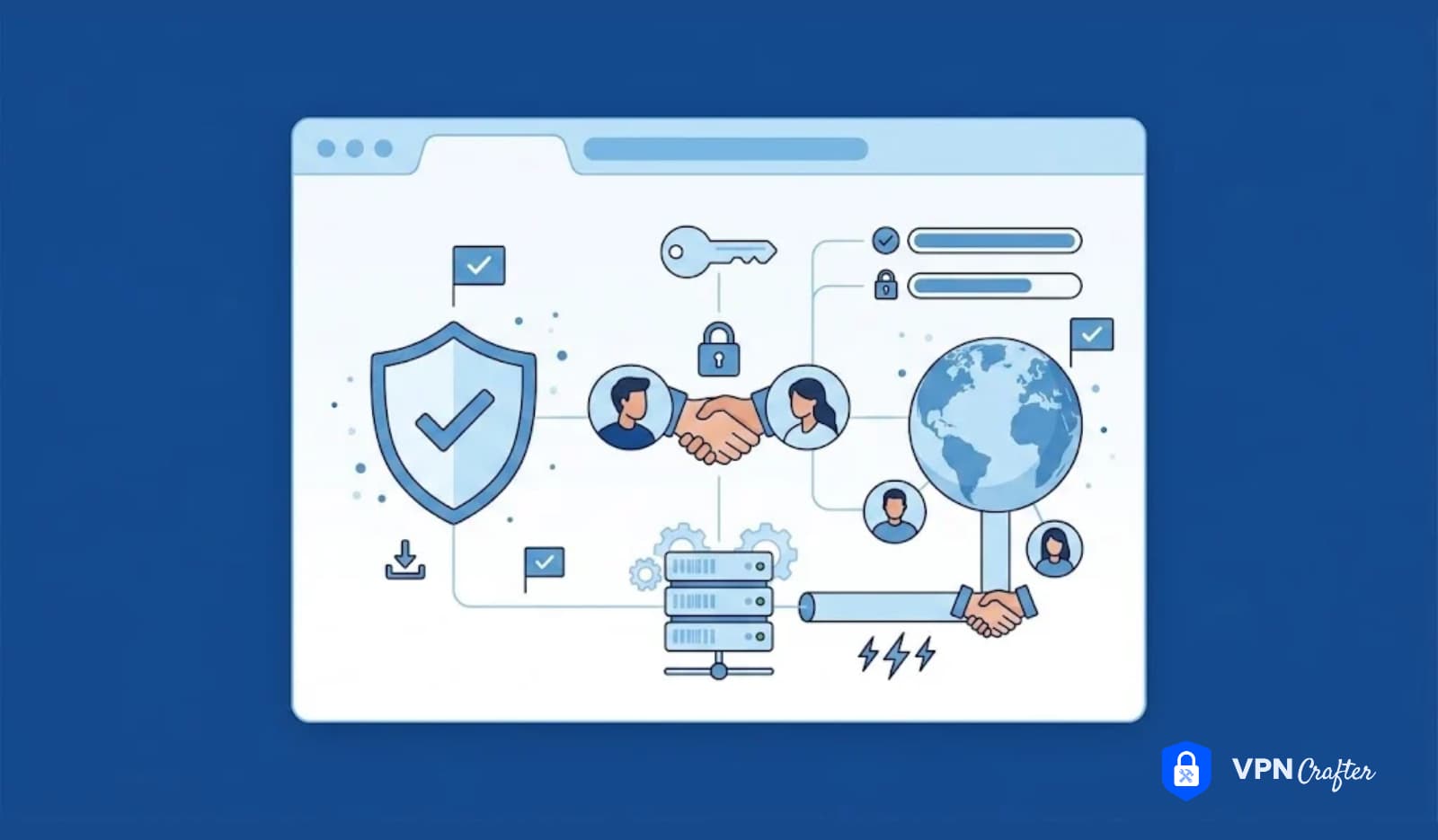
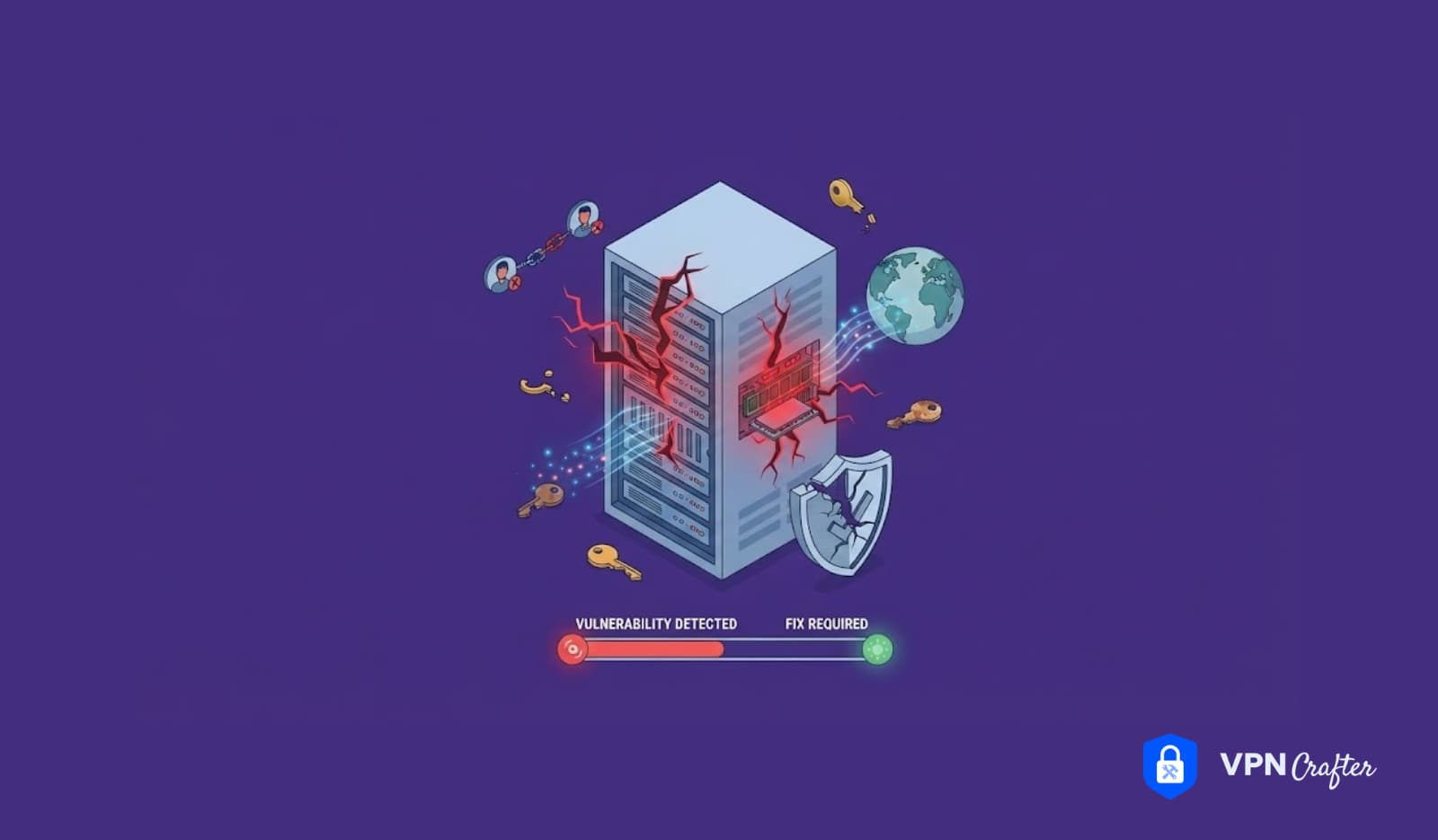

A VPN business sells trust before it sells anything else. Customers hand over their traffic on the promise that it disappears into an encrypted tunnel and comes out the other side untouched. That promise only holds if the server on the other end is as solid as the marketing page claims, and for a large share of providers, it is not.
Common VPN server vulnerabilities rarely start with the encryption itself. Modern ciphers are mathematically sound, and breaking AES-256 or ChaCha20 directly is not a realistic attack for anyone outside a nation-state budget. Instead, the real damage comes from what surrounds the cipher: a config file with a leftover debug flag, a management port left open to the internet, a certificate that never got rotated, or a login page with no rate limiting. These are the gaps that show up in breach reports year after year, and they are entirely preventable.
We build VPN infrastructure at VPN Crafter, so this list is not theoretical. Every vulnerability below is one we have found during our own audits, patched on client deployments, or watched play out in a public incident. If you run a VPN service, resell one under a white-label agreement, or are building your own from scratch, this guide gives you the full map of where things actually break.
The most common VPN server vulnerabilities are outdated or unpatched VPN software, misconfigured firewalls and exposed management ports, weak or password-only authentication, outdated protocols such as PPTP and L2TP with pre-shared keys, poor key and certificate management, insufficient logging and monitoring, DNS and IP leaks, and unprotected APIs used for provisioning. Nearly every major VPN breach on record traces back to one of these categories rather than a flaw in the encryption algorithm itself.
Table of Contents
- Why VPN Server Vulnerabilities Deserve Special Attention
- The 15 Most Common VPN Server Vulnerabilities
- How Hackers Actually Attack VPN Servers
- VPN Server Vulnerability Assessment: A Step-by-Step Framework
- Protocol-Specific Vulnerabilities: SSTP, PPTP, L2TP, OpenVPN, WireGuard, IKEv2
- Expert Insights From the VPN Crafter Team
- Statistics and Data on VPN Server Attacks
- Common Mistakes VPN Businesses Make
- Best Practices for Fixing and Preventing VPN Server Vulnerabilities
- Frequently Asked Questions
- Conclusion
- Key Takeaways
Why VPN Server Vulnerabilities Deserve Special Attention
A VPN server is a strange kind of target. Unlike a normal web server, it is designed to be reachable from anywhere on earth, it terminates encrypted traffic that customers assume is private, and it often sits at the edge of a larger network with elevated trust. That combination makes it more attractive to attackers than almost any other piece of infrastructure a business runs.
Three groups feel the consequences of a poorly secured VPN server differently, and it is worth naming all three before diving into the list.
VPN service providers risk their entire brand on a single incident. A breach at a company selling privacy is a different kind of story than a breach at a retailer, because the core product has failed, not just a side feature.
White-label operators and resellers inherit whatever security posture the underlying infrastructure has, whether they know it or not. Anyone evaluating a White Label VPN Development partner needs to ask hard questions about server hardening before launch, because the reseller’s name goes on the breach even when someone else built the backend.
VPN developers building a product from the ground up face the steepest learning curve, since a single misconfigured firewall rule or an authentication shortcut taken to hit a launch date can undo months of otherwise solid engineering.
The good news is that almost none of the vulnerabilities below require exotic defenses. They require discipline, a checklist, and a habit of treating the server as hostile territory by default.

The 15 Most Common VPN Server Vulnerabilities
1. Outdated and Unpatched VPN Software
This is, without question, the single largest category of real-world VPN breaches. When a vendor discloses a CVE, attackers start scanning the entire internet for vulnerable servers within hours, often before most administrators have even read the advisory.
Pulse Secure’s CVE-2019-11510 allowed unauthenticated attackers to read arbitrary files, including session data that let them log in without a password. Fortinet’s CVE-2018-13379 leaked plaintext credentials from FortiOS SSL VPN and was still being actively exploited years after a patch existed. In 2024, Ivanti Connect Secure suffered a chained pair of vulnerabilities (CVE-2023-46805 and CVE-2024-21887) that gave attackers full remote code execution on gateways used by government agencies worldwide.
The fix: subscribe to vendor security advisories for whatever VPN software you run, patch critical CVEs within 24 to 72 hours, and never assume “nobody will target us” is a defense. Automated scanners do not discriminate by company size.
2. Misconfigured Firewalls and Exposed Management Ports
A VPN server should answer on exactly one port from the public internet. In practice, audits regularly find SSH, web-based admin panels, database ports, and monitoring dashboards all reachable from anywhere.
This exact mistake caused NordVPN’s 2018 server incident in Finland, where an insecure remote management system, not the VPN software itself, gave an attacker access to the server. The encryption held. The management port did not.
The fix: apply default-deny firewall rules, allow only the VPN port inbound from the public internet, and put every management interface behind a separate bastion host or VPN-only network.
3. Weak or Password-Only Authentication
Password-based logins invite brute force and credential stuffing, and VPN gateways are a favorite target for both. The 2021 Colonial Pipeline ransomware attack traced back to a single compromised VPN password on an account with no multi-factor authentication.
The fix: require certificate or key-based authentication wherever the protocol supports it, and layer multi-factor authentication on top for every human login. Secure VPN authentication should never rely on a password as the only barrier.
4. Outdated Protocols Still Running in Production
Legacy protocols carry known, unfixable weaknesses. PPTP’s MS-CHAPv2 authentication has been broken for years and should never appear on a production VPN server. L2TP with pre-shared keys is easy to misconfigure and difficult to secure properly.
SSTP deserves specific mention here, since it appears in the probable title for this exact topic. SSTP wraps VPN traffic inside an SSL/TLS tunnel over port 443, which makes it useful for bypassing restrictive firewalls, and Microsoft’s implementation has held up reasonably well over time. Its main weakness is not a cryptographic flaw but exposure: because it depends on the TLS stack of the underlying server, any vulnerability in that TLS implementation, such as a Heartbleed-style flaw, extends directly to SSTP. It is also proprietary to Windows, which limits how thoroughly the wider security community has been able to audit it compared to open-source alternatives.
The fix: retire PPTP entirely, isolate L2TP on separate servers with separate keys if legacy client support is unavoidable, and keep the TLS stack behind SSTP patched as aggressively as the VPN software itself.
5. Weak or Deprecated Encryption Ciphers
Running a modern protocol does not guarantee modern encryption. Older OpenVPN configurations sometimes still permit BF-CBC or 3DES if cipher negotiation is left open, and both have practical attacks against them on current hardware.
The fix: hard-code strong ciphers such as AES-256-GCM or ChaCha20-Poly1305, disable negotiation fallbacks entirely, and require TLS 1.2 as a floor with TLS 1.3 preferred for the control channel. Our breakdown of how VPN encryption works covers the mechanics behind these choices in more depth.
6. Poor Key and Certificate Management
Long-lived keys accumulate risk quietly. A key that leaked from a backup two years ago is still valid today if nobody rotated it. Certificate authorities stored on the VPN server itself are an even bigger liability, since compromising the server hands an attacker the ability to mint new trusted certificates.
The fix: rotate peer keys and certificates on a schedule measured in months, store the certificate authority’s private key offline or in a hardware security module, and maintain a certificate revocation list so a compromised device can be cut off immediately.
7. Unprotected or Poorly Secured APIs
Modern VPN services run on more than just the tunnel. Provisioning APIs issue client configs, billing systems verify subscriptions, and management dashboards control server fleets. An exposed or weakly authenticated API can let an attacker generate valid credentials for the entire network without touching a single VPN server directly.
The fix: treat the API layer with at least the same rigor as the servers, enforce strong authentication and rate limiting on every endpoint, and audit it separately from the infrastructure it manages. Teams considering VPN Development from scratch should design this layer with security requirements from day one, not bolt it on after launch.
8. Insufficient Logging and Security Monitoring
Many VPN server breaches go unnoticed for weeks or months, simply because nobody was watching. Without logs of authentication attempts, connection patterns, or configuration changes, an operator has no way to detect an intrusion until the damage is already public.
The fix: centralize authentication and connection logs on a separate, hardened system so an attacker who compromises the VPN server cannot erase their tracks, and set alert thresholds for unusual patterns such as repeated failed logins or a spike in handshake attempts from a single IP range.
9. Missing Intrusion Detection and Rate Limiting
Brute force attempts and exploit scans against VPN servers run constantly and automatically, whether or not anyone is actively targeting your business specifically. A server with no rate limiting on its login attempts will eventually get brute-forced, given enough time and a weak enough credential somewhere in the system.
The fix: deploy tools like Fail2ban or CrowdSec to block repeat offenders automatically, and add a network intrusion detection layer such as Suricata in front of the VPN server to catch exploit signatures before they reach the daemon.
10. DNS and IP Address Leaks
A DNS leak defeats the purpose of a VPN even while the tunnel is technically active. If client DNS queries resolve through the user’s ISP instead of through the tunnel, an observer can still see every domain the user visits. IPv6 leaks work the same way: a connection tunneled perfectly over IPv4 can leak entirely over IPv6 if that traffic is not also routed through the VPN.
The fix: force DNS through the tunnel using a private resolver, block outbound port 53 to anything else, and either tunnel IPv6 correctly or disable it on the client. Publishers helping customers understand this issue should also read our guide on how to detect a VPN data leak, since leak testing should be part of every provider’s own QA process, not just something end users discover on their own.
11. Session Hijacking and Weak Session Management
Sessions that never expire, or that reuse the same session token across reconnects, give an attacker who intercepts a token a long window to impersonate a legitimate user. This risk grows when a VPN server sits behind a poorly configured load balancer that does not properly isolate sessions.
The fix: set reasonable session timeouts, rotate session tokens on reconnect, and ensure load-balanced infrastructure does not leak session state between servers.
12. Privilege Escalation Through the VPN Daemon
Several VPN server vulnerabilities have allowed attackers to escalate from a low-privilege foothold to full root access on the underlying machine, once they gained even limited access to the VPN process. This happens most often when the daemon runs with unnecessary root privileges by default.
The fix: run the VPN process as an unprivileged user wherever the software supports it, and apply mandatory access control frameworks such as AppArmor or SELinux to contain what the process can touch even if it is compromised.
13. DDoS Exposure on VPN Gateways
A VPN server with a single public IP and no upstream protection is an easy target for volumetric attacks. Beyond simple denial of service, some DDoS attacks against VPN infrastructure are used as cover for a simultaneous intrusion attempt, since security teams are distracted by the outage.
The fix: use upstream DDoS scrubbing from your hosting or network provider, keep capacity headroom above normal peak load, and choose protocols like WireGuard whose handshake can cheaply reject unverified connection attempts under load. Our guide on how to prevent DDoS attacks covers this in more technical depth for teams building their own mitigation layer.
14. Shared Infrastructure Without Proper Isolation
Providers running multiple customers or brands on shared servers, a common setup for reseller and white-label models, face a specific risk: a vulnerability or misconfiguration affecting one tenant can expose others on the same hardware if isolation is weak.
The fix: understand the real isolation model of your infrastructure before signing a reseller or white-label agreement. Our comparison of a dedicated VPN server vs shared VPN server explains exactly what changes from a security standpoint between the two models, and it is worth reviewing before choosing which one to build a business on.
15. Physical and Data Center Risks
Servers sitting in a rented data center inherit whatever physical and out-of-band security that facility has. A poorly secured remote management card, an out-of-band KVM interface, or lax physical access controls can all bypass every software protection you have put in place.
The fix: ask data center partners specifically about out-of-band management access, who holds credentials to it, and whether it is reachable from the public internet. Run servers from RAM with no persistent storage where possible, so that physical access to the hardware yields nothing of value.
How Hackers Actually Attack VPN Servers
Understanding the attack chain makes the fifteen vulnerabilities above easier to prioritize. Most real incidents follow one of a small number of patterns.
Pattern 1: Scan, exploit, persist. Attackers run automated scanners across the internet looking for VPN servers matching a known vulnerable version. Once found, they exploit the CVE, often chaining it with a second flaw to gain full control, and then install a backdoor to maintain access even after the original vulnerability is patched.
Pattern 2: Credential attack, lateral movement. Rather than exploiting software, attackers brute-force or purchase leaked credentials, log in as a legitimate user, and then move laterally into whatever network the VPN grants access to. This pattern does not require any technical vulnerability at all, just weak authentication.
Pattern 3: Supply chain and provisioning compromise. Instead of attacking VPN servers directly, attackers target the API or system that issues credentials to those servers. A single compromise here can generate valid access across an entire fleet without triggering any server-side alert.
Pattern 4: Man-in-the-middle via rogue infrastructure. Attackers set up fake VPN servers, often distributed through malicious apps or compromised update mechanisms, to intercept traffic that users believe is encrypted end to end. This pattern targets end users more than infrastructure providers, but it damages the reputation of the entire industry when it surfaces publicly.
The Anatomy of a VPN Breach
- Reconnaissance — automated scans identify software version, open ports, and exposed services.
- Exploitation — a known CVE, weak credential, or misconfiguration provides initial access.
- Escalation — privilege escalation or lateral movement expands the foothold.
- Persistence — a backdoor or new credential ensures access survives a patch.
- Exfiltration or abuse — data theft, further network intrusion, or resale of access on criminal marketplaces.
VPN Server Vulnerability Assessment: A Step-by-Step Framework
A structured assessment turns this list from theory into an actual audit you can run quarterly.
Step 1: Inventory every server and its software version. You cannot patch what you do not know exists. Include every region, every protocol variant, and every legacy server still technically in production.
Step 2: Run an external port scan against every server. Confirm that only the intended VPN port answers from the public internet. Anything else is an immediate finding.
Step 3: Review authentication configuration. Confirm certificate or key-based authentication is enforced, MFA is active for human accounts, and no fallback to password-only login exists anywhere in the stack.
Step 4: Audit cipher and protocol configuration. Check for negotiation fallbacks to weak ciphers, confirm TLS versions, and flag any server still running PPTP or L2TP with pre-shared keys.
Step 5: Test for DNS and IP leaks. Connect through each server and verify with independent leak-testing tools that DNS and IPv6 traffic route correctly through the tunnel.
Step 6: Review logging and alerting. Confirm logs are shipped off-server in real time and that alert thresholds exist for brute force patterns, unusual geographic access, and configuration changes.
Step 7: Check key and certificate expiry and rotation history. Flag anything approaching expiry and anything that has not rotated within your policy window.
Step 8: Test the provisioning and billing APIs separately. Run authenticated and unauthenticated requests against every endpoint to confirm access controls behave as expected.
Step 9: Commission an external penetration test annually. Internal reviews catch drift; independent testers catch blind spots internal teams miss by habit.
Step 10: Document findings and set remediation deadlines. A finding without an owner and a date rarely gets fixed before it matters.
Protocol-Specific Vulnerabilities: SSTP, PPTP, L2TP, OpenVPN, WireGuard, IKEv2
| Protocol | Primary Vulnerability Class | Current Recommendation |
|---|---|---|
| PPTP | Broken MS-CHAPv2 authentication, trivially crackable | Retire completely |
| L2TP/IPsec (PSK) | Weak pre-shared key handling, difficult to configure securely | Avoid; use certificate-based IPsec instead |
| SSTP | Inherits TLS stack vulnerabilities; proprietary, limited independent audit | Acceptable as a firewall-bypass option if the TLS stack is kept current |
| OpenVPN | Large codebase and dependency surface (OpenSSL); cipher downgrade risk if misconfigured | Secure with explicit strong ciphers, TLS 1.2+, and regular patching |
| IKEv2/IPsec | Implementation quality varies widely; commercial appliances have produced major CVEs | Secure on well-maintained implementations; verify vendor patch history |
| WireGuard | Minimal historical CVEs; small, formally reviewed codebase | Preferred default for new deployments |
A short read on the two protocols most relevant to this topic follows.
SSTP’s real-world risk profile is lower than PPTP or unpatched L2TP but higher than WireGuard in terms of independent scrutiny. Because it tunnels over standard TLS on port 443, it is genuinely useful in restrictive network environments, and Microsoft has maintained it reasonably well. The practical vulnerability is less about SSTP itself and more about operators forgetting that its security is only as strong as the underlying Windows Server TLS configuration. A server running SSTP on an outdated TLS stack inherits every weakness in that stack.
WireGuard’s advantage comes from its size. At roughly 4,000 lines of code, compared to well over 100,000 for OpenVPN and its dependencies, WireGuard gives auditors and attackers alike far less surface to examine. Its protocol has undergone formal verification using the Tamarin prover, and it offers no cipher negotiation at all, which removes an entire category of downgrade attacks by design. For a deeper technical comparison, our article on WireGuard vs OpenVPN walks through the tradeoffs in full.
Expert Insights From the VPN Crafter Team
A few patterns from our own audits that rarely make it into generic vulnerability lists.
The provisioning system is usually the weakest link, not the VPN server. Everyone hardens the VPN daemon. Far fewer teams apply the same scrutiny to the API that hands out client configurations. In one audit we ran for a reseller client, the VPN servers themselves were well configured, but the provisioning API accepted requests without rate limiting, which meant an attacker could have enumerated valid subscription tokens through brute force alone.
White-label operators frequently inherit security debt they never see. We have reviewed white-label platforms where the customer-facing app was polished and well-designed, while the backend still allowed weak cipher negotiation and had no certificate rotation policy at all. Anyone building a business through VPN reseller program or white-label channels should request a security summary from the infrastructure provider before launch, not after an incident forces the question.
Reseller and affiliate growth strategies should not outpace security maturity. Teams focused on VPN affiliate marketing or scaling a VPN reseller model sometimes prioritize growth features over infrastructure review. A fast-growing customer base sitting on unpatched servers is a liability that compounds, not a business asset.
Monetization decisions can quietly introduce vulnerabilities. Teams exploring different VPN Monetization Models, particularly free tiers funded by ad SDKs or data partnerships, need to audit those third-party SDKs as carefully as the VPN daemon itself. A data-collecting SDK bundled into a free app is not a traditional “server vulnerability,” but it produces the same outcome: user data leaving the system through a channel nobody adequately reviewed. Our broader look at how VPN companies make money touches on why this tension exists across the industry.
Choosing between reseller and white-label models has direct security implications. The decision covered in our guide on white label vs reseller is not just a business model choice. Reseller models typically mean the underlying infrastructure security is entirely out of your hands, for better or worse, while white-label models give you more control and more responsibility simultaneously. Know which one you are signing up for.
Statistics and Data on VPN Server Attacks
- 56% of organizations experienced at least one VPN-related cyberattack in the previous year, according to Zscaler’s ThreatLabz VPN Risk Report (2024), with over 90% of respondents expressing concern about VPNs as an attack vector.
- Breaches beginning with vulnerability exploitation rose approximately 180% year-over-year, per Verizon’s 2024 Data Breach Investigations Report, which specifically called out edge devices and VPN gateways as a growing point of entry.
- CVE-2018-13379 in FortiOS was still being actively exploited years after a patch was available, according to multiple security vendor reports, illustrating how slowly patch management moves across the industry even for well-publicized flaws.
- The NSA and CISA jointly published hardening guidance for remote access VPNs in 2021, explicitly noting that VPN servers are attractive targets because they are internet-facing and hold credentials that unlock internal networks.
- CISA’s Known Exploited Vulnerabilities catalog lists dozens of entries for VPN and remote access gateway products from Fortinet, Ivanti/Pulse Secure, Cisco, Citrix, and Palo Alto Networks, confirming that this is a sustained, industry-wide pattern rather than isolated incidents.
- Compromised remote access credentials, including VPN logins without MFA, consistently rank among the top initial access methods for ransomware, according to incident response analysis published by firms including Coveware and Sophos.
- WireGuard’s protocol has undergone formal cryptographic verification using the Tamarin prover, alongside multiple independent code audits, which supports its reputation as the protocol with the smallest practical attack surface among current options.
Common Mistakes VPN Businesses Make
Assuming the vendor’s default configuration is secure. Commercial VPN appliances have produced some of the most severe CVEs on record. Default settings are a starting point, not a finished security posture.
Treating the VPN server as the entire attack surface. Provisioning APIs, billing systems, and management dashboards are just as capable of leaking data or credentials.
Delaying patches to avoid downtime. A short, planned maintenance window is far cheaper than an unplanned incident response after a known CVE gets exploited.
Running password-only authentication on any production VPN account. This single practice caused the Colonial Pipeline breach and remains disturbingly common.
Never testing what a deactivated or compromised server actually exposes. Teams rarely simulate a worst-case scenario until it becomes a real one.
Ignoring the security posture of a white-label or reseller partner. The business relationship does not transfer the responsibility. Customers will still blame the brand they signed up with.
Skipping independent penetration testing. Internal reviews are useful but predictable; they tend to miss the same blind spots repeatedly because the same team designed both the system and the test.
Best Practices for Fixing and Preventing VPN Server Vulnerabilities
- Patch on a fixed schedule, faster for critical CVEs. Aim for 24 to 72 hours on anything with active exploitation reported.
- Default-deny every firewall and expose only the VPN port publicly.
- Require certificate or key-based authentication with MFA layered on top for every human login.
- Retire PPTP and pre-shared-key L2TP entirely; migrate legacy clients to modern alternatives on isolated infrastructure if unavoidable.
- Hard-code strong ciphers and disable negotiation fallbacks across every protocol in use.
- Rotate keys and certificates on a defined schedule, and keep the certificate authority’s private key offline.
- Secure the provisioning and billing APIs with the same rigor as the VPN servers themselves.
- Centralize logs off-server and set alerts for brute force patterns and unusual access.
- Deploy rate limiting and intrusion detection on every public-facing VPN endpoint.
- Test for DNS and IPv6 leaks on every server, on every protocol, after every configuration change.
- Run an internal vulnerability assessment quarterly and an external penetration test annually.
- Document a written incident response plan and rehearse it before an actual breach forces improvisation.
Frequently Asked Questions
What are the most common VPN server vulnerabilities?
The most common are outdated or unpatched VPN software, misconfigured firewalls with exposed management ports, weak or password-only authentication, outdated protocols like PPTP and L2TP with pre-shared keys, poor key and certificate management, insufficient monitoring, DNS and IP leaks, and unprotected provisioning APIs.
How do hackers attack VPN servers?
Attackers typically scan for servers running known vulnerable software versions and exploit published CVEs, brute-force or purchase weak credentials to log in as legitimate users, target provisioning APIs to generate unauthorized access, or set up rogue VPN infrastructure to intercept traffic through man-in-the-middle attacks.
How do I identify vulnerabilities in my VPN server?
Run an external port scan to confirm only the VPN port is publicly reachable, audit authentication settings for MFA and certificate use, check cipher and protocol configuration for weak fallbacks, test for DNS and IPv6 leaks, review logging coverage, and commission an independent penetration test at least annually.
How do I secure a VPN server against common attacks?
Patch the VPN software and operating system on a fixed schedule, restrict the firewall to the VPN port only, require certificate-based authentication with MFA, disable weak ciphers and legacy protocols, rotate keys regularly, and centralize logs off the server so an attacker cannot erase evidence of an intrusion.
Is SSTP a secure VPN protocol?
SSTP is reasonably secure because it tunnels through standard TLS, but its security depends entirely on the underlying TLS implementation staying patched. It is proprietary to Windows and has received less independent security auditing than open protocols like WireGuard or OpenVPN, so it works best as a firewall-bypass option rather than a primary protocol.
What is the most secure VPN protocol currently available?
WireGuard is generally considered the most secure and easiest to deploy correctly, due to its small codebase, formally verified protocol, and lack of cipher negotiation. OpenVPN and IKEv2/IPsec can be equally secure when configured carefully, but they involve more configuration decisions that can go wrong.
Can a VPN server be hacked even with strong encryption?
Yes. Strong encryption protects data in transit, but it does not protect against an outdated VPN daemon with a remote code execution flaw, a weak password, an exposed management port, or a misconfigured firewall. Nearly every major VPN breach on record involved a weakness outside the encryption itself.
How often should a VPN server be patched?
Operating system and VPN software patches should be applied on a regular schedule, ideally weekly for routine updates. Critical vulnerabilities with active exploitation in the wild should be patched within 24 to 72 hours of disclosure, since automated scanning for known CVEs typically begins within hours.
What is VPN server hardening?
VPN server hardening is the process of reducing a server’s attack surface by removing unnecessary services, restricting firewall rules to essential ports, enforcing strong authentication, applying mandatory access controls, running the VPN process with minimal privileges, and keeping all software current with security patches.
Do free VPNs have more server vulnerabilities than paid VPNs?
Free VPN services often operate with less investment in server hardening, patch management, and monitoring, since their revenue model does not typically fund that level of infrastructure. Some free VPNs have also been documented bundling data-collecting SDKs, which introduces a data exposure risk separate from traditional server vulnerabilities.
What is the difference between a VPN server vulnerability and a VPN protocol vulnerability?
A server vulnerability relates to the specific machine’s configuration, software version, and operational practices, such as an unpatched service or an exposed port. A protocol vulnerability is a flaw in the underlying VPN technology itself, such as PPTP’s broken authentication, which affects every server running that protocol regardless of configuration.
How do VPN businesses detect a data leak from their servers?
Detection typically combines automated DNS and IP leak testing tools run against every server and protocol combination, centralized log monitoring for unusual access patterns, and periodic third-party audits. Our detailed walkthrough of how to detect a VPN data leak covers the specific tools and tests used in practice.
Should VPN resellers worry about server vulnerabilities if they don’t manage the infrastructure?
Yes. Resellers and white-label operators are the customer-facing brand, so a security incident on infrastructure they do not directly manage still damages their reputation and legal standing. Reviewing the infrastructure provider’s patch management, authentication policies, and audit history should be part of any reseller agreement before launch.
What role does multi-factor authentication play in VPN server security?
Multi-factor authentication prevents a stolen or guessed password from being sufficient to access the VPN, since it requires a second verification factor such as a hardware token or authenticator app. It is one of the single most effective defenses against credential-based attacks, which remain among the top methods attackers use to compromise VPN infrastructure.
Conclusion
Common VPN server vulnerabilities almost never come from a flaw in the math behind encryption. They come from the parts of the system that never make it into a sales page: a firewall rule left too permissive, a certificate nobody rotated, a login page with no rate limiting, a provisioning API trusted a little too much. Every major VPN breach covered in this guide, from Pulse Secure to Colonial Pipeline to NordVPN’s Finland incident, traces back to exactly this category of gap rather than a broken cipher.
For a VPN business, developer, or reseller, that is genuinely good news. It means the fixes are known, documented, and within reach: patch on a schedule, restrict what the internet can see, require strong authentication everywhere, rotate keys, watch the logs, and test regularly instead of hoping quietly. None of it demands a research budget. It demands consistency.
At VPN Crafter, we build and audit VPN infrastructure with exactly this list in mind, whether that means hardening a server fleet, reviewing a white-label backend before launch, or helping a reseller ask the right questions of an infrastructure partner. If your VPN business has not gone through this checklist recently, now is the right time to start.
Talk to VPN Crafter about building your VPN infrastructure →