

Have you noticed how VPN apps are suddenly everywhere, or why businesses are racing to develop their own? The reason is simple: in today’s digital world, online privacy and security are no longer optional – they’re essential. Individuals want to protect personal data, while businesses need secure networks to safeguard sensitive information.
This naturally leads to the big question: how much does it cost to develop a VPN app?
White label VPN app development costs can vary widely depending on the features, security protocols, and infrastructure you choose. A basic VPN app can start around $3,500, while a fully-featured, high-end solution may exceed $40,000.
As 2026 approaches, demand for VPN services continues to soar, and so does competition. Building a VPN app is not a trivial undertaking – it requires strategic planning, expert development, and a clear understanding of costs to ensure a successful launch. Whether you’re entering the VPN market or expanding an existing service, knowing the financial landscape upfront is key to making informed decisions.
In this guide, we’ll explore the factors that determine white label VPN app development costs, explain the different types of VPN apps, and walk you through a step-by-step approach to building a secure, high-performing VPN solution within your budget.
Key Functions of a VPN App
A VPN app does more than just hide your IP address – it acts as a complete shield for your digital life. Its core functions include:
- Privacy Protection: By encrypting your internet traffic, a VPN ensures that personal data, passwords, and online activity remain private, safe from hackers, trackers, and unauthorized access.
- Enhanced Security: VPNs guard your devices against cyber threats, particularly when using unsecured public Wi-Fi networks, keeping sensitive information safe from breaches.
- Access to Restricted Content: VPNs break down digital borders, allowing users to stream, browse, and engage with content that may otherwise be blocked due to regional restrictions.
- Secure Remote Access: For remote employees and digital nomads, VPNs provide a safe bridge to work or home networks, enabling confidential communications and file transfers.
As cyber threats grow and digital privacy becomes a universal concern, VPN apps have transformed from niche security tools into essential utilities for individuals, businesses, and educational institutions alike.
Why VPN App Development Is a Booming Industry in 2026
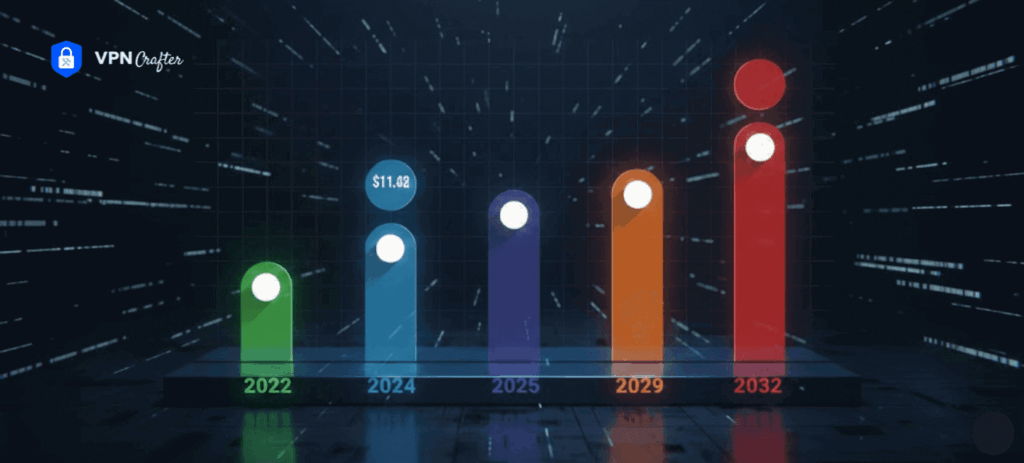
VPNs are no longer just a tool for tech enthusiasts – they are a mainstream necessity. The VPN industry has evolved into a multi-billion-dollar market with enormous growth potential. The global VPN market, valued at $45 billion in 2022, is projected to soar to $350 billion by 2032, according to Statista.
With a well-planned strategy, startups and established businesses alike can capitalize on this surge, creating scalable, profitable VPN services that address a growing demand for online privacy and unrestricted access.
Rising Demand Drives Market Expansion
The surge in VPN adoption isn’t driven by privacy concerns alone. Several factors are fueling growth:
- Increased Consumer Awareness: Online safety has become a top priority for users of all ages, not just tech-savvy individuals. Older demographics are increasingly adopting VPNs to protect their digital footprint.
- Business & Remote Operations: As remote work continues to expand globally, companies require secure VPN connections to protect confidential data and maintain seamless operations.
- Educational & Research Use: Universities, research labs, and scholars rely on VPNs to safely access restricted academic resources and collaborate across borders.
- Expanding Use Cases: VPNs are now mainstream tools used for streaming, gaming, and managing social media securely, making them versatile solutions for diverse digital activities.
Why VPN App Development Is a Lucrative Opportunity
The VPN market’s rapid growth makes app development a highly attractive investment. Rising privacy concerns, coupled with fewer digital boundaries, have increased the demand for reliable VPN solutions. According to The Business Research Company, the VPN market is projected to grow from $61.42 billion in 2024 to $71.66 billion in 2026, at a CAGR of 16.7%. By 2029, it is expected to reach $154.09 billion, with a CAGR of 21.1%.
This explosive growth highlights why investing in VPN app development today can establish a strong foothold in a profitable and expanding market.
Rising Demand for Online Privacy
As data breaches, cyberattacks, and surveillance continue to escalate, internet users are actively seeking reliable VPN services to safeguard their online activities. By 2026, monitoring by both governments and corporations will intensify, making VPNs not just an option but a crucial tool for digital privacy.
Unlocking Geo-Restricted Content
Streaming platforms like Netflix, Disney+, and Hulu often restrict content based on user location. VPNs enable gamers, remote professionals, and global audiences to bypass these restrictions, access region-specific services, and navigate censorship in countries like China, Russia, and the UAE.
Strengthening Corporate Security and Remote Work
Businesses increasingly rely on VPNs to secure remote connections, protect sensitive data, and ensure safe access to cloud-based systems. VPNs support encrypted communications, safeguard against cyber espionage, and empower distributed teams to work confidently from anywhere.
The Rise of Decentralized and Private Browsing
Emerging technologies such as blockchain-powered and decentralized VPNs (dVPNs) offer enhanced privacy without depending on centralized providers, giving users greater control over their data and reducing reliance on traditional VPN networks.
Why VPN Apps Are a Lucrative Business Opportunity
VPN apps combine strong market demand with scalable business potential. Launching a high-quality VPN app can be transformative for startups or a strategic expansion for established tech companies. Key advantages include:
- High Demand: Millions of users actively search for reliable VPN solutions.
- Recurring Revenue Models: Subscription-based services provide predictable, long-term income.
- Low Entry Barriers with High ROI: Even moderate development investments can deliver significant returns through subscriptions or premium features.
- Scalability: Expanding server networks allows businesses to accommodate more users with minimal operational overhead.
The question isn’t whether the VPN market will grow—it’s how quickly businesses can capitalize on this surge. Next, we’ll break down the actual costs of developing a VPN app in 2026.
VPN App Development Cost in 2026
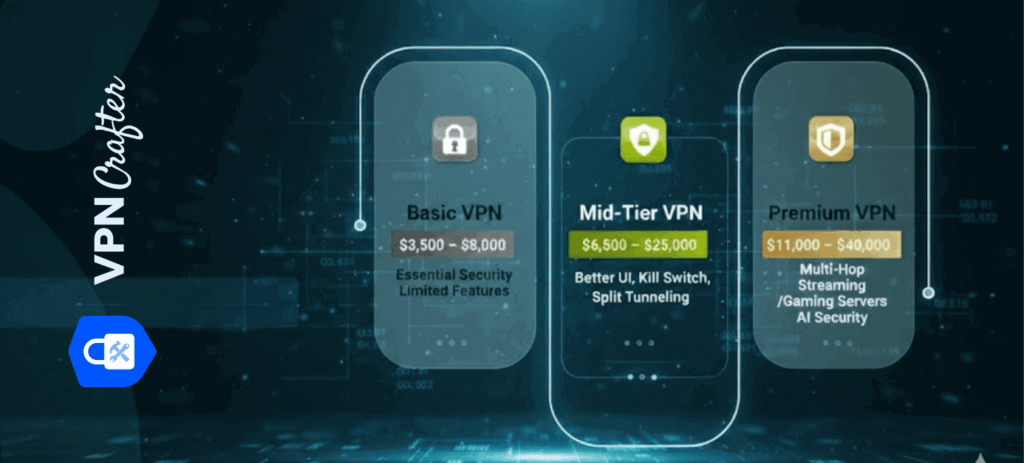
With the VPN market expanding rapidly, the demand for high-quality, secure VPN apps is higher than ever. In 2026, the cost of developing a VPN app depends on multiple factors, including the app’s complexity, choice of encryption protocols, advanced security features, and the location and expertise of your development team. Each of these elements can significantly influence your investment, so planning carefully is key to maximizing ROI.
| VPN App Type | Features | Estimated Development Cost | Time to Build |
|---|---|---|---|
| Basic VPN App | Simple, intuitive UI, secure encryption, 3–5 server locations, standard backend with admin panel and API, basic testing | $3,500 – $8,000 | 1–2 months |
| Mid-Tier VPN App | Enhanced UI/UX, advanced features like kill switch and split tunneling, 10–20 server locations, strong backend with API integration, comprehensive testing | $6,500 – $25,000 | 2–3 months |
| High-End VPN App | Premium UI/UX, advanced encryption protocols, 50+ servers worldwide, cross-platform support (iOS, Android, Windows, macOS), ad-blocking, gaming/streaming servers, custom DNS, push notifications, fully integrated backend | $11,000 – $40,000+ | 3–6 months or more |
Key Takeaways for Startups & Businesses:
- VPN apps remain one of the most profitable tech investments in 2026 due to rising privacy concerns and digital security needs.
- Prioritize robust security measures and smooth user experience—performance issues can quickly drive users away.
- Choose a monetization model that aligns with your goals, whether it’s subscription-based plans, freemium tiers, or B2B solutions.
- Long-term success relies on selecting the right development team, implementing advanced security protocols, and building a scalable infrastructure.
VPN App Essential Features
Selecting the right features for your VPN app is crucial—not only for delivering an exceptional user experience but also for accurately estimating white label VPN app development costs. While some features are essential for basic functionality and security, advanced features can elevate your app, improve retention, and differentiate it in a competitive market—but they also increase development investment.
In this section, we’ll break down the core features every VPN app must have, along with premium capabilities that can make your product stand out.
Must-Have Features
- Secure Encryption (AES-256, WireGuard, OpenVPN, etc.): Encryption is the backbone of any VPN. Implementing robust protocols like AES-256, WireGuard, or OpenVPN ensures users’ data remains private, secure, and resistant to cyber threats. The choice of protocol can also affect app speed and overall performance.
- Multiple Server Locations & Load Balancing: The efficiency of a VPN largely depends on its server network. More server locations mean faster, more reliable connections. Proper load balancing ensures smooth performance even during peak usage, preventing slowdowns or disconnections.
- No-Logs Policy & Privacy Compliance: Maintaining a strict no-logs policy is essential to user trust. Compliance with global privacy regulations such as GDPR or CCPA further reassures users that their online activity is never tracked or stored.
- Kill Switch to Prevent IP Exposure: This feature automatically disconnects users from the internet if the VPN connection drops, preventing accidental data leaks or exposure of the user’s real IP address.
- Cross-Platform Compatibility (Android, iOS, Windows, macOS, Linux): Supporting multiple platforms expands your user base and ensures consistent functionality across devices. Building cross-platform compatibility requires careful testing but significantly enhances user adoption.
Advanced Features
These premium features enhance functionality, offer unique advantages, and help your VPN stand out—though they also increase development costs:
- Split Tunneling: Gives users the ability to route some apps through the VPN while allowing others to access the local network. This is ideal for balancing privacy with performance or accessing local content.
- Multi-Hop VPN (Double VPN): Routes traffic through multiple servers, adding extra layers of encryption for users requiring top-tier privacy.
- Ad-Blocking & Malware Protection: Protects users from intrusive ads and malicious websites. Maintaining updated threat databases is essential for continuous security.
- Gaming & Streaming-Optimized Servers: Provides high-speed, low-latency connections for gamers and streamers, ensuring smooth performance without interruptions.
- Smart VPN for Automatic Fastest Server Selection: Uses intelligent algorithms to connect users to the optimal server based on location and server load, offering a seamless and efficient experience.
By combining these core and advanced features strategically, your VPN app can deliver both security and convenience, while also maximizing its appeal in a crowded marketplace.
White Label VPN App Development Cost: Features vs. Market Pricing
When planning your VPN app, understanding the cost of individual features is crucial. The table below provides an estimated breakdown for basic, mid-tier, and high-end VPN apps in 2026:
| Feature | Basic App Cost (USD) | Mid-Tier App Cost (USD) | High-End App Cost (USD) |
|---|---|---|---|
| Secure Encryption (AES-256, WireGuard, OpenVPN, etc.) | $1,000 – $2,000 | $1,500 – $2,500 | $2,000 – $3,000 |
| Multiple Server Locations & Load Balancing | $500 – $1,000 | $1,500 – $2,500 | $3,000 – $5,000 |
| No-Logs Policy & Data Privacy Compliance | $300 – $700 | $800 – $1,200 | $1,200 – $2,000 |
| Kill Switch | $200 – $500 | $500 – $1,000 | $1,000 – $1,500 |
| Cross-Platform Compatibility (Android, iOS, Windows, macOS, Linux) | $1,500 – $3,000 | $3,000 – $5,000 | $5,000 – $8,000 |
| Split Tunneling | – | $1,000 – $2,000 | $1,500 – $2,500 |
| Multi-Hop VPN | – | $1,500 – $2,500 | $2,500 – $4,000 |
| Ad-Blocking & Malware Protection | – | $500 – $1,000 | $1,000 – $2,000 |
| Gaming & Streaming-Optimized Servers | – | $2,000 – $4,000 | $4,000 – $6,000 |
| Smart VPN (Fastest Server Selection) | – | $500 – $1,000 | $2,000 – $3,000 |
Note: Costs are approximate and may vary depending on the development region, team expertise, and specific project requirements.
Key Factors Affecting White Label VPN App Development Cost
Building a VPN app involves multiple cost drivers beyond just features. Understanding these factors is essential for budgeting and project planning. Here are the primary considerations:
1. App Complexity & Features
The number and sophistication of features directly influence development costs. Basic VPN apps with essential functions are more affordable, while high-end apps with advanced security and AI-driven features require higher investments.
| App Complexity | Estimated Cost (USD) |
|---|---|
| Basic VPN App (Essential Features) | $3,500 – $8,000 |
| Mid-Tier VPN App (Advanced UI/UX & Additional Features) | $6,500 – $15,000 |
| Premium VPN App (High-End Security, AI Features, Custom Servers) | $11,000 – $30,000+ |
2. Design & User Experience (UI/UX) Investment
A smooth, intuitive design is critical for user adoption and retention. While simple UI/UX is cost-effective, investing in advanced designs ensures your app stands out and provides a seamless experience.
| UI/UX Complexity | Estimated Cost (USD) |
|---|---|
| Basic UI/UX | $2,000 – $3,000 |
| Custom UI with Advanced UX | $3,500 – $5,000+ |
3. Security Features & Compliance
Security is non-negotiable for VPN apps. Features like encryption, kill switches, and adherence to regulations such as GDPR and CCPA increase development costs but are essential for trust and legal compliance.
| Security Level | Estimated Cost (USD) |
|---|---|
| Basic Encryption & Security | $3,000 – $5,000 |
| Advanced Security & Compliance | $5,000 – $7,000+ |
4. Server Infrastructure & Maintenance
Servers power your VPN. The cost of setting up and maintaining multiple server locations, cloud hosting, bandwidth, and encryption services can be significant. Ongoing maintenance for security updates, bug fixes, and feature enhancements must also be considered.
| Hosting Type | Estimated Monthly Cost (USD) |
|---|---|
| Cloud Hosting (AWS, Google Cloud, DigitalOcean) | $500 – $2,500 |
| Dedicated Servers (Full Control) | $1,500 – $5,000 |
5. Development Team Expertise
The skill, experience, and location of your development team affect both cost and product quality. Agencies generally charge more than freelancers but offer full-stack expertise, scalability, and compliance assurance.
| Region | Freelancer Rate (USD/hr) | Agency Rate (USD/hr) |
|---|---|---|
| USA & Canada | $80 – $150 | $100 – $200 |
| Western Europe | $60 – $120 | $80 – $180 |
| Eastern Europe | $30 – $60 | $50 – $100 |
| India & Southeast Asia | $20 – $50 | $40 – $80 |
| Latin America | $25 – $60 | $45 – $90 |
6. Third-Party Integrations
Integrating external services like payment gateways, analytics, and AI chatbots enhances user experience but adds to development costs.
| Integration Type | Estimated Cost (USD) |
|---|---|
| Basic API Integrations (Payments, Analytics) | $1,000 – $3,000 |
| Advanced Integrations (AI Chatbots, Support Tools) | $3,000 – $5,000 |
7. Testing & Quality Assurance
Thorough testing ensures performance, security, and stability. Costs vary with app complexity and the level of automation implemented.
| Testing Type | Estimated Cost (USD) |
|---|---|
| Basic Functional Testing | $1,500 – $4,000 |
| Performance & Load Testing | $2,000 – $5,000 |
| Security Testing (Penetration Testing) | $3,000 – $8,000 |
| Automated Testing Setup | $2,000 – $6,000 |
| Ongoing QA for Updates | $500 – $2,000/month |
8. Marketing & User Acquisition
Even the best VPN app needs visibility. Marketing strategies like SEO, content marketing, and paid ads have distinct costs but are vital for acquiring and retaining users.
| Marketing Strategy | Estimated Cost (USD) |
|---|---|
| SEO & Content Marketing | $5,000 – $10,000 |
| Paid Ads | $10,000 – $20,000+ |
Step-by-Step Guide to Building a VPN App
Creating a VPN app requires careful planning, design, and technical expertise. Each stage ensures that your final product is not only secure but also user-friendly and effective. In this guide, our VPN development experts walk you through every step of the process, including estimated timelines and cost considerations. This roadmap will give you a clear picture of what it takes to turn a VPN app concept into a fully functional product.
Step 1: Market Research & Business Strategy
Before writing a single line of code, take a step back and understand the market. Launching a VPN app without research is like setting sail without a map – you may move forward, but you won’t know where you’re headed.
Analyze competitors: Study top VPN providers such as Cure VPN, NordVPN, ExpressVPN, and Surfshark. Identify their strengths, weaknesses, and opportunities they may have missed. Examine pricing, features, customer reviews, and online reputation. This isn’t about copying – it’s about uncovering gaps in the market. Perhaps there’s a demand for budget-friendly plans, unique security features, or superior mobile performance.
Understand user needs: VPN users are not a monolithic group. Gamers, businesses, and privacy-conscious users all have different priorities. Knowing your audience helps you design an app that they will value and pay for. Ask yourself:
- Do they need ultra-fast servers for gaming?
- Are they seeking an affordable but secure option?
- Do they want a simple way to bypass content restrictions?
Define monetization strategy: Decide how your VPN will generate revenue. Common models include:
- Subscription plans (monthly, yearly, lifetime): Most profitable in the long run.
- Freemium model: Offer basic features free, with premium upgrades for advanced features—great for user acquisition.
- One-time payment/lifetime license: Works for niche audiences but limits recurring revenue.
If you adopt a freemium model, ensure there’s a compelling reason for users to upgrade, such as faster speeds, more server locations, or enhanced security.
Ensure legal compliance: VPNs handle sensitive user data and are subject to strict regulations in many regions. Comply with GDPR (Europe), CCPA (California), and research the legal status of VPNs in your target countries.
Pro Tip: Include a transparent no-logs policy and clearly explain how user data is handled. Trust is the backbone of a successful VPN app.
Step 2: VPN App Design (Wireframing & UI/UX)
Design goes beyond aesthetics—it shapes how users feel and interact with your app. A clean, intuitive interface can be the deciding factor in user retention.
Wireframing: Create a blueprint of your app for mobile (iOS/Android) and desktop (Windows/Mac). Map out the structure of key screens such as the home dashboard, server selection, and settings.
User Interface (UI): Bring your brand to life with consistent color schemes, typography, and graphics. Aim for a professional, sleek, and simple design that attracts users and reinforces credibility.
User Experience (UX): Focus on ease of use:
- One-click connect for instant VPN access
- Intuitive dashboard for effortless navigation
- Minimized steps to perform actions within the app
Prototyping: Convert wireframes into clickable prototypes. Gather real user feedback and fix issues early – it’s far cheaper to refine now than after full development.
Step 3: Backend & Server Setup
The backend is the powerhouse of your VPN app, managing encryption, user authentication, server connections, and data routing. A secure, scalable backend is critical for performance.
Backend Development:
- VPN protocols: Your choice affects speed, reliability, and security:
- OpenVPN: Highly secure, slightly slower due to heavy encryption
- WireGuard: Lightweight, fast, strong encryption
- IKEv2/IPSec: Excellent for mobile VPNs, reconnects quickly on network changes
- Technology stack: Select frameworks based on performance and scalability:
- Node.js: Efficient for real-time data flows
- Python: Strong security, ideal for AI features and complex logic
- Go (Golang): Handles multiple concurrent connections efficiently
Server Setup:
- Deploy secure servers worldwide for optimal performance. Options include AWS, Google Cloud, or dedicated VPN hosts.
- Load balancing: Prevent slowdowns by distributing traffic evenly across servers.
- Admin dashboard: Monitor user management, server health, analytics, and subscriptions in one place.
Step 4: Frontend Development & API Integration
The frontend is the user-facing part of your VPN app, where usability meets functionality.
- Cross-platform development: Build apps for iOS, Android, Windows, and macOS using frameworks like React Native or Flutter.
- API integration: Connect frontend to backend systems for authentication, payments, and server management.
- Essential features:
- Kill switch to prevent data leaks if VPN disconnects
- Server switching for flexible connections
- Real-time performance monitoring
Step 5: Security Implementation & Testing
Security is non-negotiable for VPN apps.
- Encryption testing: Verify protocols like AES-256 and TLS are correctly implemented.
- Server load testing: Simulate high-traffic scenarios to ensure stability.
- Security audits: Conduct penetration tests and compliance checks.
- Bug fixes & refinements: Continuously address leaks, latency issues, or vulnerabilities.
Step 6: Deployment & App Store Submission
After rigorous testing, it’s time to launch.
- App store submission: Follow Apple App Store, Google Play, Windows, and macOS guidelines to avoid delays.
- Pre-launch marketing: Build hype through SEO, PPC, influencer campaigns, and social media strategies.
Step 7: Post-Launch Support & Feature Expansion
Launch is just the beginning. Continuous improvements keep users satisfied and engaged.
- Regular updates: Optimize performance, fix bugs, and add features.
- Security patches: Stay ahead of threats with regular updates.
- User feedback: Implement requested features to enhance retention.
- Scalable infrastructure: Expand servers and resources as your user base grows.
Development Timeline & Cost Estimates
| Development Stage | Estimated Time | Estimated Cost |
|---|---|---|
| Market Research & Business Strategy | 2–4 weeks | $2,000–$5,000 |
| VPN App Design | 4–6 weeks | $5,000–$15,000 |
| Backend & Server Setup | 8–12 weeks | $10,000–$25,000 |
| Frontend Development & API Integration | 6–10 weeks | $15,000–$30,000 |
| Security Implementation & Testing | 4–8 weeks | $5,000–$12,000 |
| Deployment & App Store Submission | 2–4 weeks | $1,000–$3,000 |
| Post-Launch Support & Feature Expansion | Ongoing | $1,000–$3,000/month |
Note: Costs vary depending on team location, app complexity, and feature set.
VPN App Monetization Strategies: Turning Your App into Profit
Creating a VPN app is only the beginning. The real challenge lies in converting downloads into a sustainable, profitable business. With the VPN market becoming increasingly competitive, selecting the right monetization model is essential for attracting users, maximizing revenue, and ensuring long-term growth.
Subscription-Based Model (Most Profitable)
The subscription model is the backbone of most successful VPN services. Users pay a recurring fee – monthly, semi-annually, or annually – to access your VPN. This model can include tiered plans such as Basic, Plus, and Premium, each offering different levels of speed, server access, and security features.
Top VPN providers like Cure VPN, NordVPN, and ExpressVPN thrive on subscriptions by delivering value through high-speed servers, robust encryption, and multi-device support.
Advantages:
- ✅ Predictable, recurring revenue stream for long-term financial stability
- ✅ Easier to scale while retaining loyal users
- ✅ Flexible pricing options, including discounts, to increase lifetime value (LTV)
Challenges:
- ❌ Initial user acquisition can be harder compared to free models
- ❌ Requires ongoing updates and strong customer support to prevent churn
Freemium Model (Limited Free Access, Paid Upgrades)
The freemium model gives users basic access for free while restricting certain features, such as speed, server locations, or data limits. Users are then encouraged to upgrade to a paid plan to unlock full functionality, advanced security, or premium servers.
ProtonVPN is a prime example of this approach – its free tier draws users in, and the premium version offers enhanced speed and features that convert free users into paying customers.
Advantages:
- ✅ Low barrier to entry, attracting a larger initial user base
- ✅ Users experience the service before committing financially, increasing conversion rates
Challenges:
- ❌ Free users still consume server resources, adding operational costs
- ❌ Monetization depends on a strong conversion funnel and compelling upgrade incentives
One-Time Lifetime License (For High-Value Customers)
Instead of recurring subscriptions, users pay a single, upfront fee to gain lifetime access to your VPN service. This pricing model is typically higher than annual subscription fees and is often leveraged during limited-time promotions such as Black Friday or seasonal campaigns.
These one-time offers can generate immediate cash flow and attract users who prefer a cost-effective, no-renewal solution.
Pros:
✅ Generates substantial upfront revenue.
✅ Simplifies payment and subscription management.
Cons:
❌ No recurring revenue, requiring continuous acquisition of new users.
❌ May impact long-term profitability and sustainability.
❌ “Lifetime” can be ambiguous—referring to company lifespan versus user access.
❌ Could raise concerns about ongoing service quality due to lack of continuous income.
B2B VPN Solutions for Enterprises & Remote Teams
Businesses often require VPN solutions tailored to their specific security needs, scalability, and compliance requirements. B2B VPN offerings may include dedicated servers, advanced encryption protocols, user management tools, and analytics dashboards. While development costs for enterprise solutions are higher, the potential ROI is significantly greater due to premium pricing and long-term contracts.
For example, Cisco provides enterprise-grade VPNs integrated with existing networking infrastructures for large-scale data protection, whereas Perimeter 81 specializes in business-focused VPNs for startups, SMEs, and distributed workforces.
Pros:
✅ Higher revenue per client.
✅ Long-term contracts ensure consistent income.
Cons:
❌ Requires enterprise-level infrastructure and dedicated support teams.
❌ Sales cycles are longer, delaying revenue realization.
Affiliate Marketing & Strategic Partnerships
VPN providers can monetize through affiliate programs and partnerships with ISPs, streaming platforms, or content creators. By driving traffic or subscriptions via referral links, businesses can earn commissions for every new user.
This strategy is particularly effective for VPNs with strong branding and influencer collaborations.
Pros:
✅ Low overhead costs, no additional infrastructure needed.
✅ Scalable through influencer marketing, referrals, and affiliate networks.
Cons:
❌ Revenue depends on third-party performance, giving less control over outcomes.
❌ Strong brand reputation is essential to attract quality partners.
Ad-Supported VPN Model (High Risk, Potentially Rewarding)
Some VPNs offer free access supported by advertisements to generate revenue. While this approach can attract a large user base quickly, it comes with privacy risks if user data is mishandled. A carefully balanced implementation is critical to maintain user trust and retention.
Many VPN providers use a hybrid model, offering a free ad-supported tier while incentivizing upgrades to a premium, ad-free subscription.
Pros:
✅ Rapidly expands the user base and increases ad revenue potential.
✅ Converts free users into paying subscribers for enhanced features.
✅ Low initial barrier for users; no upfront payment required.
Cons:
❌ High risk of privacy concerns if ads involve data monetization.
❌ Less profitable than subscription or enterprise-focused models.
Comparison of VPN Monetization Models
| Monetization Strategy | Revenue Potential | User Impact | Longevity | Ideal For |
|---|---|---|---|---|
| Subscription-Based | High | Positive if priced fairly | High | Privacy-conscious individuals, frequent travelers, and businesses seeking consistent, long-term security. |
| Freemium with Paid Features | Medium to High | Neutral to Positive, depending on feature balance | Medium | Casual users, mobile-first audiences, and those who want to try before committing to paid plans. |
| One-Time Lifetime License | Medium (market-dependent) | Positive | Low | VPN startups seeking a rapid cash injection; works best when combined with recurring revenue models. |
| B2B VPN Solutions | Very High | Highly Positive (adds business value) | High | Enterprises, remote teams, and IT departments needing scalable, secure solutions. |
| Affiliate Marketing & Partnerships | Low to Medium | Neutral | Medium | VPNs with strong brand recognition looking to leverage partnerships and influencer marketing. |
| Ad-Supported Model | Medium to High | Can be intrusive if not managed carefully | Low to Medium | Users in developing markets seeking free VPN access; requires careful balancing to protect privacy and trust. |
This comparison highlights that while subscription-based and B2B models offer the most stable revenue and longevity, freemium, affiliate, and ad-supported approaches can complement them to reach wider audiences and drive growth. Selecting the right combination depends on your target market, product positioning, and long-term business goals.
Top 6 Challenges in VPN App Development and How to Overcome Them
Building a VPN app is no small feat. From server infrastructure to legal compliance, the journey is packed with challenges. Addressing these proactively ensures your VPN app is secure, reliable, and stands out in a highly competitive market. Below, we break down six critical obstacles and actionable strategies to tackle them effectively.
1. Building a Secure and Scalable Server Infrastructure
Challenges:
- High costs for deploying and maintaining servers worldwide.
- Potential performance issues due to overloaded or poorly located servers.
Solutions:
- Leverage cloud platforms such as AWS, Google Cloud, or DigitalOcean to reduce infrastructure costs and gain scalability.
- Implement load balancing to distribute traffic evenly and prevent server overload.
- Continuously monitor server performance and expand resources dynamically as your user base grows.
2. Ensuring Top-Tier Security and Privacy
Challenges:
- Users expect military-grade encryption and absolute privacy.
- Security breaches, IP leaks, and vulnerabilities can quickly damage reputation.
Solutions:
- Use AES-256 encryption and reliable VPN protocols like WireGuard, OpenVPN, or IKEv2.
- Conduct regular penetration testing and security audits.
- Integrate features like multi-hop VPNs and kill switches to maintain user trust and prevent accidental data leaks.
3. Navigating Legal and Compliance Requirements
Challenges:
- VPN laws vary globally, with some countries banning or restricting VPNs.
- Compliance with regulations like GDPR and CCPA is essential.
Solutions:
- Consult legal experts to ensure your VPN meets regional compliance standards.
- Maintain a strict no-logs policy and transparent data handling practices.
- Provide clear Terms of Service and privacy policies to reduce legal risks.
4. Delivering a Seamless User Experience (UX/UI)
Challenges:
- Complex or slow apps lead to high user churn.
- Supporting multiple platforms (Android, iOS, Windows, macOS) increases development complexity.
Solutions:
- Prioritize one-click connect and intuitive app navigation.
- Optimize for speed with lightweight protocols such as WireGuard.
- Conduct user testing and iterate based on feedback to continually refine UX.
5. Standing Out in a Crowded VPN Market
Challenges:
- Hundreds of VPN providers create fierce competition.
- Free VPNs exert pricing pressure on new entrants.
Solutions:
- Offer niche features like streaming-optimized servers, gaming VPNs, or anti-malware tools.
- Invest in a strong brand identity and transparent marketing strategies.
- Use a freemium model to attract users and convert them into paying subscribers.
6. Providing Reliable 24/7 Customer Support
Challenges:
- Users expect fast troubleshooting for connection issues.
- Supporting multiple time zones can strain resources.
Solutions:
- Implement community forums for peer-to-peer support.
- Offer live chat, AI chatbots, and email support for instant assistance.
- Maintain help centers, FAQs, and tutorial videos for self-service support.
Final Insights
The VPN industry is not slowing down – it’s evolving rapidly. With rising cyber threats, privacy concerns, and global content restrictions, the demand for secure, reliable, and unrestricted internet access is higher than ever. Launching a VPN app today isn’t just about offering a product; it’s about building a trusted service that users can rely on daily.
Success comes from focusing on security, seamless user experience, and continuous innovation, combined with smart monetization strategies and building lasting trust with users.
At VPN Crafter, we specialize in creating secure, scalable VPN solutions tailored to your business needs. Our applications offer military-grade encryption, cross-platform performance, and customizable features. With the right planning, development team, and vision, your VPN app can become a market leader.
Frequently Asked Questions (FAQs)
1. How can I create a VPN app?
Hire a skilled development team or leverage your own expertise, set up secure server infrastructure (or use a cloud provider), and ensure full legal compliance. Start with a minimal viable product (MVP) and iterate based on user feedback.
2. What programming languages are best for VPN development?
Python, C++, Go, Java, and Swift are widely used, depending on the target platform and performance requirements.
3. Do VPN apps make money?
Yes, but it’s competitive. Monetization can include subscription plans, freemium models, enterprise solutions, and affiliate partnerships.
4. How much does white label VPN app development cost?
Costs typically range from $3,500 to $30,000+, depending on features, security protocols, UI/UX, and platform support.
5. What are the key features of a VPN app?
Secure encryption, kill switch, multi-platform support, a wide server network, no-logs policy, and speed optimization are essential.
6. How long does it take to build a VPN app?
Development can take 3 to 12+ months, depending on app complexity and team expertise.
7. What is the best monetization model for a VPN app?
Subscription-based models are most profitable. Freemium and lifetime licensing options can complement this strategy.
8. What are the top VPN protocols to use in 2026?
WireGuard, OpenVPN, and IKEv2 are recommended for their speed, security, and efficiency.