
The global VPN market keeps growing, yet most new VPN startups disappear within their first two years. Market demand looks strong on paper, privacy awareness keeps rising, and consumer trust in digital security tools continues to grow. Still, survival rates tell a different story.
Launching a VPN appears simple. Buy servers, build apps, add encryption, and start marketing. Reality hits fast once infrastructure costs, security risks, compliance pressure, and user expectations collide. Many founders confuse visibility with viability and branding with ownership.
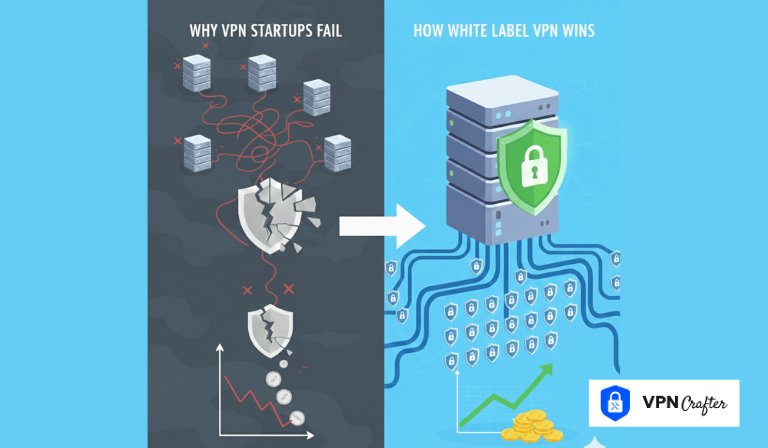
This article breaks down why VPN startups fail, where founders miscalculate, and how a white label VPN for business removes the most dangerous risks while preserving control, margins, and growth potential. Let’s start with the cause of failure:
Why Most VPN Startups Fail
1. The Harsh Truth Behind Why Most VPN Startups Fail
Oversaturation is not the real problem. Weak execution is.
The market is crowded, but users still switch providers when performance drops or trust breaks. What kills most startups is underestimating what it takes to run a secure, scalable VPN network.
Common mistakes include:
- Assuming infrastructure can be “figured out later.”
- Treating VPN for security as a feature rather than a foundation
- Believing the brand alone creates loyalty
Many founders invest heavily in logos, websites, and influencer deals while relying on fragile backend setups. Branding without infrastructure ownership creates a dangerous illusion of control.
2. Infrastructure Costs Kill Startups Before Growth
Server deployment alone can drain early capital. Add bandwidth spikes, multi-region redundancy, and DDoS protection, and expenses compound quickly.
Supporting users across North America, Europe, and Asia requires:
- Geo-distributed servers
- Load-balanced traffic routing
- Real-time failover systems
Custom-built VPN networks collapse under these costs. Cash flow evaporates before user acquisition stabilizes. This pattern explains why White Label VPN vs Custom VPN decisions often determine survival.
3. Technical Debt and Security Gaps
VPNs live or die by trust. One security incident can destroy a brand overnight.
Maintaining tunneling protocols like WireGuard, OpenVPN, and IKEv2 requires constant updates. Kill switch failures, DNS leaks, or misconfigured encryption quickly surface in audits and reviews.
Strong providers rely on:
- AES-256 encryption
- Hardened authentication layers
- Continuous vulnerability monitoring
Startups that build everything from scratch accumulate technical debt faster than they can fix it. This reality explains why white-label VPN development continues to dominate behind the scenes.
4. App Development Bottlenecks Across Platforms
Users expect seamless apps on Android, iOS, macOS, Windows, routers, and smart TVs. Each platform introduces unique SDK constraints and compliance rules.
App Store rejections slow growth. OS updates break functionality. Small teams struggle to keep pace while competitors ship weekly improvements.
This operational burden forces founders to choose between product stability and marketing momentum. Neither choice scales well.
5. Legal, Privacy, and Compliance Blind Spots
No-logs policies mean nothing without enforcement mechanisms. Jurisdiction selection affects subpoena exposure, data retention laws, and surveillance alliances.
Mistakes include:
- Hosting servers in risky regions
- Ignoring Five Eyes implications
- Overpromising privacy without legal backing
Enterprise clients also demand SLAs, audit trails, and transparency. Many startups fail here because compliance was never part of the original plan.
6. Poor User Experience and Retention Failure
Slow connections cause churn faster than any competitor ad. Users expect instant connections, low latency, and stable performance during peak hours.
Without smart routing, traffic optimization, and server health monitoring, experience degrades quickly. Acquisition costs rise while lifetime value shrinks.
Retention failure explains why marketing alone never saves a VPN business.
7. The Monetization Trap: Subscriptions Alone Do Not Scale
Subscription models face brutal price pressure. Large providers can afford razor-thin margins. New entrants cannot.
After infrastructure costs, support expenses, and refunds, CAC often exceeds LTV. Many founders learn too late that price wars favor incumbents.
This creates urgency for diversified revenue models for your white label VPN business, not single-channel subscriptions.
How White Label VPN Solves These Failures
A white label VPN solution eliminates the most expensive and risky layers instantly.
Founders gain:
- Proven infrastructure with global coverage
- Built-in security hardened by real-world traffic
- Predictable operational costs
Rather than reinventing the backend, teams focus on market positioning and customer trust. This shift alone changes survival odds.
Understanding how white label VPN works reveals why it outperforms custom builds in early and mid stages.
White Label VPN as a Strategic Business Model
White label VPN for business enables brand ownership without infrastructure liability. User data, billing, and relationships remain under your control.
Key advantages include:
- Faster iteration cycles
- Clear cost forecasting
- Reduced technical headcount
Ownership shifts from servers to users, which is where long-term value lives.
Speed to Market Becomes the Competitive Advantage
Building a VPN from scratch can take 12 months. A white label setup launches in weeks.
Speed matters when:
- News cycles spike demand
- Geo-political events increase privacy adoption
- Influencer momentum peaks
Those who launch your own VPN brand quickly capture attention before the window closes.
Scalability Without Rebuilding Everything
Traffic spikes no longer threaten stability. Auto-scaling infrastructure handles growth from 10,000 to 100,000 users without re-architecture.
SLA-backed uptime and dynamic routing ensure performance consistency. Founders scale revenue, not stress.
Revenue Expansion Beyond Subscriptions
Smart operators layer monetization:
- B2B VPN licensing
- Regional bundles
- Community and influencer access plans
These models stabilize cash flow and reduce dependence on price-sensitive users.
Who Should Choose White Label VPN
White label VPN for business fits:
- Influencers building private communities
- SaaS platforms bundling privacy tools
- Agencies serving enterprise clients
- Political and privacy-first organizations
Anyone exploring how to start your own VPN brand without infrastructure risk belongs here.
What to Look for in a White Label VPN Partner
Choose partners that own their infrastructure. Demand transparency around logging policies, encryption standards, and roadmap support.
Strong partners treat privacy as architecture, not marketing.
Build a VPN Business, Not a Technical Burden
Most failures in this industry are avoidable. The problem is not demand. The problem is execution under pressure. White label VPN for business offers a smarter entry point, faster validation, and sustainable growth. Founders who understand how to use white label VPN models stop fighting infrastructure and start building brands that last.
The next successful VPN brands will not be the ones with the most servers. They will be the ones with the clearest focus, strongest trust, and fastest path to market. If the goal is to launch your own VPN brand without repeating the mistakes that cause VPN startups to fail, the solution is already proven.