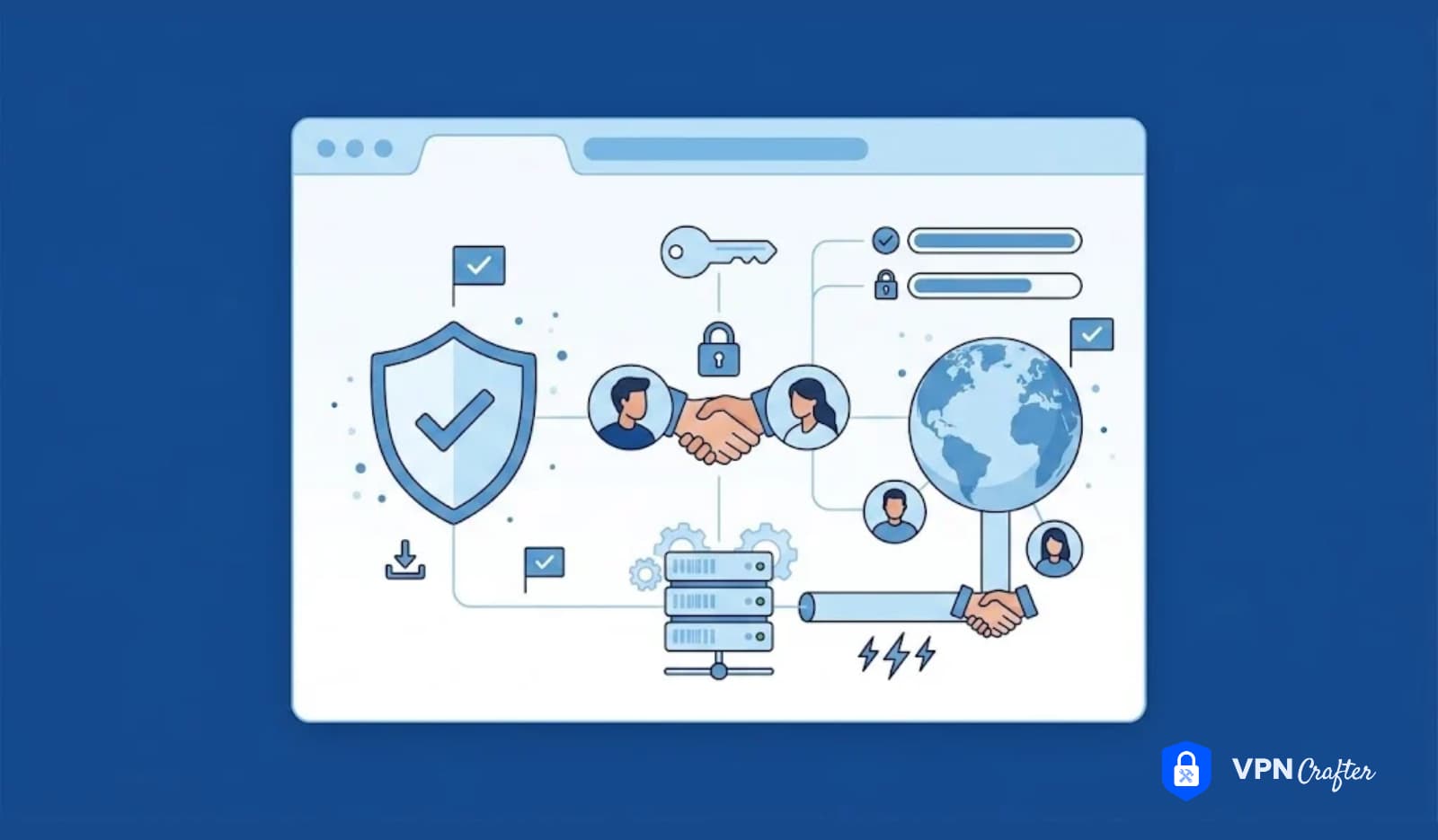

A white-label VPN for business turns “we should offer a VPN” from a two-year engineering project into a decision you can act on this quarter. Instead of building server infrastructure, developing cross-platform apps, engineering a billing backend, and standing up a security team, you license a proven platform, apply your brand, and sell VPN service as your own. Your customers see your logo, your app, your pricing — the infrastructure stays invisible. For an ISP, a SaaS company, a cybersecurity firm, or an agency with the right audience, that shortcut is the difference between shipping a revenue-generating product and shelving the idea entirely.
VPN Crafter builds the platforms beneath those brands, which shapes how this guide is written: from inside the machine, for the people deciding whether — and how — to launch. Rather than a generic overview, you’ll get a vertical-by-vertical playbook — the specific fit, revenue model, and pitfalls for each business type that succeeds with white-label VPN — plus the honest cross-cutting essentials every operator needs: the model mechanics, pricing reality, compliance requirements (GDPR, LGPD), and the launch sequence with its real bottlenecks. If your business already has customers or a channel, this is how you turn that asset into a VPN product.
Quick Answer: What Is a White-Label VPN for Business?
A white-label VPN for business is a complete, production-ready VPN platform — servers, backend, apps, and billing — that a technology provider licenses to a company to rebrand and sell as its own. The business supplies the brand, pricing, and customers; the provider supplies and maintains the engineering. The model compresses a 12–24 month, six-to-seven-figure build into a launch measured in weeks. It fits businesses with existing distribution best — ISPs bundling to subscribers, SaaS and cybersecurity firms extending their suites, hosting providers, and agencies with privacy-conscious clients. A complete platform includes custom-branded apps (iOS, Android, Windows, macOS), a WireGuard/OpenVPN stack, a management panel and API, billing integration, a global server network, and no-log, compliance-ready (GDPR/LGPD) architecture. Success depends on distribution and unit economics far more than on the platform alone.
That’s the model in one box. The playbook — who wins, how, and what it costs — fills the rest.
The Three Paths: Build, White-Label, or Resell
Every VPN venture begins with one decision, and getting it wrong is costly. Here’s the honest comparison:
| Path | You Own | Time to Launch | Upfront Investment | Technical Burden | Best Fit |
|---|---|---|---|---|---|
| Build from scratch | The entire stack | 12–24+ months | Six-to-seven figures | Total, forever | Funded firms making VPN their core moat |
| White-label platform | Brand, pricing, customers, UX | Weeks to ~2 months | Setup + recurring | Near-zero infrastructure | Most businesses — ISPs, SaaS, agencies, founders |
| Reseller program | Sales only | Days | Minimal | None | Affiliates, not brands |
The distinction that trips people up runs between white-label and reselling. A true white-label VPN carries your identity end to end — your app in the stores, your domain, your pricing, infrastructure invisible. A reseller sells another company’s branded product for commission, their identity showing. Businesses conflate these constantly, then discover they built a referral link instead of an asset. If you want equity in a brand, white-label is the floor.
Building from scratch earns its place in one scenario only: a well-funded company for whom proprietary VPN infrastructure is a genuine moat and the core product. For everyone else — the businesses adding VPN to an existing offering or launching a focused brand — the license-versus-build math favors licensing so decisively that building becomes an expensive detour. Understanding what standalone VPN development actually requires clarifies exactly why, which is why serious teams weighing the build path should study its full scope before committing.
How the White-Label VPN Model Works
The mechanics are cleaner than the jargon implies. Four moving parts:
- The platform provider owns and operates the hard parts — the global server network, the backend (authentication, node management, tunnel infrastructure), the apps, and ceaseless security maintenance.
- You, the brand owner, license that platform and apply your identity: app branding, logo, color scheme, domain, and store listings.
- Your customers download your app, pay your prices, and contact your support, never seeing the infrastructure beneath.
- The management panel and API are your controls: user provisioning, subscription management, analytics, and integration with your existing systems.
The value exchange is clean. You bring market access, brand, and customer relationships — the parts you understand. The provider brings capital-intensive, expertise-heavy infrastructure — the parts that would otherwise consume years and fortunes. Consequently, your competitive energy flows entirely into marketing, positioning, pricing, and service — the winnable battles — instead of into reinventing tunnel software that already works flawlessly.
The Vertical Playbook: Which Businesses Win, and How
White-label VPN doesn’t succeed equally across all businesses — it succeeds where distribution already exists. Here’s the specific fit, model, and edge for each winning vertical.
ISPs and Telecom Companies
The fit: exceptional. You already own, bill, and serve a customer base — the single hardest asset to acquire in the VPN market, and you have it by default.
The model: bundle a branded VPN into existing connectivity plans as a value-add or premium tier. Because acquisition cost is effectively zero (you’re upselling existing subscribers), the unit economics are the strongest in the entire white-label market.
The edge: trust and billing are already established. Customers who pay you for internet extend that relationship naturally to a privacy product carrying your name — no cold acquisition required.
SaaS and Cybersecurity Companies
The fit: strong and strategic. VPN extends a security or privacy suite as a logical, expected feature, deepening accounts and raising retention.
The model: fold VPN into existing tiers or offer it as an add-on. For a cybersecurity firm especially, a branded VPN completes a protection story customers already came for — the antivirus, the password manager, and now the encrypted connection, all under one trusted name.
The edge: you’re selling to an installed base that already trusts you with their security. Retention lifts because bundled products are stickier than standalone ones, and average revenue per account rises without a separate acquisition fight.
Hosting Providers and MSPs
The fit: natural. Privacy and secure-access services slot cleanly beside existing infrastructure offerings.
The model: offer secure remote access and privacy tooling to the businesses and individuals already buying your hosting or managed services — often as a per-seat B2B product rather than consumer subscriptions.
The edge: infrastructure credibility. Customers already trust you to run their servers; running their secure connections is an adjacent, believable extension.
Agencies and Consultancies
The fit: solid, and underexploited. A branded VPN becomes a recurring-revenue product layered onto project-based services.
The model: offer a privacy product to a client base you already advise — converting one-time engagements into subscription income, and deepening client relationships with a tangible, ongoing tool.
The edge: advisory trust plus a client roster. You’re not finding customers; you’re serving ones who already pay you for judgment.
Entrepreneurs and Creators With an Audience
The fit: viable when — and only when — genuine distribution exists. A creator, community, or niche with an engaged audience can convert attention into subscriptions.
The model: niche-focused subscription, positioned for the specific audience the giants underserve — a privacy-focused community, a regional market, a professional segment.
The edge: direct connection to a defined audience. The danger, addressed bluntly below, is mistaking a small or disengaged following for real distribution.
The through-line across every winning vertical is unmistakable: white-label VPN rewards businesses that bring distribution. The engineering is solved; the market gap is your contribution — and the genuinely hard part.
What a Complete Business Platform Must Include
Incomplete “platforms” strand businesses at the worst moments. A genuinely full offering delivers:
- Custom-branded apps across iOS, Android, Windows, macOS, and ideally Linux and browser extensions — your identity, store-published and maintained against every OS update.
- A global, scalable server network with capacity headroom and the ability to add locations as you grow.
- The modern protocol stack — WireGuard as the performance default, OpenVPN and IKEv2 for compatibility, plus obfuscation for restrictive markets. Protocol implementation shapes the speed and reliability your customers feel, and the transport choices are subtler than they appear; the trade-offs are worth understanding before you make speed claims.
- A management control panel and API for provisioning, subscription control, analytics, and integration with your CRM and billing.
- Billing and subscription infrastructure, native or API-integrated, with gateway support, trials, proration, and dunning.
- Scalable authentication and user management that grows without your engineering involvement.
- No-log, audit-ready architecture you can publicly stand behind — because your customers will demand the same proof end users demand of any provider.
- Compliance tooling and guidance — data-processing terms, GDPR/LGPD-friendly design, and app-store policy navigation.
- Ongoing security maintenance and support for the infrastructure — the endless invisible work.
- Optional source-code or deep-customization access for businesses wanting control beyond surface branding.
Score each item against your actual roadmap. A gap dismissed at signing becomes a crisis at scale.
Choosing a White-Label VPN Provider
Your platform partner becomes the foundation of your entire business, so evaluate as if the stakes are existential — because they are:
- Infrastructure quality. Server network breadth, capacity, uptime history, and the protocol stack. Your product can only be as good as the rails beneath it.
- No-log architecture and audits. You inherit the provider’s privacy posture and its reputational risk — RAM-only servers, audit history, and jurisdiction all become your story to tell.
- Branding depth. Genuine white-label or surface reskin? Confirm exactly what carries your identity — apps, store listings, domains — before signing.
- Scalability. Can the platform grow from your first hundred users to your first hundred thousand without a painful migration? Ask about capacity and expansion explicitly.
- API and integration depth. A thin or closed API caps what your business can become. Confirm you can automate provisioning and integrate with your existing stack.
- Support and partnership model. You’ll depend on this provider operationally forever — test responsiveness and technical depth before committing.
- Compliance support. Data-processing arrangements, GDPR/LGPD-friendly architecture, payment guidance, and app-store navigation — areas where an experienced partner saves months.
These mirror the criteria end users apply to picking a VPN, because you’re buying wholesale the qualities you’ll retail. A provider that can’t satisfy a discerning consumer can’t equip you to satisfy one.
Pricing and Unit Economics
Straight numbers-thinking, since vague pricing is the industry’s fog machine. White-label arrangements typically combine:
- Setup/onboarding fee — one-time, scaling with customization depth.
- Per-user/per-seat recurring cost — predictable, scaling with your active base.
- Revenue-share — the provider takes a subscription percentage, aligning incentives and lowering upfront risk.
- Tiered flat fees — fixed costs per capacity band, favorable at scale.
- Add-ons — extra locations, premium features, dedicated infrastructure, source-code access.
Rather than quote figures that vary too widely to be honest, internalize the model: your subscription price, minus per-user platform cost, minus customer-acquisition cost, minus payment processing and support, is your margin — and your business. Newcomers fixate on the setup fee; operators obsess over per-user cost and CAC, because those compound across every subscriber. Build the unit-economics spreadsheet before signing — and treat a provider unwilling to give you the inputs as a signal about the partnership ahead.
The vertical you occupy changes this math dramatically. An ISP bundling to existing subscribers carries near-zero CAC, making almost any reasonable platform cost profitable. A standalone brand acquiring customers cold must clear a far higher bar. Model your actual numbers, not the industry’s averages.
Monetization Models by Business Type
Selling strategy shapes viability as much as the product, and the right model tracks your vertical:
- Bundling (ISPs, SaaS, hosting) — fold VPN into an existing paid offering. Frequently the strongest model, because it deepens a relationship rather than fighting a standalone sale, and it lifts retention across the whole product.
- Subscription (the standard) — monthly and annual plans, with annual driving the cash flow and retention that make VPN businesses viable. The right default for audience-driven brands.
- Tiered plans — basic-to-premium ladders by features, devices, or dedicated IPs, capturing more willingness-to-pay across a mixed customer base.
- B2B/team plans (MSPs, agencies, hosting) — per-seat sales to businesses, higher-value and lower-churn than consumer, in a less saturated market.
- Freemium — potent for acquisition, but only if your platform economics survive free users’ server costs. Model it carefully before committing.
Durable white-label operators rarely brawl with consumer giants on price and server count. They win through distribution (an owned base), bundling (VPN as retention glue), or niche (an audience the giants underserve). Match the model to what your distribution actually supports, not to what sounds biggest.
Compliance: The Non-Negotiable Layer
Selling privacy while mishandling privacy law is the fastest way to end a VPN brand — and the target markets for this guide, from Brazil to the EU to the UK, carry real regulatory teeth. The essentials no operator can skip:
- GDPR (EU/UK). Even a no-log VPN processes some personal data — billing details, account emails, support records. GDPR governs how you collect, store, and honor rights over it, with meaningful penalties for failure. Lawful basis, data-subject rights, and breach procedures all bind you as the brand of record.
- LGPD (Brazil). Brazil’s data-protection law parallels GDPR with its own requirements, and given Brazil’s status as one of the fastest-growing VPN markets, LGPD compliance is commercial necessity, not a footnote. Its details differ enough from GDPR to require specific attention rather than assumed equivalence. Our dedicated guide to GDPR & LGPD for VPN companies breaks down the obligations that actually apply to VPN brands.
- The no-log story you can defend. Privacy is the product; your logging posture is the promise. You inherit and publicly own your platform’s architecture, so “our provider handles it” fails the trust test. Choose a platform whose no-log design — ideally RAM-only and audit-backed — you can explain as your own. Understanding why no-logs audits became the industry’s trust currency is essential before you position on privacy, and if you’ll pursue that credibility, our walkthrough on how to prepare your VPN for its first no-logs audit maps what auditors examine so you don’t waste months entering unprepared.
- Jurisdiction and consumer law. Where your entity and infrastructure are based shapes which authorities can compel what, while refund rights, cancellation rules, and marketing-claim regulations vary across your target countries and bind you as the seller.
The operative point: compliance is the brand owner’s responsibility, even on rented infrastructure. A capable partner supports you; the legal accountability sits with the entity whose name customers see. Treat compliance as a launch prerequisite, not a someday task — because regulators and customers increasingly treat it as the price of admission, and the audit-ready brand wins the deals the careless brand can’t.
Launch Timeline: Contract to First Customer
Realistic sequencing, decision to revenue:
- Weeks 0–2 — Provider selection and contracting. Evaluate against the criteria, model economics, sign. The highest-leverage fortnight of the process.
- Weeks 2–4 — Branding and configuration. Brand assets, app configuration, domain, plan setup. The platform carries the technical load.
- Weeks 3–6 — App-store submission. Parallel iOS/Android review, with VPN apps facing extra policy scrutiny — build in buffer.
- Weeks 4–6 — Billing and merchant setup. Payment gateway plus the frequent bottleneck: merchant-account approval, slower for VPN than founders expect.
- Weeks 4–6 — Compliance groundwork. Privacy policy, data-processing terms, GDPR/LGPD posture — in parallel, because retrofitting compliance is painful.
- Weeks 5–8 — Testing and soft launch. Real-device testing, a limited cohort, workflow validation.
- Week 8+ — Public launch and marketing. The starting line — because customer acquisition, the real work, begins now.
Roughly two months to public launch with a capable partner, versus 12–24 months building from scratch. The honest caveat holds: launching is the easy milestone. The business is won in the marketing and retention months that follow — which is exactly why offloading the technical and compliance burden matters, freeing your full attention for the part that decides everything.
Expert Insights: What Separates Winners From Casualties
Operating VPN platform infrastructure surfaces patterns the sales decks omit.
Distribution decides outcomes more than any other factor. The single strongest predictor of a white-label VPN’s success isn’t platform choice — it’s whether the business brought an audience. ISPs bundling to subscribers, SaaS firms extending to installed bases, agencies converting clients: these win because acquisition was solved before launch. A recurring pattern from teams we’ve worked with: a technically meticulous founder chose an excellent platform, nailed every architecture question — and stalled for a year because no acquisition plan sat behind the perfect product. Choose your platform with rigor, but choose your market first.
The “passive income” framing is where money dies. A repeated story: someone buys into white-label VPN expecting the platform to supply customers, invests in setup, launches to silence, and abandons it within months — blaming the platform for a marketing failure that was always theirs. The platform removes the technical burden entirely; it does not remove the business burden. Anyone selling white-label VPN as hands-off income is selling the part that doesn’t exist. Enter with a customer-acquisition plan or don’t enter.
Compliance readiness is a moat, not a cost. Brands that treated GDPR and LGPD as launch-week paperwork hit walls when a data-subject request, a breach, or a market-entry review arrived — while brands that built compliance in from day one moved into regulated markets and enterprise deals their rivals couldn’t touch. In a trust business, provable compliance is marketing. The audit-ready brand wins the customers the careless brand can’t reach.
Support quality is the churn valve. VPN customers contact support about connections, setup, and billing, and the quality of those touches drives retention more than any feature grid. Businesses that staff support seriously — or partner with platforms offering strong support infrastructure — keep customers; those treating it as an afterthought watch churn quietly consume growth. In subscriptions, retention is the business, and support is its front line.
Statistics & Data
The market context, with sources worth citing:
- The VPN market is large and compounding. Grand View Research and MarketsandMarkets size the global VPN market in the tens of billions of dollars with sustained double-digit projected growth, driven by consumer privacy demand and remote-work security.
- Adoption is broad and international. Statista and Security.org research places VPN use across a substantial share of internet users worldwide, with strong momentum precisely in this guide’s target markets — Brazil, India, and Europe prominent among them.
- Remote work structurally expanded demand. The durable shift to distributed and hybrid work turned secure remote access from a nice-to-have into infrastructure, expanding the business-VPN segment specifically — the segment white-label operators can serve without competing head-on with consumer giants.
- Build economics justify licensing. Standard software-development benchmarks place a full multi-platform VPN build — apps, backend, infrastructure, security — firmly in the six-to-seven-figure range across 12–24 months, the exact math making white-label’s weeks-to-launch compelling.
- Trust drives the category. Consumer research consistently shows privacy and no-log credibility topping VPN purchase criteria — the reason a reputable, ideally audited platform partner is a core marketing asset, not just technical diligence.
Direct sources worth citing: Grand View Research and MarketsandMarkets market analyses, Statista and Security.org adoption research, and standard software-development cost benchmarks from established industry sources.
Common Mistakes
- Confusing reselling with white-label. A commission link isn’t a brand. Confirm end-to-end branding before signing, or you’ve built a referral stream mislabeled as a business.
- Expecting the platform to supply customers. It delivers technology, never a market. Enter with distribution or an acquisition plan — the mistake that sinks the most ventures.
- Skipping the unit-economics model. Per-user cost, price, CAC, and churn — not the setup fee — determine survival. Build the spreadsheet first.
- Treating compliance as a someday task. GDPR and LGPD bind you as the brand of record from day one. Retrofitting privacy law after launch is painful and sometimes fatal.
- Choosing a platform on price alone. Cheap infrastructure with poor uptime, weak protocols, or dubious logging becomes your reputation problem. Your product inherits your provider’s quality.
- Underestimating merchant-account friction. VPN faces extra payment-processor scrutiny; approval can bottleneck launch. Start early, lean on your partner’s experience.
- Neglecting a defensible no-log story. “Our provider handles it” fails the trust test. Own an architecture you can explain publicly.
- Competing head-on with the giants. Fighting established brands on price and server count is a losing war for a newcomer. Win on distribution, bundling, or niche instead.
Best Practices
- Choose your market before your platform — distribution advantage is the top success predictor; confirm yours first.
- Model unit economics for your specific vertical — an ISP’s near-zero CAC and a standalone brand’s acquisition cost are different businesses. Know your real numbers.
- Build compliance in from day one — GDPR, LGPD, jurisdiction, and privacy policy as launch prerequisites, because provable compliance is a moat.
- Own a defensible no-log story — inherit audit-ready, RAM-only architecture you can publicly stand behind.
- Evaluate the platform like an end user vetting a VPN — infrastructure, protocols, API depth, support — because you’re buying wholesale what you’ll retail.
- Confirm branding depth in writing — exactly what carries your identity: apps, listings, domains, support touchpoints.
- Start payment and app-store processes early — the reliable bottlenecks; a head start protects the timeline.
- Lead with the revenue model your vertical supports — bundling for existing-customer businesses, niche subscription for audience-driven ones.
- Resource support deliberately — retention is the business, and support is its engine.
Frequently Asked Questions
What is a white-label VPN for business?
A white-label VPN for business is a complete VPN platform — servers, backend, apps, and billing — that a provider licenses to a company to rebrand and sell as its own. The business supplies the brand, pricing, and customers; the provider builds and maintains the technology invisibly beneath, compressing a 12–24 month build into a weeks-long launch.
How is a white-label VPN different from a reseller program?
White-label gives you your own brand end to end — your app, domain, and pricing, with infrastructure hidden. A reseller program sells another company’s branded product for commission, their identity visible. White-label builds a business you own; reselling builds a referral stream you don’t.
Which businesses benefit most from a white-label VPN?
Businesses with existing distribution: ISPs and telecoms bundling to subscribers, SaaS and cybersecurity firms extending security suites, hosting providers and MSPs, and agencies with privacy-conscious clients. Each converts an owned customer relationship into VPN revenue with minimal acquisition cost — the market’s biggest advantage.
How much does a white-label VPN for business cost?
Costs typically combine a setup fee with per-user pricing or revenue share, plus optional add-ons for extra locations or source-code access. Figures vary widely by scope, so model your unit economics — price minus platform cost minus acquisition cost — rather than fixating on any single quoted number.
How long does it take to launch a white-label VPN?
Roughly two months from contract to public launch with a capable partner, versus 12–24 months building from scratch. The timeline covers branding, app-store submission, billing and merchant setup, compliance groundwork, and testing — with merchant-account approval often the main bottleneck.
Do I need technical skills to run a white-label VPN business?
No deep infrastructure expertise is required — the platform handles servers, backend, apps, security, and maintenance. Your core work is brand, market, pricing, and support. Business and distribution skills matter far more than engineering ones in this model.
Can ISPs and telecom companies offer their own branded VPN?
Yes — they’re among the strongest fits. ISPs bundle a branded VPN into existing connectivity plans, monetizing subscribers they already own and bill, with near-zero acquisition cost. Bundling into an established paid relationship is often the most durable and profitable VPN revenue model.
Can SaaS and cybersecurity companies add a white-label VPN?
Absolutely. VPN extends a security or privacy suite as an expected feature, deepening accounts and lifting retention. For cybersecurity firms especially, a branded VPN completes a protection story customers already trust the brand to deliver, raising average revenue without a separate acquisition fight.
What should a complete white-label VPN platform include?
Custom-branded apps across major platforms, a global scalable server network, a WireGuard/OpenVPN/IKEv2 protocol stack, a management panel and API, billing infrastructure, scalable authentication, no-log audit-ready architecture, compliance tooling for GDPR/LGPD, and ongoing security maintenance — with optional source-code access for deeper customization.
What compliance requirements apply to a white-label VPN business?
As the brand of record, you’re accountable for data-protection law — GDPR in the EU/UK, LGPD in Brazil, and equivalents elsewhere — covering billing data, account details, and support records even on a no-log service. Jurisdiction strategy and consumer-protection rules also apply. A capable platform supports compliance, but legal accountability is yours.
Is a white-label VPN business profitable?
It can be, but profitability depends on distribution and unit economics, not the platform alone. Businesses bundling VPN into existing offerings or converting an owned audience see the strongest returns; standalone brands with no distribution face the crowded consumer market’s full difficulty.
What protocols should a white-label VPN platform support?
WireGuard as the modern performance default, OpenVPN and IKEv2 for compatibility, and obfuscation for restrictive markets. Protocol implementation quality — leak-free tunnels, a correct kill switch, clean key rotation — matters more than the cipher name, so evaluate the engineering rather than the “military-grade” marketing.
Can I get custom branding and source-code access?
A complete white-label platform provides fully branded apps carrying your name, logo, and design. Some providers also offer source-code or deep-customization access for businesses with engineering resources and specific requirements. Confirm both the branding depth and the customization level upfront, since they vary significantly between providers.
What should I look for in a white-label VPN provider?
Evaluate infrastructure quality, no-log architecture and audit-readiness, branding depth, scalability, API and integration depth, support and partnership model, transparent pricing, and compliance support for GDPR/LGPD. These mirror the criteria end users apply to any VPN — because you’re buying wholesale the same qualities you’ll retail.
Is running a white-label VPN business legal?
Operating a legitimate VPN service is legal across mainstream markets, where VPNs are standard privacy and security tools. Success requires lawful positioning, data-protection compliance (GDPR, LGPD), and adherence to payment-processor and app-store policies. A few jurisdictions restrict VPNs, so understand your target markets before launch.
Conclusion
A white-label VPN for business collapses the hardest, most expensive part of entering the privacy market — the infrastructure, the apps, the years, the fortune — into a licensing decision and a two-month launch. That leaves you free to compete where you can actually win: brand, distribution, positioning, and service. The businesses that thrive understand the trade precisely. They pick the vertical that fits their existing distribution — ISP bundling, SaaS extension, agency recurring revenue — model the economics honestly, build compliance in from day one, and refuse the fantasy that technology alone makes a business.
VPN Crafter exists for exactly those operators — the ISPs, SaaS firms, cybersecurity companies, and founders who want the infrastructure, protocols, no-log architecture, and compliance-ready rails built right, so their energy goes entirely into the market they alone can win. The engineering is solved. The playbook is yours.
Bring the brand and the market. We’ll bring the infrastructure, the protocols, and the compliance-ready rails. Talk to VPN Crafter about launching your VPN for business — and turn a two-year build into a two-month launch, engineered to endure its first audit and its first hundred thousand users.