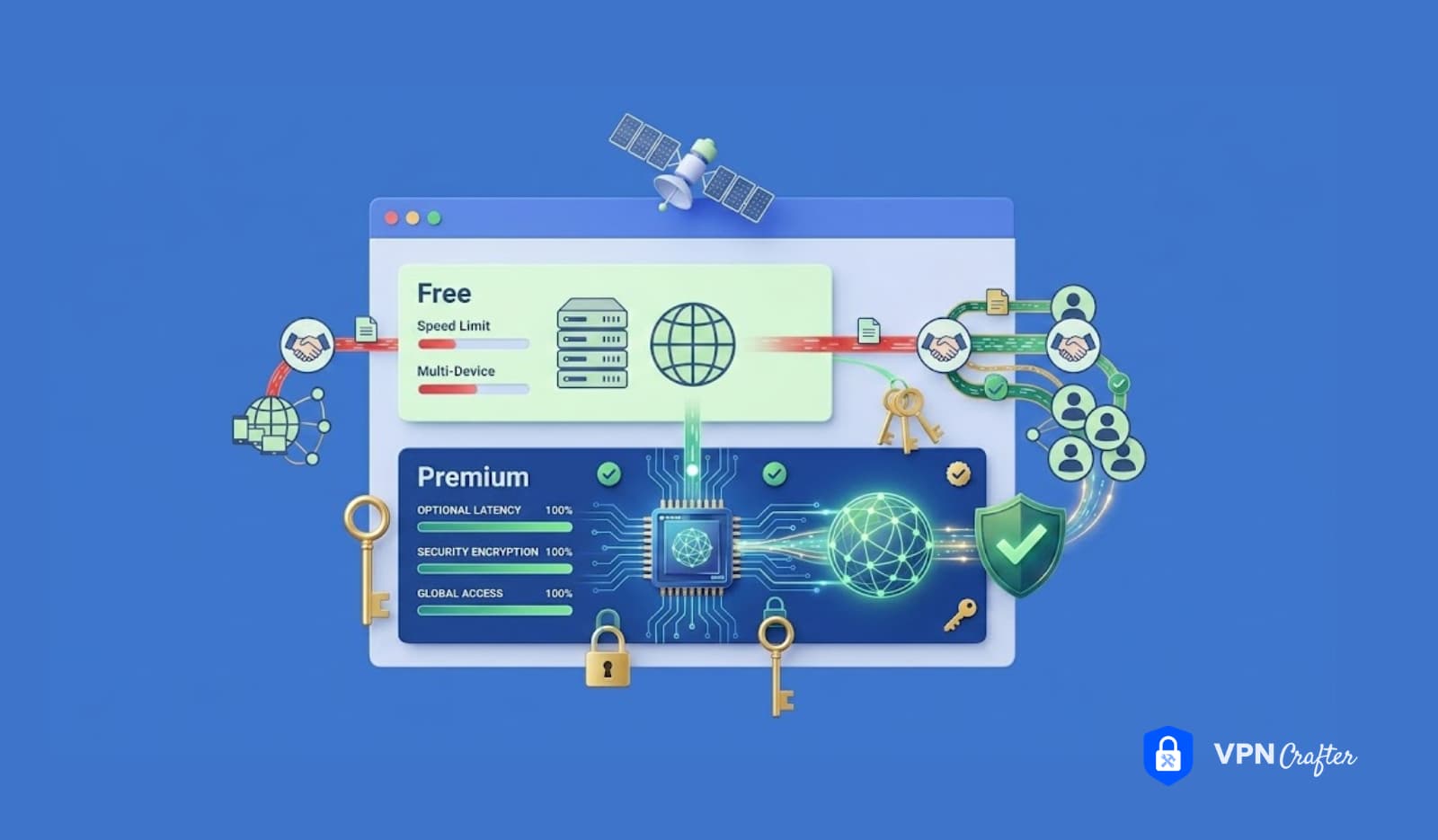

The VPN freemium business model sounds deceptively simple — give away the product for free, charge for the premium version, and watch conversion happen. In practice, it’s one of the most precision-dependent business architectures in software. The gap between a freemium model that compounds into a self-sustaining acquisition flywheel and one that hemorrhages infrastructure costs while generating no meaningful revenue comes down to a handful of specific design decisions that most VPN founders make without realizing they’re making them.
This guide is the definitive operational breakdown of how the VPN freemium model actually works — not the theoretical version, but the mechanics-level reality. We’ll cover free tier design, the psychology of upgrade conversion, the unit economics that determine whether the model is profitable, where most implementations fail, and the specific levers that move conversion rates from 1% to 6%+. If you’re designing a freemium VPN product, or if you already have one and conversion is underperforming, this is the guide you needed before you launched.
What Is the VPN Freemium Business Model?
The VPN freemium business model is a pricing strategy in which a VPN provider offers a free tier with genuine but limited functionality, and a paid premium tier with full functionality. The free tier serves as a low-friction acquisition channel and product demonstration vehicle. Revenue is generated exclusively from users who upgrade to the premium tier, either through subscription or in-app purchase. The free tier costs the provider in infrastructure but generates no direct revenue — it is an investment in user acquisition and conversion.
The term “freemium” combines “free” and “premium” — and the model’s commercial logic rests on one assumption: the value you provide for free is compelling enough to attract users at scale, and the limitations you impose are compelling enough to convert a percentage of those users into paying subscribers.
Both conditions must be true simultaneously. Free value without conversion incentive produces large inactive user bases with no revenue. Aggressive paywalls without free value produce low sign-ups regardless of premium quality. The freemium model’s entire profitability depends on calibrating these two variables correctly — and that calibration is the hardest part.

How the VPN Freemium Model Works — The Complete Mechanics
The Economic Logic
Freemium is fundamentally a customer acquisition strategy disguised as a product offering. When you offer a free VPN tier, you’re not losing money — you’re investing in acquiring users at a different CAC (customer acquisition cost) profile than paid advertising would produce.
Compare two acquisition scenarios:
Scenario A — Paid advertising acquisition CAC: $25 per subscriber via Google/Meta ads Monthly ARPU: $6 Payback period: 4.2 months LTV at 12-month retention: $72
Scenario B — Freemium acquisition Cost to serve 100 free users: ~$50/month infrastructure Conversion rate: 4% Converted users: 4 paying subscribers Effective CAC: $12.50 per subscriber Monthly ARPU: $6 Payback period: 2.1 months LTV at 12-month retention: $72
Freemium wins on CAC when infrastructure costs per free user are low — which they typically are for digital products — and when conversion rates are maintained above a threshold that justifies the investment.
The Three Levers of Freemium Profitability
Lever 1 — Free user acquisition volume: More free users means more conversion opportunities at the same conversion rate. The freemium model scales conversion with acquisition — if 4% of free users convert, 10,000 users converts 400; 100,000 converts 4,000.
Lever 2 — Conversion rate: The percentage of free users who upgrade to premium. This is the model’s most sensitive lever — moving conversion rate from 2% to 4% doubles revenue from the same acquisition base without additional marketing spend.
Lever 3 — Infrastructure cost per free user: The cost of serving each free user determines how many free users you can sustain before the model’s economics invert. Lower cost per free user means you can maintain larger free user bases profitably.
VPN Freemium vs Subscription-Only vs Free Trial — Compared
Before committing to freemium, VPN businesses should understand how it compares to the primary alternatives.
| Model | Sign-Up Friction | CAC | Revenue Certainty | Conversion Mechanism | Best For |
|---|---|---|---|---|---|
| Freemium | Very low | Low-Medium | Low initially | Limitation encounter → upgrade | Apps with strong organic distribution |
| Subscription-only | High | High | High once acquired | Direct purchase | Established brands with strong credibility |
| Free trial (time-limited) | Medium | Medium | Medium | Trial expiration → subscribe | Products where value is felt quickly |
| Free trial (feature-limited) | Medium | Medium | Medium | Feature limitation → subscribe | Complex products with large feature sets |
When Freemium Outperforms Free Trial
Freemium outperforms time-limited free trials in categories where:
- Users need multiple sessions before experiencing the product’s core value (privacy benefits aren’t always immediately felt)
- Word-of-mouth and organic discovery are primary acquisition channels
- The product delivers meaningful value even in the limited state
A 7-day free trial forces a decision before many users have genuinely engaged with the product. Freemium allows the user to build genuine product familiarity and trust before the conversion moment arrives — which typically produces higher-quality subscribers with better retention.
When Subscription-Only Outperforms Freemium
Subscription-only models work better for VPN products with established brand recognition where the free tier’s conversion subsidy is less valuable than the increased revenue from all sign-ups converting to paid. For new market entrants without brand equity, freemium almost always outperforms subscription-only because it removes the primary adoption barrier.
Designing the Free Tier — The Most Consequential Product Decision
Free tier design is the decision with the largest downstream impact on freemium economics. Every choice about what to include and exclude in the free tier directly determines your conversion rate, your infrastructure costs per user, and the quality of users you attract.
The Free Tier Design Framework
Principle 1 — Deliver real, perceptible value Users who don’t experience genuine value in the free tier never develop the product familiarity and trust that motivates premium upgrades. The free tier must work. Users should be able to accomplish at least one meaningful use case with the free product before encountering any limitation.
Principle 2 — Create limitations that users encounter during meaningful engagement The conversion trigger is most powerful at the exact moment a user wants to do something the free tier doesn’t allow. This means limitations should affect features that engaged users actually use — not hypothetical features they might want someday.
Principle 3 — Limitations should be quantity-based, not quality-based Degrading the product quality (slower speeds, lower security) in the free tier creates negative associations that carry into the premium experience. Quantity limitations (fewer servers, less bandwidth) restrict scope without affecting quality within the scope.
Principle 4 — The limitation must be clearly connected to a specific premium resolution When the user hits the paywall, they should understand exactly what upgrading gives them. Vague “upgrade for more” prompts convert at a fraction of the rate of specific “unlock 60+ server locations in 40+ countries” prompts.
Free Tier Limitation Options — Effectiveness Ranked
| Limitation Type | Conversion Effectiveness | Infrastructure Cost Control | User Experience |
|---|---|---|---|
| Server location restriction (best) | High | High | Neutral — affects capability, not quality |
| Bandwidth cap | High | High | Negative if hit mid-session |
| Speed throttling | Medium | High | Negative — quality degradation |
| Device limit | Medium | Low | Neutral for single-device users |
| Feature restriction | Medium-High | Low | Neutral |
| Time limit (not true freemium) | Low-Medium | High | Negative urgency |
Server location restriction is the most effective freemium limitation for VPN apps — it directly limits the product’s core value proposition (access to content from specific regions) while maintaining full quality within the available servers. Users who want to access a specific streaming library, corporate server, or geo-restricted service encounter this limitation naturally during meaningful use.
What the Free Tier Should Include?
To deliver the “real value” required by Principle 1:
- Connection to at least 2–5 server locations (home country + 1–2 others)
- Full VPN encryption quality (no degraded security protocols)
- Kill switch functionality
- DNS leak protection
- Reasonable speed on available servers (not throttled)
Premium Tier Design — What Must Be Worth Upgrading For
The premium tier must justify its price against the free alternative so clearly that the upgrade decision feels obvious rather than reluctant.
Premium Differentiators That Drive Conversion
Server access expansion — 60–100+ server locations across 40+ countries. This is the primary value unlock for most VPN users who’ve hit a geo-restriction limitation in the free tier.
Unlimited bandwidth — Particularly important for users who’ve hit bandwidth caps during media consumption or large downloads.
Speed priority — Premium users get bandwidth priority during peak server load. This is most valuable in high-density markets where server congestion is a real issue.
Simultaneous connections — Upgrading from 1 to 5 or more simultaneous devices is a meaningful quality-of-life improvement for users with multiple devices.
Advanced features — Split tunneling, dedicated IP (as an add-on), obfuscated servers for restricted networks, streaming-optimized server categories.
Ad-free experience — If the free tier contains any advertising, premium removes it. This is a meaningful psychological differentiator even when the ads themselves are minor.
Priority support — Premium subscribers get faster response times and dedicated support channels.
The Freemium Conversion Funnel — Stage by Stage
The VPN freemium conversion funnel has five stages: (1) Acquisition — users discover and install the free VPN; (2) Activation — users experience the product’s core value in their first session; (3) Engagement — through regular use, users encounter the free tier’s limitations; (4) Conversion — upgrade prompts appear at the limitation encounter moment; (5) Retention — premium subscribers renew and develop long-term loyalty.
Stage 1 — Acquisition
Free users arrive through:
- Organic app store discovery (search rankings, featured categories)
- Content marketing — blog posts, comparison articles, privacy guides
- Social media and community engagement
- Affiliate-referred downloads (your affiliate program promoting the free app)
- Word of mouth from existing users
- Paid app install campaigns (used carefully — free user CAC must be low enough to support conversion economics)
The acquisition channel mix matters because different channels produce different quality free users. Organic search-acquired users who specifically searched for VPN solutions convert at higher rates than users who installed casually from a “free apps” roundup. Quality over volume — particularly early in the product’s life.
Stage 2 — Activation
Activation is the user’s first meaningful experience of the product’s core value. For a VPN app, activation typically means:
- Successfully connecting to a VPN server in the first session
- Experiencing access to content that wasn’t previously accessible
- Seeing the privacy indicators (IP address changed, connection secured)
Users who don’t activate — who install and never connect, or who connect once and experience a technical issue — almost never convert to premium. Activation rate improvement directly increases conversion volume from the same free user base.
Activation optimization tactics:
- Onboarding flow that connects the user to the best available server in one tap
- First-session success prompt: “You’re protected — your IP is now [VPN IP]”
- Tutorial highlighting the specific geo-restriction capability the user can try immediately
- Push notification after 24 hours if no second session has occurred: “Try [specific feature] — it’s available free on your account”
Stage 3 — Engagement
Between activation and conversion, free users need regular reasons to open and use the app. Engagement during the free period determines whether users are still active when they encounter the limitation that triggers upgrade consideration.
For VPN apps specifically, engagement is often tied to specific usage triggers — traveling, accessing streaming content, working remotely, privacy concerns from news events. Building in-app reminders and notifications that reconnect users to these triggers maintains engagement between natural use occasions.
Stage 4 — Limitation Encounter (The Conversion Trigger)
The limitation encounter is the highest-leverage moment in the freemium funnel. When a user hits the free tier’s boundary — whether that’s reaching the bandwidth cap, finding their target server location locked, or hitting the device limit — the upgrade impulse is at its natural peak.
The upgrade prompt at this moment should be:
- Contextually specific — tell the user exactly which premium feature resolves their current frustration
- Friction-minimal — payment in one or two taps with Apple Pay, Google Pay, or saved card
- Value-clear — show what premium unlocks, with the annual plan prominently featured
- Urgency-enabled — limited-time offer or promotional pricing creates decision urgency without being manipulative
Stage 5 — Post-Conversion Retention
The first 30 days after upgrade are the highest churn-risk period. Users who don’t actively use their premium features during this window disengage and cancel at the annual renewal point.
Post-conversion engagement tactics:
- Welcome email highlighting 3 specific premium features to try in the first week
- In-app prompt after first premium session: “You just accessed [specific feature] — try [related feature] next”
- 45-day check-in notification if usage has dropped: “Your premium subscription includes [feature] — here’s how to use it”
- Renewal reminder 30 days before annual expiration with a loyalty discount offer for early renewal
Conversion Rate Benchmarks and What Moves Them
Industry freemium conversion benchmarks for consumer software apps range from 2–8%, with VPN-specific products typically landing between 3–6% for well-designed implementations.
Factors That Push Conversion Rate Higher
| Factor | Impact on Conversion Rate | How to Optimize |
|---|---|---|
| Contextual upgrade prompt timing | Very high | Trigger at exact limitation encounter moment |
| Annual plan prominence in upgrade UI | High | Center the annual plan; make monthly feel like the alternative |
| Fast upgrade flow (1–2 taps) | High | Apple Pay / Google Pay as default payment option |
| Specific limitation messaging | Medium-High | “Unlock [city/country] servers” vs generic “upgrade” |
| Free trial offer at upgrade point | Medium | “Try premium free for 7 days” at paywall reduces friction |
| Activation rate | Medium-High | Users who activate convert; users who don’t, almost never do |
| Push notification re-engagement | Medium | Brings dormant users back to an engagement state before the trial offer |
What 1% More Conversion Rate Is Worth?
At 50,000 free users:
- Baseline 3% conversion = 1,500 premium subscribers
- Improved 4% conversion = 2,000 premium subscribers
- Revenue difference at $60/year ARPU = $30,000 additional annual revenue
This is why conversion rate optimization is the highest-ROI activity in freemium businesses — the same acquisition base produces dramatically different revenue based purely on funnel efficiency.
VPN Freemium Unit Economics — The Real Numbers
Freemium only works if the math works. Here is the unit economic framework VPN businesses need to model before launching a freemium product.
Cost Per Free User Per Month (Infrastructure)
| Usage Level | Server + Bandwidth Cost | Monthly Cost per User |
|---|---|---|
| Light user (< 1GB/month) | ~$0.10–$0.30 | $0.20 average |
| Moderate user (1–5GB/month) | ~$0.30–$1.00 | $0.65 average |
| Heavy user (5GB+ monthly) | ~$1.00–$3.00 | $2.00 average |
The free tier’s bandwidth cap directly controls your cost per free user. A 2GB/month cap keeps costs manageable. An unlimited free tier with no restrictions produces costs that quickly exceed what conversion revenue can offset.
Break-Even Free User to Paying Subscriber Ratio
At $6/month ARPU and $0.40/month average infrastructure cost per free user:
- A 3% conversion rate means 1 paying subscriber per 33 free users
- Revenue per paying subscriber: $6/month
- Infrastructure cost for 33 free users: 33 × $0.40 = $13.20/month
- Net contribution: $6.00 – $13.20 = -$7.20/month (free user pool is a net cost)
Wait — the math looks negative. But this ignores that paying subscribers also use infrastructure (at similar or higher rates), and the paying subscriber’s revenue covers their own infrastructure plus contributes to the business. The correct framing:
- Paying subscriber generates $6/month revenue
- Paying subscriber infrastructure: ~$1.00/month
- Gross margin per paying subscriber: ~$5.00/month
- Free user infrastructure: $0.40/month × 32 non-converting free users = $12.80/month
- Net contribution from 1 converting user’s cohort: $5.00 – $12.80 = -$7.80/month
This is why the model only works when:
- Free user acquisition cost is effectively zero (organic discovery)
- Conversion rate is above the break-even threshold (approximately 5–8% at these unit economics)
- OR the model is viewed over a longer time horizon as free users accumulate and continue converting at lower rates
The freemium model is not immediately profitable at typical conversion rates — it’s an investment in building a subscriber base that pays off over 12–24 months as the free user pool compounds and conversion accumulates.
For a comprehensive view of all VPN monetization models and their unit economics, our guide on how to monetize a VPN app provides the complete framework including non-freemium alternatives.
Free VPN User Acquisition — Building the Top of Funnel
The freemium model’s economics depend on low-cost free user acquisition. The most sustainable sources:
Organic App Store Search
Ranking your VPN app for “free VPN” search terms in the App Store and Google Play generates high-volume, high-intent installs at effectively zero marginal cost per install. This requires investing in App Store Optimization (ASO) — optimizing your app title, description, screenshots, and review volume.
Content Marketing
Privacy-focused blog content, comparison guides, and educational articles drive organic search traffic that converts to free app downloads. This channel is particularly valuable because the users it attracts — people actively researching VPN solutions — have demonstrated intent that correlates with higher conversion rates.
Community Engagement
Privacy communities on Reddit (r/privacytoolsIO, r/VPN), tech forums, and niche communities where VPN discussions are common provide organic word-of-mouth acquisition at no direct cost. Participating genuinely in these communities — answering questions, sharing expertise — builds brand presence that drives downloads.
Affiliate Program for Free App Promotion
Extending your affiliate program to cover free app installs (not just paid conversions) allows publishers to promote your free tier as an entry point. You pay per install or per activated free account rather than per paid conversion — typically $0.50–$2.00 per quality install through this model.
Retention Strategy for Free Users
Free user retention determines how many users reach the natural limitation encounter that triggers conversion. Users who install and never return don’t convert.
Engagement Tactics That Keep Free Users Active
Triggered push notifications — sent at moments when VPN use is most relevant: travel announcements, privacy news events, streaming season premieres in geo-restricted markets.
In-app value reminders — periodic messages highlighting protection statistics (“You’ve been protected for 30 days — here’s what was encrypted”).
Feature discovery prompts — “Did you know you can [use case] with [feature]?” prompts that introduce free users to capabilities they haven’t tried yet, maintaining product exploration.
Usage streak recognition — simple milestone acknowledgment (“You’ve connected 10 days in a row — you’re building a great privacy habit”) creates positive reinforcement for regular use.
VPN Freemium vs Free Trial — Which One to Choose
This decision deserves explicit analysis because the two models attract fundamentally different user profiles and produce different economics.
Free Trial (Time-Limited)
How it works: Full product access for 7–14 days, then conversion required.
Strengths: Forces a decision before the user has a chance to disengage. High intent users convert quickly. No ongoing infrastructure cost for non-converting users (trial expires).
Weaknesses: Insufficient time for many users to experience the product’s privacy value. High pressure feels transactional. Users who don’t convert immediately are typically lost.
Freemium (Feature/Usage Limited)
How it works: Permanent access to limited product, with upgrade available at any time.
Strengths: Removes all sign-up friction. Allows trust to build over time. Users who convert after 3–6 months of free use tend to have much better retention than those converted under trial pressure. Creates a growing base of potential future converters.
Weaknesses: Infrastructure cost for non-converting users is ongoing. Conversion rate is lower and slower than time-limited trial. Revenue takes longer to materialize.
Recommendation
For VPN apps targeting privacy-conscious consumers who need time to develop trust: freemium. For VPN apps with an existing brand or strong credibility signals that can drive quick decisions: free trial or a hybrid offering both. For enterprise/B2B VPN products: free trial is almost always more appropriate.
Real-World VPN Freemium Examples — What Works
Proton VPN (Strong Freemium Implementation)
Proton VPN’s free tier offers unlimited bandwidth — an unusual choice — with restrictions to 1 device and 3 server locations (one per continent). This free tier is transparently subsidized by paying subscribers and has no advertising or data monetization. Consequently, it attracts high-trust users who convert to paid at above-average rates and retain exceptionally well.
The model works for Proton because their brand equity around privacy and security reduces the trust barrier significantly — users trust that the free tier is genuinely what it claims to be.
Windscribe (Generous Freemium with Referral Enhancement)
Windscribe offers 10GB/month free with 10 server locations, plus additional data for email verification and referring friends. This referral enhancement turns each free user into a potential organic acquisition channel, lowering the effective acquisition cost of the entire free user base.
The model demonstrates that freemium limitations can be dynamic — users who invest more in the product (by referring others) receive more value, creating a natural engagement and loyalty mechanism.
The Common Thread
Both successful implementations deliver genuine, quality-maintained free tiers with specific limitations tied to meaningful use cases, transparent monetization (no data collection), and upgrade paths that feel natural rather than pressured.
Common Mistakes That Kill Freemium VPN Conversion
1. Making the free tier too restrictive to deliver real value A free tier with 50MB of bandwidth and 1 server location isn’t a free product — it’s a broken demo. Users who can’t accomplish any meaningful task with the free tier don’t trust the premium product enough to pay for it.
2. Making the free tier too generous to motivate upgrades Unlimited everything in the free tier eliminates conversion incentive. The limitation must be something users encounter during normal, meaningful use.
3. Triggering upgrade prompts at the wrong moment Generic “upgrade to premium” prompts in settings menus or dashboards convert poorly. Contextual prompts at the exact moment of limitation encounter convert at 2–4× higher rates.
4. Hiding the annual plan in the upgrade flow If the upgrade screen defaults to monthly pricing, most users will choose monthly — and monthly subscribers churn at dramatically higher rates than annual. Always display annual plan as the primary option with clear savings messaging.
5. Ignoring activation rate If 30% of free users never connect to the VPN after installing, no amount of conversion funnel optimization recovers those users. Activation rate improvement is frequently the highest-leverage intervention in underperforming freemium VPN businesses.
6. Not modeling infrastructure costs per free user Launching a freemium product without modeling the cost of serving non-converting free users leads to margin surprises as the free user base grows. Model cost per free user against your expected conversion rate before launch, not after.
Best Practices for a Profitable VPN Freemium Business
- Use server location restriction as your primary free tier limitation — it’s the most conversion-effective limitation with the best cost control
- Maintain full quality in the free tier — never throttle speeds or reduce security protocols; restrict quantity, not quality
- Build the upgrade prompt exactly at the limitation encounter moment — contextual timing is the single highest-impact conversion optimization
- Feature the annual plan prominently in all upgrade flows — annual subscribers churn 5–8× less than monthly subscribers
- Offer a post-paywall free trial option — “Try premium free for 7 days” at the upgrade prompt reduces conversion friction and increases trial volume
- Track activation rate as a primary KPI — unactivated users will never convert regardless of downstream funnel quality
- Maintain a referral mechanism within the free tier — free users who refer friends reduce your effective CAC for the entire free user cohort
- Design retention touchpoints for free users at 7, 30, and 90 days — users who remain engaged through 90 days convert at meaningfully higher rates than those who drift to inactivity
Expert Insights
On free tier generosity calibration: The freemium calibration mistake I see most often is thinking about the free tier as what you’re willing to give away, rather than what the user needs to experience genuine value before they hit the conversion trigger. Those are different design questions producing different outcomes. Design for “what’s the minimum the user needs to understand why this product matters?” — then limit from there. Design for “how little can we give away?” — and you’ll build a demo, not a freemium product.
On the conversion trigger timing: Every additional click between “I’ve hit the limitation” and “I’m now a paying subscriber” costs you conversion. Mobile payment friction is the primary conversion killer in otherwise well-designed freemium funnels. Apple Pay and Google Pay one-tap checkout isn’t just a convenience feature — it’s a conversion rate multiplier. We’ve seen A/B tests where reducing checkout from 4 steps to 1 step via Apple Pay increased conversion rate by 30–40% at the paywall moment.
On the infrastructure cost reality: Building a VPN freemium model without a white-label infrastructure partner that controls costs predictably is a capital risk most founders underestimate. When your free user base grows faster than your conversion rate, infrastructure costs scale before revenue catches up. This is the specific scenario where having a platform with predictable, subscription-based infrastructure costs — rather than variable, usage-based self-managed infrastructure — protects the business during growth phases. VPN Crafter’s platform pricing model is specifically designed to provide cost predictability during the acquisition-before-conversion phase that every freemium product goes through.
Statistics & Data
- Consumer mobile app freemium-to-paid conversion rates average 2–5%, with privacy-focused products typically converting at 3–6% (product analytics industry benchmarks)
- Annual plan subscribers churn at approximately 3–8% annually versus 15–25% monthly for monthly subscribers (SaaS subscription benchmarks)
- Proton VPN’s free tier reported over 100 million registered accounts globally as of 2024, demonstrating freemium’s reach at scale (Proton company data)
- Windscribe’s free tier with referral mechanism consistently generates a meaningful portion of its paying subscriber base through referral-assisted conversion (Windscribe founder interviews, 2021–2022)
- The global VPN market is valued at $17 billion in 2024 and projected to reach $534 billion by 2034 (Precedence Research, 2024)
- Mobile VPN app downloads exceeded 480 million globally in 2023 (data.ai mobile app market report)
- 84% of free VPN apps studied had privacy-invasive permissions — a data point that advantages transparent freemium operators who can clearly differentiate from data-monetizing “free” VPNs (CSIRO, 2019)
- Contextual upgrade prompts at limitation encounter moments convert at 2–4× the rate of generic “upgrade” prompts elsewhere in the app (mobile product analytics studies)
FAQs — VPN Freemium Business Model
Q: What is the VPN freemium business model? The VPN freemium model offers a free tier with genuine but limited VPN functionality alongside a paid premium tier with full features. Revenue comes exclusively from users who upgrade to premium. The free tier serves as a low-friction acquisition channel — users experience real value, encounter limitations, and upgrade when those limitations matter enough.
Q: Is a freemium VPN business profitable? Yes, but the timeline to profitability is longer than subscription-only models because the model invests in free user infrastructure before capturing conversion revenue. With conversion rates above 3–4% and controlled infrastructure costs per free user, freemium VPN businesses reach profitability as the subscriber base compounds over 12–24 months.
Q: How do free VPNs make money through freemium? Freemium free VPNs make money through premium subscription upgrades — a percentage of free users upgrade to paid when they encounter free tier limitations. The model requires no advertising or data monetization. This distinguishes legitimate freemium VPNs from “free” VPNs that monetize through data collection.
Q: What is a good freemium conversion rate for a VPN app? Industry benchmarks suggest 2–5% for consumer apps, with VPN-specific products typically ranging 3–6% for well-designed implementations. Conversion rate depends heavily on free tier limitation design, upgrade prompt timing, and payment friction reduction.
Q: What should I restrict in the free VPN tier? Server location access is the most effective free tier limitation — it restricts the core geo-access value proposition while maintaining full quality within available servers. Bandwidth caps are also effective. Speed throttling and security degradation are less effective because they create negative product associations that carry into premium perception.
Q: How do I convert free VPN users to premium? The highest-converting conversion path: trigger the upgrade prompt at the exact moment the user hits the free tier limitation (contextual timing), present the annual plan as the primary option, offer one-tap payment via Apple Pay or Google Pay, and optionally offer a 7-day premium trial to reduce friction at the paywall moment.
Q: How is freemium different from a free trial for VPN apps? A free trial offers full product access for a limited time (7–14 days), then requires payment. Freemium offers permanently limited access with unlimited time and a paid upgrade path. Freemium removes time pressure and builds longer trust relationships before conversion; free trials create more urgency but reach fewer users.
Q: What is the break-even conversion rate for a freemium VPN? At typical infrastructure costs of $0.30–$0.50 per free user per month, and $5–6 gross margin per premium subscriber per month, break-even occurs when conversion rate and premium subscriber ARPU together offset free user infrastructure costs. Generally, 5–8% conversion rate makes the model clearly profitable; 2–3% requires very low free user acquisition costs to justify.
Q: How do I stop free VPN users from churning before converting? Maintain engagement through triggered notifications at relevant moments (travel, privacy news, streaming events), feature discovery prompts that introduce unused capabilities, and referral mechanisms that give free users reasons to invest further in the product before the upgrade decision point.
Q: Can I build a VPN freemium business without my own infrastructure? Yes — through white-label VPN platforms that provide the infrastructure. This dramatically reduces the infrastructure cost per free user because platform costs are fixed rather than variable, protecting unit economics during the free user growth phase before conversion revenue catches up.
Key Takeaways
- The VPN freemium business model works when free tier design creates genuine value, genuine limitations, and contextual conversion triggers — all three conditions simultaneously
- Server location restriction is the most effective free tier limitation for VPN apps — it restricts geo-access value while maintaining full connection quality
- Conversion rate is the freemium model’s most sensitive lever — moving from 2% to 4% doubles revenue from the same user base without additional acquisition spend
- Activation rate is often a larger constraint than conversion funnel efficiency — users who don’t connect to the VPN in their first session almost never convert
- Annual plan prominence in upgrade flows is non-negotiable — annual subscribers churn at 3–8% versus 15–25% for monthly
- Infrastructure cost per free user must be modeled before launch — the freemium model is unprofitable short-term and requires compounding conversion over 12–24 months
- Contextual upgrade prompts at the limitation encounter moment convert at 2–4× the rate of general upgrade prompts
Ready to Build Your Freemium VPN Business on Proven Infrastructure?
The freemium model’s economics hinge on one variable you can’t control through product design alone: the cost of serving free users while conversion accumulates. Infrastructure that scales predictably — rather than exploding with every new free install — is what keeps the model solvent during the investment phase before payback.
VPN Crafter provides the infrastructure layer that makes freemium economics work: WireGuard-first platform, predictable platform-based pricing, white-label customization for your free and premium tiers, in-app upgrade flow support, and the multi-platform app delivery that consumer freemium requires. You design the conversion strategy. VPN Crafter ensures the infrastructure costs don’t outrun your revenue before it has time to scale.
The freemium playbook is now in your hands. The platform that executes it is one conversation away.
👉 Build Your VPN Freemium Business with VPN Crafter