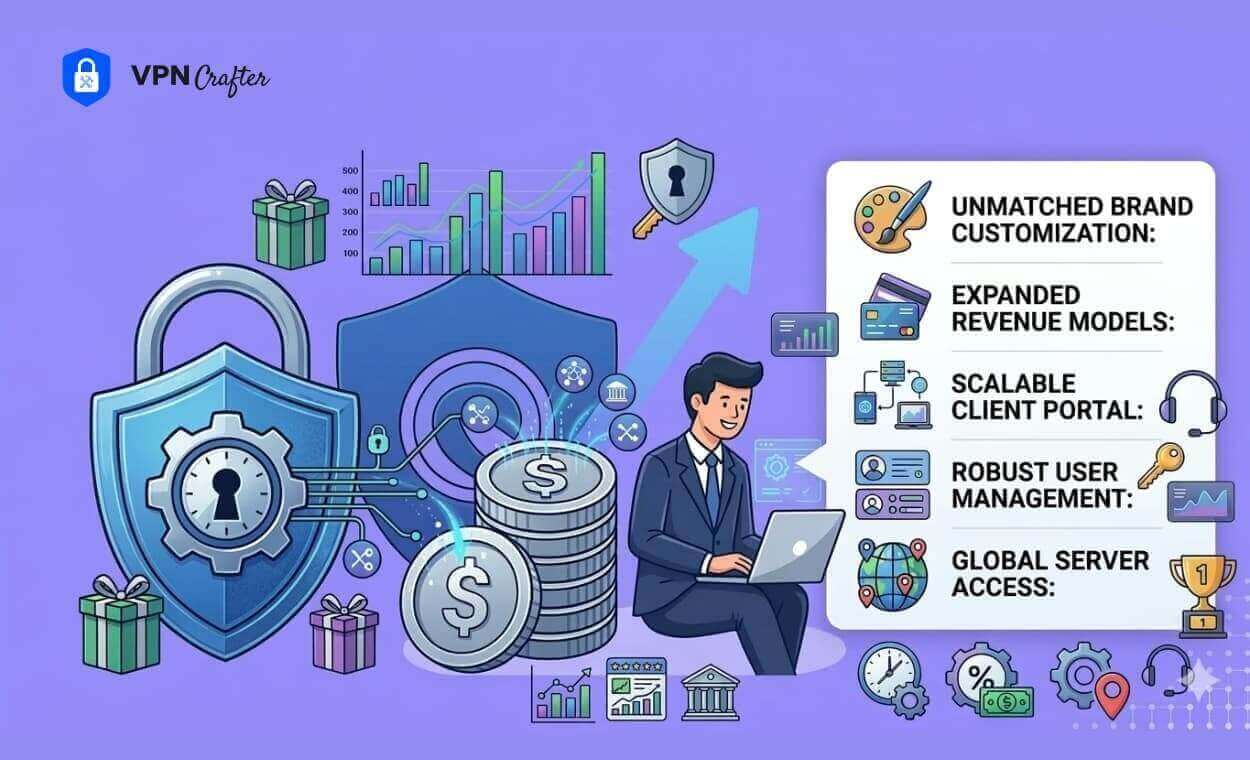
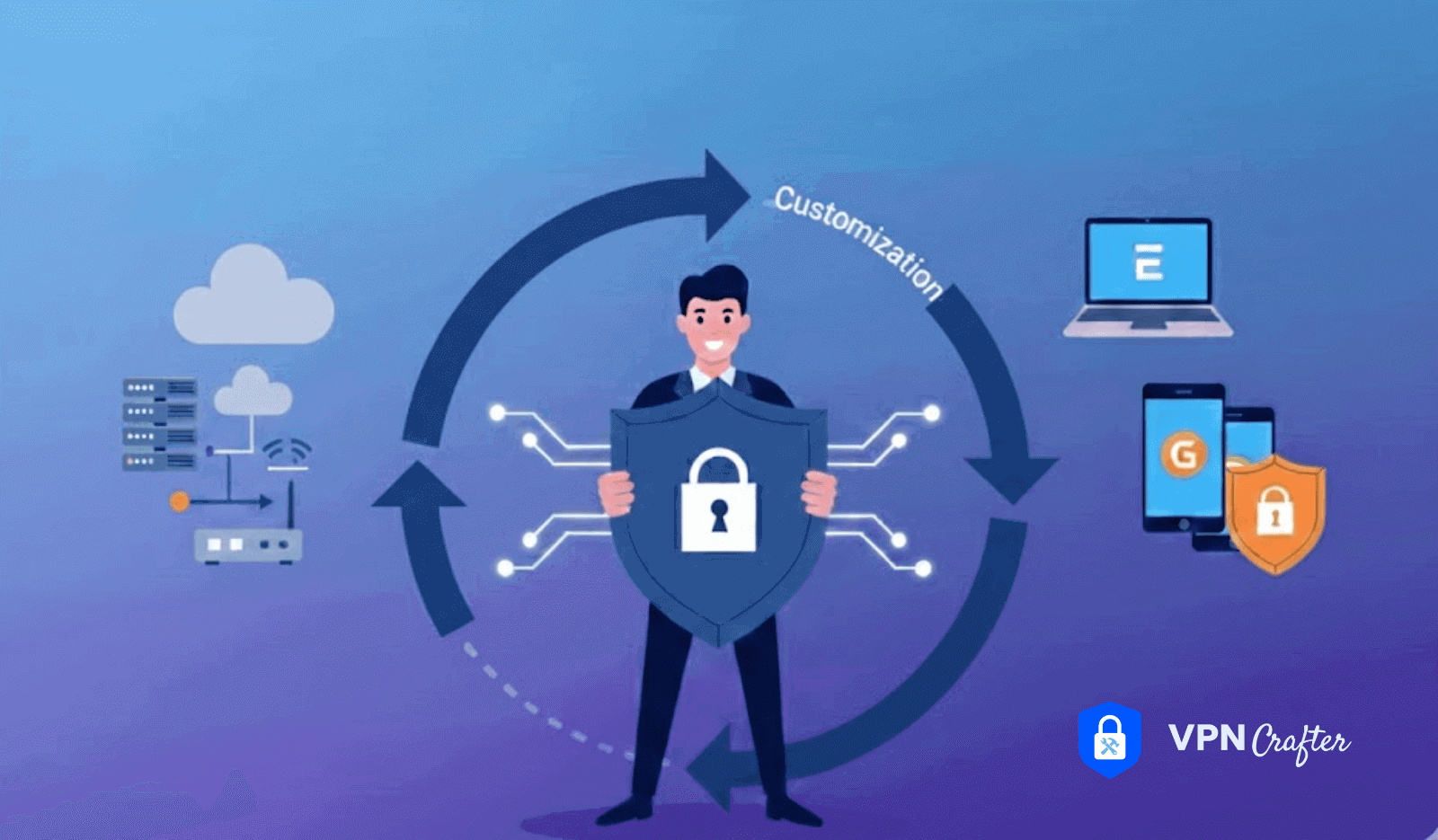

Businesses are adopting white-label VPNs because they need enterprise-grade privacy, secure remote access, and a fast path to market without building complex infrastructure themselves. That single sentence answers the core question of how white-label VPN works for businesses and sets the tone for everything that follows.
Privacy expectations have changed. Remote work is no longer optional. Customers, partners, and internal teams now assume encrypted connections, protected data flows, and consistent access across devices and regions. Regulatory pressure, from data protection laws to industry compliance standards, has only intensified that expectation. Security is no longer a technical feature. It is part of brand trust.
At the same time, businesses face a harsh reality. Building a VPN from scratch demands deep networking expertise, long development cycles, and ongoing operational overhead. Full stack VPN app development involves far more than writing client apps. Teams must manage global server infrastructure, tunneling protocols like WireGuard or OpenVPN, encryption standards such as AES-256, key management, uptime monitoring, and constant security updates. Even well-funded SaaS companies struggle to justify that investment when VPNs are not their core product.
This gap between market demand and technical complexity explains the rise of the White Label VPN model. Instead of reinventing the wheel, companies partner with a White Label VPN Development Service that already operates secure, scalable infrastructure. The business focuses on branding, distribution, and customer relationships. The provider handles the heavy lifting behind the scenes.
At a practical level, how white-label VPN works for businesses is straightforward. A provider supplies a proven VPN backend, including servers, protocols, and security operations. The business launches fully branded apps and dashboards under its own name, controls pricing and user access, and owns the customer relationship. Users experience a seamless VPN service, while the business avoids the risks and delays of building a custom VPN stack.
That balance between speed, control, and security is why startups, SaaS platforms, and digital service providers increasingly choose a White Label VPN Solution over building in-house. The sections ahead break down exactly how this model works, what infrastructure sits underneath it, and when it makes sense compared to a custom build.
What Is a White-Label VPN? (Business-First Explanation)
A white-label VPN is a ready-built VPN infrastructure that businesses can launch under their own brand, without building the technology from scratch. The provider handles the complex engineering, security, and server operations. The business owns the branding, customer relationship, pricing, and go-to-market strategy. That packaged approach is commonly referred to as a white-label VPN solution.
Decision-makers do not need to worry about cryptography stacks, tunneling protocols, or server orchestration. The focus stays on growth, positioning, and customer trust. That separation is exactly why white-label VPNs appeal to founders, SaaS operators, and digital service providers who want speed without technical debt.
Consumer VPNs vs Business VPN Offerings
Consumer VPNs sell privacy directly to end users. The brand, infrastructure, and policies belong to a single company. Users subscribe to that company’s ecosystem and have little flexibility beyond plan selection.
A White Label VPN for Business works differently. The infrastructure sits beneath multiple brands in a controlled, multi-tenant environment. Each business runs its own branded apps, dashboards, pricing models, and customer support workflows. From the end user’s perspective, the VPN feels like a standalone product built by that brand.
Key structural differences matter here:
- Ownership: Consumer VPNs own the users. White-label VPNs let businesses own the customer relationship.
- Control: Business VPN offerings allow pricing rules, subscription logic, and feature packaging.
- Purpose: Consumer VPNs focus on mass-market privacy. Business VPNs support monetization, bundling, or security features inside larger products.
This distinction becomes critical when evaluating White Label VPN vs Custom VPN development. Building everything internally offers full control but introduces long timelines, heavy capital costs, and operational risk. White-label models remove those barriers while preserving brand authority.
Why White-Label VPNs Fit Modern B2B and SaaS Models
SaaS products increasingly compete on trust, data protection, and compliance narratives. A VPN layer strengthens that story instantly. White-label VPNs align well with B2B needs because they integrate into existing products rather than sitting beside them.
Several use cases stand out:
- SaaS platforms adding secure access for remote teams
- Agencies offering privacy tools as part of a broader service stack
- Startups exploring white label VPN development for startups as a fast route to revenue
- Founders researching How to Start a VPN Business without building infrastructure
From a business lens, the appeal comes down to leverage. A single White Label VPN Development Solution can power mobile apps, desktop clients, billing systems, and admin dashboards. That level of readiness would normally require years of full stack VPN app development.
The model also supports long-term brand equity. Companies can refine positioning, experiment with pricing, and expand features while the underlying VPN layer scales quietly in the background.
That balance of speed, control, and credibility explains why white-label VPNs have become a practical foundation for modern digital businesses rather than a shortcut.
3. How White-Label VPN Works for Businesses (Step-by-Step)
How White-Label VPN works for businesses is simple at its core. A company partners with an established VPN provider, uses their proven infrastructure and security stack, and launches a fully branded VPN product under its own name without building or maintaining the technology from scratch.
That simplicity is exactly why this model has become the fastest path for SaaS companies, agencies, and founders who want a white label VPN for business without technical drag.
Let’s break the process down step by step.
Partnering With a White-Label VPN Provider
Everything starts with choosing the right White Label VPN Development Service. This decision shapes your product quality, security posture, and long-term scalability.
A reliable provider handles the hard parts of White-Label VPN Development, including:
- Global server infrastructure and bandwidth management
- Secure tunneling protocols like WireGuard and OpenVPN
- Encryption standards such as AES-256
- Backend orchestration and uptime monitoring
From a business perspective, this removes the need for full stack VPN app development in-house. Founders avoid hiring protocol engineers, DevOps specialists, and security auditors just to get a product live.
This partnership model is why many founders exploring How to Start a VPN Business choose a white label VPN solution first. It reduces risk while keeping control where it matters.
Accessing Shared Infrastructure With Isolated Branding
Once onboarded, your brand gains access to a shared, enterprise-grade VPN infrastructure built on a multi-tenant architecture.
Here is the critical part many people misunderstand.
Shared infrastructure does not mean shared identity or shared data.
Each business operates in an isolated environment with:
- Separate authentication layers
- Segmented user databases
- Dedicated configuration rules
- Independent billing logic
Traffic isolation ensures one brand’s users never overlap with another’s. From the end user’s perspective, it feels like a standalone VPN product, not a reseller setup.
This structure explains How White Label VPN Works at scale. Providers optimize servers and routing globally, while businesses focus on positioning, messaging, and customer trust. That balance is what makes White Label VPN vs Custom VPN such a practical comparison. Custom builds offer control but demand heavy investment. White label VPN development for startups offers speed without sacrificing credibility.
Launching Apps, Dashboards, and Billing Under Your Brand
After infrastructure access is granted, the product comes to life under your brand.
A typical White Label VPN Solution includes:
- Branded mobile apps for Android and iOS
- Desktop clients for Windows and macOS
- A centralized admin dashboard
- User subscription and device management
- Integrated payment and renewal systems
Logos, app names, UI elements, and even app store listings carry your identity. Customers never see the underlying provider.
Business teams manage pricing tiers, free trials, coupons, and subscription rules from the control panel. That flexibility matters for companies planning to Launch Your Own VPN Brand or bundle VPN access into an existing SaaS offering.
From the user side, onboarding feels intuitive. Download the app, sign in, choose a server, connect. That simplicity defines How to Use White Label VPN effectively and keeps churn low.
This step completes the loop of how white-label VPN works for businesses. Infrastructure stays invisible. Branding stays front and center. Growth becomes a marketing and trust exercise rather than an engineering one.
4. White-Label VPN Infrastructure Explained
Direct answer:
A white-label VPN infrastructure lets a business deliver secure VPN services under its own brand while relying on a proven backend built, maintained, and scaled by a specialized provider. This is the technical foundation behind how white-label VPN works for businesses without forcing them to become network operators.
This section breaks down what actually runs under the hood and why infrastructure decisions directly affect trust, performance, and long-term viability of a white label VPN for business.
Server Ownership vs Leased Infrastructure
Every White Label VPN solution is built on one of two infrastructure models.
Some providers operate owned bare-metal servers in selected data centers. Others rely on leased cloud or colocation infrastructure spread across regions. Each approach has trade-offs.
Owned servers offer tighter control over traffic routing, kernel-level optimizations, and predictable performance. That matters for brands positioning themselves around speed, stability, or privacy-first messaging. Leased infrastructure, on the other hand, enables faster geographic expansion and lower upfront costs, which is why many white label VPN development for startups choose this route.
What matters for your business is transparency. A reliable White Label VPN Development Service clearly explains where servers are hosted, who controls them, and how traffic is isolated between tenants.
This clarity becomes critical when customers ask hard questions about data jurisdiction and compliance.
Multi-Tenant Architecture and Traffic Isolation
A scalable white-label VPN infrastructure relies on multi-tenant architecture. Multiple brands operate on shared backend resources, but each brand’s users remain logically isolated.
Proper isolation happens at several layers:
- Dedicated authentication namespaces per brand
- Segmented user databases
- Separate encryption keys
- Isolated traffic routing policies
When implemented correctly, one brand’s growth or traffic spike never impacts another. This design allows businesses to launch and scale quickly while maintaining brand independence, user ownership, and operational control.
This model also explains why White Label VPN vs Custom VPN is often less risky. Custom builds frequently underestimate the engineering effort required to maintain secure tenant isolation at scale.
Encryption Standards and Tunneling Protocols
Security credibility depends on standards, not promises.
A professional white-label VPN infrastructure supports modern, audited cryptography such as AES-256 encryption, ChaCha20, and secure key exchange using Perfect Forward Secrecy. These are table stakes for any serious White Label VPN platform.
Protocol support also matters. Businesses typically deploy a mix of:
- WireGuard for speed and efficiency
- OpenVPN for mature, battle-tested stability
- OpenConnect and Shadowsocks for restricted networks
- V2Ray for advanced routing and obfuscation use cases
This flexibility allows a White Label VPN solution to serve varied audiences without fragmenting the product. It also simplifies decisions around how to use white label VPN across regions with different network conditions.
Reliability, Uptime, and Performance Management
Infrastructure quality shows up first in uptime and latency.
High-performing white-label VPN infrastructure uses active monitoring, automated failover, and intelligent load balancing across regions. Traffic routes dynamically based on server health, congestion, and geographic proximity.
From a business standpoint, this reduces churn and support overhead. Users rarely complain about encryption. They complain about dropped connections and slow speeds.
Reliable providers publish uptime metrics, enforce internal SLAs, and continuously tune performance at the network layer. This operational maturity is one reason many founders exploring how to start a VPN business choose white-label models instead of attempting full stack VPN app development from scratch.
5. Branding, Customization, and Control
A white-label VPN only creates real business value when it gives you full control over how the product looks, feels, and operates. This is where most decision-makers separate a basic reselling setup from a serious white-label VPN platform built for long-term growth.
Here is how branding, customization, and ownership actually work in practice.
App Branding: Logo, UI, and App Identity
With a mature White-Label VPN setup, the VPN app is not a skin or a wrapper. It is your product in every visible way.
Your brand assets define the experience:
- App name, icon, and package identity belong to your business
- Custom UI colors, typography, and layout reinforce brand recognition
- Onboarding screens, login flows, and in-app messaging match your tone
This level of control matters when you want users to trust the product. A security app that feels generic struggles to convert and retain. A properly branded VPN app feels native to your ecosystem, whether you are a SaaS company, ISP, or a startup entering the privacy market.
This approach is common in white label VPN development for startups that want speed without sacrificing brand equity.
Website and Customer Touchpoints
Brand control extends beyond the app.
A reliable white-label VPN platform allows full customization across:
- Customer dashboards and account portals
- Subscription pages and upgrade flows
- Transactional emails, invoices, and alerts
- Support interfaces and helpdesk integration
Every touchpoint reinforces that users are interacting with your company, not a third-party provider. This consistency builds trust and reduces churn, especially for businesses positioning VPN access as a premium or bundled service.
For companies exploring How to Start Your Own VPN Brand, this is often the biggest advantage over affiliate or referral-based models.
Policy Control and Pricing Configuration
A strong White Label VPN Solution gives you commercial control, not just technical access.
You decide:
- Subscription plans, pricing tiers, and billing cycles
- Trial rules, discounts, and promotional offers
- Device limits, bandwidth caps, and feature access
- Regional pricing or reseller-based pricing models
This flexibility allows the VPN to align with your broader business model. SaaS companies often bundle VPN access with premium plans. Agencies may resell it under multiple sub-brands. Founders exploring How to Start a VPN Business rely on this control to test and optimize revenue models quickly.
Such freedom is rarely possible when building a VPN in-house without a large engineering and operations team.
Ownership of Users and Data
One of the most common concerns around white-label solutions is ownership. The reality is simple when the provider architecture is built correctly.
You own:
- Customer relationships
- User accounts and billing data
- Brand reputation and communication
The provider manages the infrastructure, security updates, and network operations. User data policies, including no-logs commitments, are defined transparently and contractually. This model supports compliance while allowing your business to grow without operational drag.
This balance of control and delegation is why white label VPN for business adoption keeps increasing across SaaS, media platforms, and remote-first organizations.
Branding, pricing, and ownership are not cosmetic features. They define whether a VPN becomes a short-term add-on or a defensible product line that strengthens your brand and revenue base.
6. Monetization Models for White-Label VPNs
A white label VPN for business only becomes valuable when it generates predictable revenue without adding operational complexity. Monetization is where most founders either build a durable asset or stall early. The good news is that the white-label model offers multiple revenue paths, each suited to different business goals, audiences, and growth stages.
Below is how monetization works in practice when businesses understand how white-label VPN works for businesses beyond just the technology.
Subscription-Based Pricing
Subscription plans remain the most stable and scalable model for any White Label VPN offering. Monthly and annual subscriptions create recurring revenue while keeping churn measurable and controllable.
Most businesses structure plans based on:
- Number of connected devices per user
- Bandwidth usage or fair-use thresholds
- Server location access
- Advanced features such as split tunneling or dedicated IPs
This model works well for companies exploring how to start your own VPN brand because it aligns with user expectations already shaped by consumer VPNs. Annual plans usually drive higher lifetime value, while monthly plans reduce friction during acquisition.
A white-label setup simplifies this approach. Billing, access control, and subscription enforcement are handled at the infrastructure level, while the brand controls pricing, positioning, and packaging.
Bundled VPN Offerings for SaaS and ISPs
Many SaaS companies and ISPs monetize VPNs indirectly by bundling them into existing products. Security becomes a value add instead of a standalone purchase.
Examples include:
- SaaS platforms offering VPN access with premium plans
- ISPs bundling VPNs with broadband subscriptions
- Remote-work tools packaging VPN access for distributed teams
This approach increases retention rather than relying on pure VPN sales. It also strengthens brand trust, especially when security and privacy are already part of the value proposition.
For these companies, White Label VPN Development Service acts as an extension of the core product rather than a separate business line.
Reseller and Partner Revenue Models
A well-structured VPN reseller model allows businesses to scale distribution without scaling marketing costs linearly. Partners resell VPN access under their own pricing while the parent brand controls infrastructure and compliance.
Common reseller structures include:
- Tier-based pricing for agencies and affiliates
- Revenue sharing with content creators or communities
- Regional resellers targeting local markets
This model fits brands focused on fast expansion or those targeting niche audiences such as gamers, privacy advocates, or remote professionals. When paired with a robust White Label VPN Solution, reseller dashboards can track usage, revenue, and renewals without manual intervention.
Pricing Flexibility and Margin Control
One overlooked advantage of white-label VPNs lies in margin control. Unlike building a VPN from scratch, infrastructure costs remain predictable. That predictability allows businesses to experiment with pricing without risking operational instability.
Pricing flexibility enables:
- Promotional offers without long-term cost exposure
- Custom enterprise plans for high-value clients
- Geo-based pricing strategies
Businesses comparing White Label VPN vs Custom VPN often find that custom builds restrict pricing agility due to fixed development and maintenance costs. White-label models allow faster adjustments based on market response, not engineering constraints.
Monetization succeeds when pricing matches audience intent, not when features are stacked blindly. Brands that treat VPNs as a business layer rather than a technical project tend to scale faster and more profitably. This becomes clear once companies fully understand how white-label VPN works for businesses at the revenue level, not just the infrastructure level.
7. Operational Responsibilities: What You Manage vs What the Provider Handles
Direct answer:
A white-label VPN for business works best when responsibilities are clearly split. The provider runs the technical backbone. Your business owns the customer relationship, brand, and growth. That separation is what makes the model scalable and low-risk.
What the White-Label VPN Provider Handles
The provider operates the parts that are expensive, complex, and risky to manage internally.
Core responsibilities usually include:
- Infrastructure management
Server provisioning, global node availability, load balancing, and traffic routing across a multi-tenant infrastructure. - Security and encryption
Implementation of AES-256 encryption, secure key exchange, and tunneling protocols like WireGuard and OpenVPN. Regular security audits and vulnerability patching stay on the provider. - System updates and maintenance
App updates, protocol upgrades, OS compatibility fixes, and backend stability monitoring happen continuously without your involvement. - Performance and uptime
Bandwidth optimization, latency control, failover systems, and uptime SLAs are managed at the network level.
This setup removes the need for full stack VPN app development on your side. Instead of hiring engineers and running servers, you inherit production-ready infrastructure through a White Label VPN solution.
What Your Business Manages
While the provider handles the engine, your company drives the brand and revenue.
Key responsibilities on your side include:
- Marketing and acquisition
Positioning the VPN, running campaigns, partnerships, and defining how the product fits your audience. This is where brand equity is built. - Customer support and communication
First-line support, onboarding content, and user education. Clear messaging builds trust, especially around privacy and usage. - Compliance messaging and policies
Publishing privacy policies, terms of service, and explaining how data is handled. Even with a no-logs infrastructure, transparency remains your responsibility. - Pricing and monetization strategy
Subscription tiers, bundles, discounts, and reseller offers live under your control. Margins depend on how well this is executed.
Ownership of users stays with you. That is a critical advantage of a white-label VPN for business compared to simple reseller models.
Why Clear Role Separation Matters
Operational friction kills VPN brands faster than poor marketing. Blurred responsibilities lead to delays, security gaps, and customer frustration.
A well-structured White Label VPN for Business model creates:
- Faster time to market
- Predictable operating costs
- Lower security exposure
- Cleaner accountability between teams
Founders exploring how white-label VPN works for businesses often underestimate this point. Success depends less on features and more on operational clarity.
When roles are defined from day one, teams move faster, risks stay contained, and growth becomes repeatable. That structure is exactly why white-label VPN for business adoption continues to rise among SaaS companies, agencies, and privacy-focused brands.
8. White-Label VPN vs Building a VPN In-House
Choosing between a white-label VPN solution and building a VPN from scratch is a strategic decision. The right path depends on speed, capital, risk tolerance, and long-term intent. Here is a clear, experience-backed comparison based on how VPN businesses actually succeed or fail.
Cost Comparison
Building a VPN in-house demands heavy upfront investment. Engineering teams, security audits, server provisioning, protocol implementation, and ongoing maintenance add up fast. Full stack VPN app development alone can consume months of senior developer time, even before the first user connects.
A white-label VPN solution removes most of that financial burden. Infrastructure, core networking logic, encryption layers, and update cycles are already in place. Businesses pay a predictable setup and operating cost instead of funding years of R&D. For startups and mid-sized companies, this cost clarity often determines whether a VPN launch is viable at all.
Time to Market
Speed matters more than most founders expect. Building a VPN internally often takes 9 to 18 months before reaching production readiness. During that time, market demand, regulations, or competitor positioning can shift.
White-label VPN for business models shorten launch timelines dramatically. Apps, dashboards, and backend systems are ready to brand and configure. Teams can launch within weeks, not quarters. Faster entry also means earlier revenue, quicker feedback, and less capital locked in pre-launch development.
Security and Compliance Risk
VPNs operate in a high-stakes security environment. Encryption flaws, DNS leaks, logging mistakes, or misconfigured tunneling protocols can damage trust overnight. Internal teams must master AES-256 encryption, WireGuard or OpenVPN tuning, key rotation, and multi-tenant isolation from day one.
White-label VPN development transfers much of that risk to a specialized provider. Mature providers run hardened infrastructure, perform regular audits, and patch vulnerabilities continuously. That does not remove responsibility entirely, but it reduces the chance of costly security missteps during early growth.
Scalability Considerations
Scaling a self-built VPN is rarely linear. User growth increases bandwidth costs, server load, support tickets, and regional compliance complexity. Many internally built VPNs struggle once traffic spikes beyond initial projections.
A white-label VPN solution is designed to scale from the start. Load balancing, global server distribution, traffic isolation, and uptime monitoring are already tested under real-world pressure. Businesses focus on customer acquisition and retention while the platform handles growth behind the scenes.
Strategic Trade-Off Summary
Both models have a place, but the trade-offs are clear:
- Build in-house when long-term protocol innovation, deep infrastructure control, or proprietary networking technology is central to the business.
- Choose a white-label VPN solution when speed, reliability, and market validation matter more than owning every layer of the stack.
For most companies exploring how white-label VPN works for businesses, the white-label path offers a safer, faster, and more capital-efficient route to market. The real advantage is not just reduced cost or faster launch. It is the ability to focus on brand equity, customer trust, and growth while proven infrastructure does the heavy lifting.
9. Who Should Use a White-Label VPN Model?
A white-label VPN for business is not a one-size-fits-all product. It works best for companies that already have distribution, users, or trust and want to extend that advantage into privacy, security, or connectivity without becoming a deep infrastructure operator. Below are the business models where this approach delivers real leverage.
SaaS Companies Adding Security Features
Many SaaS platforms reach a point where customers expect more than core functionality. Security becomes part of the value conversation.
A white-label VPN fits naturally when a SaaS product handles sensitive data, remote access, or compliance-heavy workflows. Project management tools, fintech platforms, HR systems, and remote collaboration software often fall into this category.
Instead of building tunneling protocols, encryption layers, and server orchestration from scratch, SaaS companies can embed a White Label VPN solution as a native feature. The result feels integrated, not bolted on.
Benefits for SaaS teams include:
- Faster feature rollout without hiring VPN specialists
- Stronger retention through bundled security value
- Higher ARPU by packaging premium access features
- Clear differentiation without infrastructure risk
This approach also supports long-term roadmap flexibility. Teams can test security-led upsells before committing to custom builds.
Digital Agencies and ISPs
Agencies and internet service providers already manage traffic, performance, and customer trust. Adding VPN services often becomes a logical extension, not a pivot.
Digital agencies use a white-label VPN for business to serve clients who want branded privacy tools, regional access control, or secure browsing for teams. ISPs use it to reduce churn and offer premium protection tiers.
A white-label model allows both to:
- Launch under their existing brand equity
- Control pricing and bundles without vendor lock-in
- Offer VPN services without owning server fleets
- Monetize privacy as a recurring service
This is especially relevant for agencies serving startups or SMBs that want secure connectivity without complexity. Many agencies quietly evolve into resellers using this structure.
Remote-First Companies
Remote work creates a permanent attack surface. Devices connect from cafes, home networks, and shared workspaces. Traditional perimeter security breaks down fast.
Remote-first companies adopt a white-label VPN for business to enforce encrypted access across distributed teams while keeping the experience simple for employees. Branded apps reduce confusion and improve adoption.
This model works well when companies need:
- Centralized access control for remote staff
- Secure connections to internal tools and dashboards
- Predictable performance across regions
- Minimal IT overhead
Rather than asking teams to install third-party tools, companies present VPN access as part of their internal stack. That shift improves compliance without friction.
Privacy-Focused Brands and Communities
Some brands are built entirely on trust. Privacy-first browsers, creator communities, activist networks, and subscription-based platforms often fall into this group.
For them, a white-label VPN for business becomes part of brand identity, not just a feature. The VPN reinforces values around data ownership, anonymity, and digital freedom.
This model supports:
- Community-driven monetization
- Branded privacy tools without external logos
- Control over messaging and transparency
- Long-term brand loyalty
Many founders exploring How to Start Your Own VPN Brand begin here. They care less about scale on day one and more about alignment with audience values. White-label infrastructure gives them that foundation without overexposure to technical risk.
A clear pattern emerges across these use cases. Companies that win with white-label VPNs already understand their audience and distribution. The technology amplifies what they have rather than replacing their core business.
That is why the white-label VPN for business model continues to grow across SaaS, agencies, remote teams, and privacy-driven
10. Compliance, Privacy, and Legal Considerations
Maintaining trust and regulatory compliance is a cornerstone of any successful VPN brand. Businesses adopting a white-label VPN solution must understand how white-label VPN infrastructure supports privacy, security, and legal obligations.
No-Logs Policies and Data Handling
A true privacy-first VPN ensures no user activity logs are stored. For businesses, this translates into stronger credibility with clients and end-users. The infrastructure should provide transparent data handling, guaranteeing that sensitive information, like connection timestamps or IP addresses, remains inaccessible to the provider or any third party.
This compliance layer is critical for companies offering White Label VPN for Business or SaaS solutions. A provider that enforces strict no-logs policies reduces liability and strengthens user trust.
Jurisdiction and Server Locations
Server locations influence both performance and legal oversight. Choosing a white-label provider with strategically distributed servers allows businesses to meet local regulatory requirements and optimize connectivity for users worldwide. For example, servers in privacy-friendly jurisdictions can help businesses market their VPN as highly secure and compliant.
User Agreements and Transparency
Clear terms of service and privacy policies are non-negotiable. Every user interaction—subscription, renewal, or cancellation—must be governed by transparent agreements. Businesses can maintain ownership of their brand experience while leveraging the provider’s infrastructure to ensure compliance without direct exposure to legal risks.
Payment and Regulatory Compliance
Handling payments for VPN subscriptions involves PCI compliance, recurring billing management, and adherence to regional tax regulations. A white-label VPN platform should support secure payment gateways, automated invoicing, and compliance tracking. Businesses benefit by focusing on growth and user experience while the provider ensures operational compliance.
11. Common Misconceptions About White-Label VPNs
Several myths persist around white-label VPNs. Understanding these misconceptions helps businesses make informed decisions.
1. “White-label means less secure”
Security depends on architecture and provider standards, not branding. A high-quality white-label provider implements AES-256 encryption, multi-protocol support, and robust monitoring, ensuring security on par with custom VPN deployments.
2. “You don’t own the users”
Ownership of user relationships is contractually defined. Businesses retain full control over their user database, subscription management, and branding, while leveraging the provider’s technical infrastructure.
3. “It limits long-term growth”
White-label solutions are highly scalable. Multi-tenant architectures, server expansion options, and flexible app updates allow businesses to grow their user base without being constrained by technical debt.
What Actually Matters When Choosing a Provider
- Infrastructure reliability and uptime
- Compliance with privacy and regional laws
- Transparency of logging and data handling policies
- Support for branding, customization, and user management
- Ability to scale as the business grows
Selecting a provider with proven experience in White Label VPN Development Service or full stack VPN app development ensures a foundation that supports both immediate launches and long-term strategic growth.
Final Thoughts: Is a White-Label VPN Right for Your Business?
Determining whether a white-label VPN solution fits your business begins with clarity on goals, resources, and timelines. Understanding how white-label VPN works for businesses helps decision-makers choose a model that balances speed, control, and scalability.
Decision Checklist for Founders and Operators
Use this checklist to assess readiness:
- Do you want to launch your own VPN brand quickly without building infrastructure from scratch?
- Is your team focused more on marketing, growth, and customer experience than on server management?
- Are you looking to reduce upfront development costs while maintaining ownership of your users and brand?
- Do you need flexible app deployment across multiple platforms, including mobile and desktop?
If you answered “yes” to most of these, a white-label VPN development solution can provide a reliable, fast-to-market path with minimal technical risk.
When White-Label VPNs Make Sense
White-label models excel when businesses aim to:
- Enter the VPN market swiftly with a fully branded service
- Offer security features as part of a SaaS or digital service bundle
- Expand into cybersecurity offerings without investing heavily in infrastructure
- Test a market or product concept before committing to a custom build
This model allows companies to focus on customer acquisition, retention, and revenue, while the provider manages encryption, uptime, and protocol updates. For startups, this can be especially valuable, aligning with the principles of white label VPN development for startups.
When a Custom VPN Approach May Be Better
Building a VPN in-house or via custom VPN development is better suited for organizations that:
- Require full control over server locations, network architecture, or proprietary protocols
- Operate under strict regulatory or compliance requirements
- Plan to scale globally and want long-term flexibility in technical design
- Seek to differentiate themselves with unique security or performance features
Custom development demands higher upfront costs, extended timelines, and ongoing operational responsibilities. The trade-off is maximum control and full independence from third-party providers.
Closing Perspective
Understanding how white-label VPN works for businesses helps founders make strategic choices. For most brands, leveraging a trusted white-label VPN platform accelerates growth, reduces operational complexity, and delivers a branded experience that customers can trust. Companies like Cure VPN demonstrate that success lies in pairing reliable infrastructure with thoughtful marketing and user-centric design, rather than building everything from scratch.
By aligning your business goals with the right model, you can launch confidently, scale efficiently, and provide a secure, professional VPN service under your own brand.